Close a U.S. FedEx Linehaul Contract Transfer in 3–6 Months

Yes, a FedEx linehaul contract can be transferred, but only through FedEx’s own approval process, not a private handshake between buyer and seller. The path runs through a Request for Information (RFI), an AIM interview at the terminal, and full document review before anything closes. Expect the whole process, from signed offer to keys-in-hand, to take several months, longer if it lands during FedEx’s peak-season transfer freeze between October and December.
TL;DR:
- FedEx requires a detailed approval process involving documentation, a terminal interview, and background checks, which can take several months, especially during peak season.
- Due diligence must include verifying financial stability, equipment titles, operational compliance, and safety records, with red flags like unexplained mileage or unfiled violations.
- Contract transfers are only approved if FedEx’s formal documentation aligns with the actual sale, and avoidance of formal assignment significantly increases risk of rejection.
- The timeline from signed LOI to closing generally spans three to six months, slowed by seasonal freezes and incomplete paperwork; preparation ahead of listing shortens this period.
- Paying above market depends on route quality and settlement consistency, with closing funds held in escrow until FedEx approves the transfer, emphasizing compliance and transparency throughout.
Table of Contents
- What Does a FedEx Linehaul Contract Transfer Actually Involve?
- What Should Buyers and Sellers Check During Due Diligence?
- What Are FedEx’s Rules for Approving a Contract Transfer?
- How Long Does a Linehaul Transfer Take, and What Slows It Down?
- How Are Linehaul Contracts Priced, and How Does Closing Work?
- What Should Happen in the First 90 Days After Closing?
- How RJR Worldwide Corp Approaches Linehaul Transfers
- Lessons From Transactions We’ve Supported
- How RJR Worldwide Corp Supports Buyers and Sellers Through a Transfer
- Primary Sources and Further Reading
- Sources
What Does a FedEx Linehaul Contract Transfer Actually Involve?
A linehaul transfer moves through five distinct stages, and skipping or rushing any one of them is how deals fall apart weeks before closing. Sellers who prepare a clean listing package upfront, and buyers who understand what they’re really buying, both save themselves months of frustration.
Here’s how the sequence typically unfolds:
- Listing and initial review. The seller assembles run details, settlement history, and equipment lists. Buyers should scrutinize Schedule A run position immediately. A run position near the top of the terminal’s list carries more security than one near the bottom, since FedEx assigns runs in order when volume shrinks.
- Letter of intent and deposit. Buyers submit an LOI with an escrow deposit, structured with a contingency clause tied directly to FedEx approval. Without that contingency, a buyer who gets rejected by FedEx can still be on the hook for the deposit.
- RFI submission. The buyer files a Request for Information with FedEx, triggering the corporate and background review.
- AIM terminal interview. Buyer and often the seller meet at the terminal with the FedEx Authorized Independent Manager to walk through operational plans, safety history, and financial capacity.
- Closing and handover. Once FedEx issues written approval, the deal moves to funding, title transfer, and operational handoff.
Sellers who keep settlement statements, maintenance logs, and driver rosters organized before listing tend to clear buyer due diligence faster. Buyers who pre-qualify with FedEx informally, before making an offer, avoid wasting months chasing a deal that was never going to clear compliance review in the first place.
What Should Buyers and Sellers Check During Due Diligence?
Due diligence on a linehaul business splits into four buckets: financial, operational, personnel, and compliance. Miss one, and you either overpay or inherit a problem you didn’t price in.
Start with the money. Request 12 to 24 months of settlement statements, a profit and loss statement, and recent bank statements, then check whether settlement income is consistent or lumpy from fuel surcharge swings, detention pay, or one-off bonuses that won’t recur under new ownership.
On the operational side, verify tractor and trailer titles are clean and match the equipment actually in service, review maintenance logs for deferred repairs, and confirm fuel card agreements and any leasing arrangements transfer or terminate cleanly at close.

Personnel review matters just as much. Look at driver agreements, any noncompete language, and realistic retention risk. Drivers who leave right after a sale can gut a route’s performance in the first month, regardless of what the contract says on paper.
Compliance is where deals actually die:
- Confirm the TSPA and Schedule A match what’s being sold, run for run.
- Check corporate good standing in the state of formation.
- Pull FMCSA safety scores and operating authority status. With MC numbers being phased out in favor of USDOT-only identification, a messy authority record is more likely to trigger extra scrutiny during buyer vetting.
- Verify current insurance coverage meets FedEx’s minimums without a lapse.
Watch for red flags: unexplained “wild miles” that inflate settlement numbers, sellers pushing a stock sale instead of a proper assignment, and settlement histories that don’t reconcile month to month.
Pro Tip: Ask for the seller’s last three FMCSA safety audits, not just their overall score. A clean score can still hide a recent pattern of violations that hasn’t caught up with the rating yet.
What Are FedEx’s Rules for Approving a Contract Transfer?
FedEx requires written approval for any change in control because the company is contracting with a specific, vetted operator, not just buying capacity on a route. That’s why a straightforward sale of company stock, without formal assignment, is one of the riskiest shortcuts in this market. FedEx can decline to recognize the new ownership for contract performance, leaving a buyer holding equity in a company FedEx won’t work with.
FedEx typically expects a specific document set before it signs off.
- The current TSPA and Schedule A, matched against what’s actually being transferred.
- Completed RFI materials and background check authorizations for the buyer.
- Proof of insurance meeting FedEx’s minimum coverage requirements.
- Corporate formation documents and a federal tax ID for the acquiring entity.
- Designation of an authorized officer as the official point of contact with FedEx, since Service Provider Solutions expects a single accountable contact, not a rotating cast of managers.
Local terminal review and corporate-level approval work in tandem. The terminal manager assesses operational fit and interviews the buyer directly, while corporate reviews financial capacity and background checks. Rejections most often trace back to weak financial documentation, an incomplete corporate structure, or unresolved safety violations turned up during the FMCSA check.
Structure your closing around FedEx’s timeline, not the other way around. Draft your purchase agreement so funding and final transfer of assets happen only after FedEx issues written approval, never before.
How Long Does a Linehaul Transfer Take, and What Slows It Down?
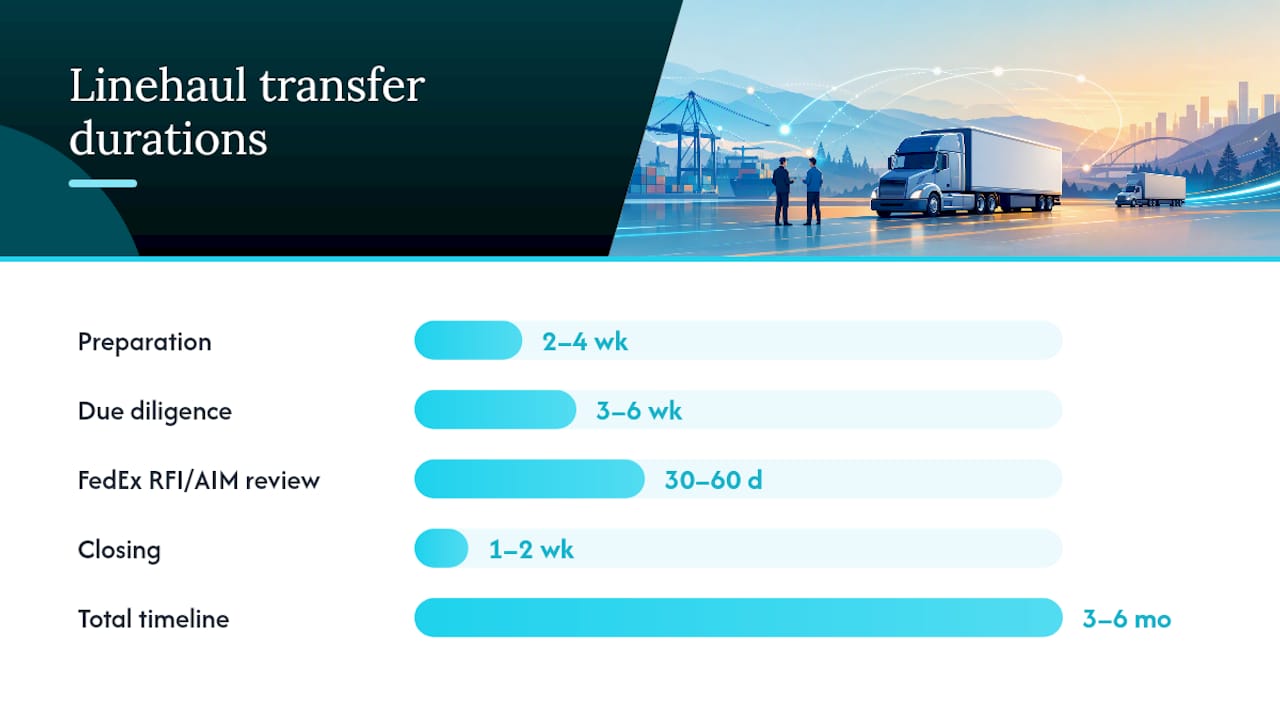
Budget three to six months from signed LOI to closed deal, with FedEx’s own review window running roughly 30 to 60 days once the RFI is submitted.
- Preparation and listing (2 to 4 weeks): seller assembles documentation, buyer arranges financing pre-approval.
- Due diligence (3 to 6 weeks): financial, operational, and compliance review by the buyer.
- FedEx RFI and AIM review (30 to 60 days): background checks, terminal interview, corporate sign-off.
- Closing (1 to 2 weeks): funding, title transfer, operational handoff.
FedEx also runs a peak-season transfer freeze from October through December, the busiest stretch for the network. This pushes any deal not closed beforehand into January. If you’re negotiating in August or September, that freeze should shape your entire timeline.
The fastest way to protect your schedule: clean up FMCSA records before listing, pre-qualify the buyer’s financing before submitting the RFI, and have every compliance document ready on day one rather than assembling it piecemeal as FedEx asks for it.
How Are Linehaul Contracts Priced, and How Does Closing Work?
Buyers are really paying for three things: run position, settlement consistency, and equipment condition. A route with a top-tier run number, two years of steady settlements, and well-maintained tractors commands a real premium over a route with the same revenue but a shakier equipment fleet or an unpredictable settlement history.
Adjust the asking price for anything that won’t repeat under new ownership. Strip out one-time fuel surcharge spikes, detention bonuses tied to a specific shipper relationship, or revenue from a lane that’s about to be reassigned. On the flip side, price in deferred maintenance and any equipment nearing replacement, since those costs land on the buyer within the first year.
Closing mechanics follow a familiar pattern:
- Funds are typically held in escrow until FedEx issues written approval.
- Payment moves by wire at closing, though seller financing is common for a portion of the purchase price, especially when a buyer is stretching to cover both the acquisition and near-term equipment upgrades.
- Entity-level tax treatment varies depending on whether the deal is structured as an asset sale or an entity sale, so involve a tax professional before you sign anything.
Resist the temptation to shortcut the process with a stock sale to avoid FedEx’s assignment review. It might look faster on paper, but it leaves the underlying contract legally exposed if FedEx later disputes recognition of the new ownership.
What Should Happen in the First 90 Days After Closing?
The first 90 days determine whether a transfer becomes a smooth operation or a scramble. Priorities:
- Offer driver retention incentives early and hand off payroll timing cleanly so no one misses a paycheck during the switch.
- Transfer equipment titles and insurance policies immediately, and notify fuel and maintenance vendors of the ownership change.
- Introduce the new authorized officer to the terminal manager and confirm dispatch system access on day one.
- Track the first three settlements closely and fix billing discrepancies fast, before they compound.
Pro Tip: Keep the outgoing owner reachable by phone for the first two settlement cycles. Most handover problems surface in week three, not week one.
How RJR Worldwide Corp Approaches Linehaul Transfers
RJR Worldwide Corp acquires and operates FedEx linehaul businesses directly from its Southern California terminals, managing dedicated lanes rather than brokering deals from a distance. That operating experience shapes how transfers get handled on the compliance side:
- Cleaning up FMCSA and operating-authority records ahead of an RFI submission to reduce approval friction.
- Building audit-ready documentation packages covering settlements, Schedule A, and equipment condition before FedEx ever asks.
- Applying index-linked pricing and full documentation practices during handover, the same transparency standard used across our chemical sourcing contracts.
Lessons From Transactions We’ve Supported
Most delays trace back to messy FMCSA records or a seller pushing a stock sale to dodge FedEx review. Clean your compliance file before you list, not after.
— RJR Worldwide
How RJR Worldwide Corp Supports Buyers and Sellers Through a Transfer
Most buyers discover midway through due diligence that a linehaul transfer is really two transactions stacked together: buying the contract and operating the business behind it. That’s the gap RJR Worldwide Corp was built to close. We acquire FedEx linehaul businesses directly, then integrate operations from our own California terminals, which means sellers get a buyer who can pass FedEx’s AIM review without a learning curve, and continuity for drivers and dispatch instead of a disruptive handoff.

If you’re weighing a sale or evaluating an acquisition, our FedEx linehaul acquisitions page walks through what we look for in a run and how our compliance-first process works. For sellers who want a straightforward, confidential conversation about your terminal, your run position, and where your business stands, reach out directly and we’ll walk through next steps.
Primary Sources and Further Reading
FMCSA authority guidance, route-transfer process breakdowns, and Schedule A due diligence resources informed this guide, including FedEx route sale timelines and FMCSA’s MC number phase-out.
Sources
- How to Sell a FedEx Route: The Complete Process Step by Step
- What initial info should you ask for from the seller when buying a FedEx Linehaul Route Business?