FedEx TSP Due Diligence: A Buyer’s Acquisition Playbook

Successful FedEx TSP due diligence must accomplish one thing above all else: confirm that the contract is assignable, the route economics are real, the operation can run without the seller, and you can qualify for FedEx approval before you wire a dollar. Every other detail flows from those four gates.
Core diligence buckets to work through:
- Contractual: Assignment rights, FedEx consent requirements, lease transferability, and lien clearance
- Financial: Settlement data, adjusted EBITDA, addbacks, working capital, and vehicle replacement reserves
- Operational: Driver stability, vehicle condition, maintenance records, DOT/IFTA compliance, and terminal relationships
- Compliance: IVMR retention, workers’ comp, insurance certificates, and driver qualification files
- FedEx approval process: Buyer financial qualification, business plan, background checks, and FedEx pre-qualification processes
- Integration risks: Seller dependency, transition plan, first-90-day staffing, and system handover
Immediate next step: Pull the last 24 months of settlement reports and open a FedEx pre-qualification conversation before you sign any letter of intent.
Key Takeaways
Successful FedEx TSP due diligence requires confirming contract assignability, verifying route economics with settlement-level data, and starting the FedEx approval process before you sign the LOI.
| Point | Details |
|---|---|
| Require FedEx approval contingency | Condition the LOI and purchase agreement on FedEx consent; approval typically takes 6–12 weeks. |
| Verify settlement data first | Request 24–36 months of settlement reports and reconcile them against bank deposits before modeling adjusted EBITDA. |
| Budget vehicle replacement reserves | Linehaul tractors cycle every 3–5 years; factor replacement costs into free cash flow before applying a valuation multiple. |
| Confirm driver stability early | High turnover above 25–30% annually signals operational continuity risk and increases post-close labor costs. |
| Involve a CPA and M&A attorney early | Engage transaction-experienced advisors before the LOI, not after; tax structure and indemnity terms are negotiated at signing, not at closing. |
| RJR Worldwide for acquisition support | RJR Worldwide provides direct acquisition advisory, FedEx approval support, and transition management for linehaul TSP transactions. |
Table of Contents
- What is a FedEx TSP and how does it differ from an ISP?
- Why market conditions make thorough diligence more critical right now
- How to value a FedEx TSP route: the metrics that actually matter
- Financial due diligence: what to request, verify, and adjust
- Operational diligence: drivers, vehicles, routes, and terminal relationships
- Legal and contractual checklist: FedEx assignment, leases, liens, and insurance
- Negotiation levers and common deal structures for FedEx TSP transactions
- What does the FedEx TSP due diligence timeline actually look like?
- Red flags that should stop or reprice the deal
- Practical due diligence packet: the exact documents to request
- How RJR Worldwide executes FedEx TSP acquisitions
- Tax implications and strategies for FedEx TSP acquisitions
- KPI benchmarking: how does this route compare to industry standards?
- Exit strategies and resale considerations for TSP owners
- What most buyers get wrong about TSP due diligence
- RJR Worldwide offers buyers direct acquisition support and transition management
- Sources
What is a FedEx TSP and how does it differ from an ISP?
A Transportation Service Provider (TSP) is a for-profit business entity that holds a Transportation Service Provider Agreement (TSPA) with FedEx to perform linehaul transportation between FedEx terminals, typically operating Class 8 tractors on dedicated or spot lanes. The distinction from an Independent Service Provider (ISP) matters enormously for buyers: ISPs hold last-mile delivery contracts covering defined geographic service areas, while TSPs operate in the linehaul network, moving freight between hubs rather than delivering to residential or commercial stops.
That difference reshapes every diligence question. TSP economics are driven by miles and loads, not stop counts. Payment mechanics tie to linehaul settlements per lane and per load rather than per-stop delivery rates. The FedEx company overview describes how service providers fit within FedEx’s broader network, and buyers need to understand that the TSPA governs lane assignments, rate structures, performance standards, and the assignment consent process that controls whether a deal can close at all.
For due diligence, the contractual distinction also determines which performance metrics FedEx will hold the new owner to, which terminal relationships must be maintained, and what financial and operational qualifications FedEx will require before approving a buyer. FedEx contracting standards require service providers to operate as established for-profit business entities, maintain safety and compliance programs, keep vehicles in proper condition, and designate authorized representatives to communicate with FedEx. Know which agreement you’re buying before you request a single document.
Pro Tip: Ask the seller for a redacted copy of the TSPA on the first call. If they hesitate, that tells you something. You need to see the assignment language before you spend time on financial diligence.
Why market conditions make thorough diligence more critical right now
FedEx has been actively restructuring its network, consolidating terminals, and realigning linehaul lanes as part of its broader operational efficiency push. For TSP buyers, that creates a specific risk that didn’t exist at the same scale five years ago: a route you underwrite today could be re-aligned, shortened, or absorbed into a different lane structure within 12–24 months of closing. That’s not a reason to avoid the market, but it is a reason to model conservatively.
Labor cost pressure compounds the issue. Driver wages for Class 8 linehaul operators have risen materially, and replacement costs for experienced drivers in tight markets can run well above what the seller’s historical payroll reflects. Add inflation-driven maintenance and parts costs for aging equipment, and the gap between a seller’s trailing EBITDA and a buyer’s forward cash flow can be wider than the numbers first suggest.
FedEx approval standards have also tightened. Buyers who would have sailed through qualification a few years ago now face more detailed financial scrutiny, longer review windows, and more documentation requirements. Practical buyer guides confirm that FedEx approval is mandatory and can span weeks to months, with purchasers needing to demonstrate financial strength, operational capability, and a credible business plan.
Pro Tip: Build at least two downside scenarios into your model: one with a 5–10% revenue reduction from lane re-alignment, and one with a 15% driver wage increase. If the deal still works at those inputs, you have real margin of safety.
How to value a FedEx TSP route: the metrics that actually matter
Value in a TSP acquisition is a function of future cash flows, not historical revenue. Adjusted EBITDA is the underwriting anchor, but it only means something if you’ve normalized it correctly and stress-tested the assumptions underneath it.
Key route metrics to collect before you model anything:
- Revenue per loaded mile: The primary top-line efficiency metric for linehaul operations
- Revenue per load/trip: Useful for comparing settlement rates across lanes
- Miles per route per week: Establishes workload and driver hour requirements
- Direct operating cost per mile: Fuel, driver wages, tolls, and variable maintenance
- Utilization rate: Percentage of available capacity actually dispatched
- Settlement lag: How quickly FedEx pays after load completion (affects working capital)
- Vehicle count and age: Determines near-term capital replacement obligations
The adjusted EBITDA calculation starts with the seller’s reported net income, then adds back owner compensation above a market-rate replacement driver/manager cost, non-recurring expenses (one-time repairs, legal fees, owner personal expenses run through the business), depreciation, amortization, and interest. What remains is the normalized cash the business generates before debt service and capex.
From there, free cash flow is what you actually own as an investor: adjusted EBITDA minus maintenance capex, vehicle replacement reserves, and working capital needs. A business generating $400,000 in adjusted EBITDA but requiring $80,000 per year in vehicle replacement reserves and $30,000 in working capital buffer is generating roughly $290,000 in investor-level free cash flow. That’s the number you apply a multiple to.
Capital obligations buyers routinely underestimate:
- Vehicle replacement cycle runs 3–5 years for linehaul tractors; budget $120,000–$180,000 per unit depending on spec and market
- Workers’ comp and payroll ramp at closing can require 4–8 weeks of cash before first settlement
- Recommended working capital cushion: 8–12 weeks of operating expenses held in reserve
Dentons’ framework for modern due diligence makes the point directly: diligence should validate the investment thesis and quantify future cash-flow potential, not just audit historical contingencies. For TSP buyers, that means modeling lane expansion potential, driver capacity headroom, and FedEx network positioning alongside the trailing numbers.
Financial due diligence: what to request, verify, and adjust
Request settlement data and supporting bank and payroll records first; verify every line item via third-party reconciliation before you finalize your model.
Documents to request (in priority order):
- FedEx settlement reports, by period and by lane, for the trailing 24–36 months
- Federal and state income tax returns for the same period (business entity returns)
- Monthly profit and loss statements, prepared or compiled
- Business bank statements, all accounts, trailing 24 months
- Payroll records and payroll tax filings (941s, state equivalents)
- Workers’ compensation policy declarations and loss runs (3 years)
- Vehicle titles, registration records, and any financing statements (UCC-1s)
- Insurance certificates: commercial auto, general liability, cargo
- Fuel purchase records and IFTA filings
- Any FedEx correspondence related to performance, penalties, or contract modifications
Once you have the settlement reports, tie each settlement line item to a corresponding bank deposit. Gaps between settlement totals and bank receipts can indicate unreported deductions, chargebacks, or simply poor record-keeping, but any gap needs an explanation before you close. Reconcile stop-level or load-level trends against the settlement reports to confirm the revenue trajectory is stable, not declining.
Common adjustments and addbacks:
- Owner compensation normalization: Replace the seller’s actual draw with a market-rate cost for a qualified operations manager or driver-manager. If the seller was driving routes personally, add back the difference between their compensation and a replacement driver’s fully loaded cost.
- Non-recurring expenses: One-time major repairs, legal settlements, or personal expenses run through the business. Document each one with source records.
- Related-party revenue: If any revenue comes from affiliated entities at non-market rates, normalize it to arm’s-length pricing.
- Seller note impact: If the deal includes seller financing, model the debt service against free cash flow to confirm coverage ratios before finalizing the purchase price.
Check for seasonality. Linehaul volumes often track e-commerce and retail shipping cycles, so a trailing 12-month average may mask a weak Q1 or a strong Q4 that inflates the run-rate. Look at the same quarter across multiple years.
Pro Tip: Hire a CPA with M&A transaction experience, not just a tax preparer, to review the settlement reconciliation. For deals above $500,000, consider a forensic accountant to pull an independent settlement-data extract directly from FedEx’s contractor portal if the seller will authorize it.
Operational diligence: drivers, vehicles, routes, and terminal relationships
Evaluate operational continuity risk first: can this business run on day one after closing without the seller, and what will it cost to get it there?
Operational inspection checklist:
- Vehicle age, mileage, and condition for each unit in the fleet
- Maintenance records and service history (look for deferred maintenance patterns)
- DVIR (Driver Vehicle Inspection Reports) logs and any open defects
- DOT compliance history: inspection reports, violations, out-of-service orders
- Driver roster: names, CDL class, endorsements, years with the business
- Driver turnover rate over the trailing 12–24 months
- Training records and FedEx-required certifications for each driver
- Current dispatch process and whether it depends on the seller personally
- Terminal relationship quality: any documented friction, complaints, or performance warnings
IVMR and IFTA compliance deserves specific attention. Individual Vehicle Mileage Reports are central to IFTA audit defensibility, and operators should retain source records including trip-level data, odometer readings, and fuel receipts. The recommended retention period is four years. If the seller cannot produce clean IVMR records, you inherit the audit exposure.
| Operational Item | What to Request | Why It Matters |
|---|---|---|
| Vehicle fleet | Titles, mileage logs, maintenance records | Quantifies near-term capex and DOT compliance posture |
| Driver files | CDL copies, MVR reports, drug test records | Confirms FedEx qualification and DOT compliance |
| IVMR records | Trip-level mileage reports, fuel receipts | IFTA audit defensibility; 4-year retention standard |
| FedEx performance | Settlement deduction history, service failure reports | Reveals pattern of penalties or terminal friction |
| DOT compliance | Inspection reports, violation history, safety rating | Unresolved violations are a walk-away trigger |
Driver qualification requirements for FedEx service providers include specific certification steps and administrative procedures. Verify that every driver in the roster meets current FedEx qualification standards, not just DOT minimums, because FedEx can reject drivers who don’t meet their internal criteria even if they hold valid CDLs.
Validate route performance with on-site observation where possible. A ride-along on a representative lane, combined with a terminal interview, will surface operational realities that no spreadsheet captures: how the dispatcher interacts with FedEx staff, whether drivers know the routes cold or depend on GPS for every turn, and whether the terminal relationship is genuinely solid or just polite.

Pro Tip: Structure the operational audit as a two-day site visit: day one for document review and vehicle inspection, day two for a terminal visit and driver interviews. Keep it low-key and frame it as standard buyer orientation. Sellers who resist a site visit are a yellow flag.
Legal and contractual checklist: FedEx assignment, leases, liens, and insurance
Confirm FedEx assignment rights and seller representations before you spend serious money on diligence. Condition any LOI on FedEx approval, and make that contingency explicit in writing.
Legal diligence checklist:
- Full copy of the TSP Agreement (TSPA), including all amendments and addenda
- Assignment and consent language: confirm FedEx must approve any transfer and what the approval criteria are
- Real estate leases for any facility, yard, or parking used in operations
- Vehicle titles for every unit, confirmed in the seller’s entity name
- UCC lien search on the seller’s entity and any related entities
- Outstanding tax liens: federal and state tax lien searches
- Employment agreements for any key employees
- Independent contractor agreements if any drivers are classified as contractors
- Insurance certificates: commercial auto, general liability, cargo, workers’ comp
- Any FedEx correspondence related to compliance, performance, or contract status
The FedEx approval process requires the buyer to submit personal financial statements, a business plan, professional references, and pass a background check. FedEx’s corporate structure and contracting expectations mean the buyer must demonstrate they can meet the same standards the seller was held to, plus satisfy any additional criteria FedEx applies at the time of the application. Approval timelines typically span several weeks, and some transactions can take longer.
On the employment side, verify whether drivers are W-2 employees or 1099 contractors. Misclassification exposure can be a significant post-close liability in states with aggressive enforcement. If the seller has been running drivers as contractors in a state that applies an ABC test (California, for example), that’s a material compliance issue that needs legal review before closing.
Pro Tip: Negotiate a purchase price holdback of 10–15% held in escrow for 90–180 days post-close, conditioned on FedEx approval and the absence of undisclosed compliance issues. Pair it with specific seller representations and indemnities covering driver classification, tax compliance, and any pending FedEx performance actions. An M&A attorney with transportation experience is worth the fee here.
Negotiation levers and common deal structures for FedEx TSP transactions
Common deal structures combine cash at closing with a seller note, bank or SBA financing, and an escrowed holdback conditioned on FedEx approval and post-close performance. The structure you choose shapes both your risk exposure and your negotiating leverage during the FedEx approval window.
Typical negotiation levers:
- Purchase price holdback: 10–15% held in escrow, released upon FedEx approval and satisfaction of reps and warranties
- Seller note: 10–20% of purchase price carried by the seller at market interest rates, subordinated to senior debt; aligns seller incentives during transition
- Earnout provisions: Tie a portion of the price to post-close revenue or EBITDA performance over 12–24 months; useful when trailing numbers are uncertain
- Reps and warranties insurance: Available for larger deals (typically $2M+); transfers indemnity risk to an insurer and reduces escrow requirements
- Escrow timing: Structure escrow release in tranches tied to FedEx approval, first 90-day operations, and resolution of any identified compliance items
Financing options:
- SBA 7(a) loans: Available for route acquisitions; lenders with transportation experience can structure these for FedEx TSP deals, though personal guarantees and collateral requirements apply
- SBA 504/CDC loans: Less common for pure service businesses but applicable when real estate or significant equipment is involved
- Regional bank term loans: Faster than SBA in some cases; require strong personal financials and often a 20–30% down payment
- Seller carry (seller note): The most flexible option for bridging working capital gaps; negotiate the subordination terms carefully if you’re also using bank debt
- Mezzanine financing: Available for larger acquisitions; higher cost but can fill gaps between senior debt and equity
Pro Tip: Draft the LOI to include an exclusivity period of at least 45–60 days, a clear FedEx approval contingency, and a financing contingency. This preserves your leverage during the approval window and prevents the seller from shopping the deal while you’re spending money on diligence.
What does the FedEx TSP due diligence timeline actually look like?
Expect the full process from signed LOI to closing to take 3–5 months when FedEx approval and lender underwriting run in parallel. Plan accordingly to accommodate the approval timeline.
Phase-by-phase timeline:
- Pre-LOI preparation (1–2 weeks): Gather publicly available information, review any teaser financials, confirm the seller has a transferable TSPA, and prepare your buyer qualification package for FedEx
- LOI and initial data exchange (1–2 weeks): Negotiate and sign the LOI with contingencies; submit the initial document request to the seller; begin preliminary financial review
- In-depth diligence window (2–4 weeks): Full document review, settlement reconciliation, vehicle inspection, operational site visit, legal review of contracts and liens, and driver file audit
- FedEx approval submission and review (6–12 weeks): Submit buyer application to FedEx with business plan, financial statements, and references; respond to FedEx information requests; this phase often runs concurrently with lender underwriting
- Lender underwriting and closing preparation (4–8 weeks): Lender appraisal and underwriting, purchase agreement negotiation, escrow setup, title and lien clearance, insurance binding, and closing document preparation
- Closing and transition (1–2 weeks): Final walk-through, fund transfer, FedEx notification of ownership change, driver and dispatch transition, and first-week operational monitoring
The FedEx approval window is the longest and least controllable phase. Buyer guides confirm that FedEx approval is mandatory and can span weeks to months. Treat the application preparation as a core diligence deliverable, not a last-minute formality. A well-prepared application with complete financials, a credible business plan, and strong references moves faster than a reactive one.
Red flags that should stop or reprice the deal
Any of these should trigger a pause, a price reduction demand, or a walk-away conversation with your attorney.
Material red flags:
- Seller cannot produce settlement-level data for the trailing 24 months
- Frequent FedEx performance penalties or documented service failures in the settlement history
- Driver turnover above 30% annually, or key drivers who have already indicated they won’t stay post-close
- Undisclosed liens, tax levies, or UCC filings on vehicles or business assets
- Vehicles with incomplete or fabricated maintenance records, or multiple units with deferred major repairs
- Seller is the sole dispatcher, primary driver, and terminal contact, with no documented processes
- Declining stop counts or revenue per loaded mile over the trailing 4–6 quarters
- Evidence of route re-alignment discussions or terminal friction in FedEx correspondence
- IVMR records that don’t reconcile with fuel receipts or GPS data
- Workers’ comp claims history suggesting a pattern of driver injuries
Walk-away triggers:
- Seller refuses to produce settlement data or authorizes only partial access
- Unresolved DOT out-of-service orders or active IFTA audit with no documentation
- FedEx has indicated it will not consider assignment to the buyer
- Driver misclassification exposure in a high-enforcement state with no indemnity available
- Liabilities that cannot be quantified or insured before closing
Practical due diligence packet: the exact documents to request
Lead with a conditional LOI that makes closing explicitly subject to FedEx approval and completion of satisfactory diligence. Then send this request list within 48 hours of signing.
Priority 1 (must-have before proceeding):
- FedEx settlement reports by lane and period, trailing 24–36 months
- Full copy of the TSPA and all amendments
- Business entity tax returns, trailing 3 years
- Business bank statements, all accounts, trailing 24 months
- Vehicle titles for all fleet units
- UCC and tax lien search results (buyer’s attorney should pull these independently)
Priority 2 (required before closing):
- Payroll records and payroll tax filings, trailing 2 years
- Workers’ comp policy and 3-year loss runs
- Commercial auto and cargo insurance certificates
- IVMR records and IFTA filings, trailing 4 years
- Driver files: CDL copies, MVR reports, drug test records, FedEx qualification records
- Maintenance records for each vehicle
- Real estate leases or parking agreements
- Any FedEx correspondence related to performance, compliance, or contract status
Priority 3 (nice-to-have for integration planning):
- Dispatch logs and route schedules
- Vendor and fuel card account information
- Employee handbook or contractor agreements
- Any existing customer or load-broker relationships outside the FedEx network
Sample initial request language:
“As part of our standard acquisition review, we request the following documents within 10 business days of this letter. All materials will be treated as confidential under the terms of our executed NDA. Please provide electronic copies via [secure data room link]. For items not immediately available, please indicate the expected delivery date.”
For the FedEx approval package, prepare separately: buyer’s personal financial statements (last 2 years), business plan for the acquired entity, professional references (ideally including a current or former FedEx terminal manager), background check authorization, and evidence of financing commitment.
How RJR Worldwide executes FedEx TSP acquisitions
RJR Worldwide combines direct linehaul operating experience with a structured acquisition workflow that reduces integration risk and shortens transition timelines for both buyers and sellers. Unlike advisory-only firms, RJR Worldwide acquires and operates FedEx linehaul businesses directly from its California terminals, which means the diligence process is informed by real operating knowledge, not just financial modeling.
RJR Worldwide’s acquisition workflow:
- Initial evaluation: Route economics screening, settlement data review, and preliminary FedEx contract assessment
- Document capture: Structured data room setup and prioritized document request using the checklist framework above
- FedEx pre-qualification: Early engagement with FedEx to assess buyer qualification requirements and timeline before LOI signing
- Operational audit: On-site vehicle inspection, driver roster review, terminal relationship assessment, and IVMR/IFTA compliance check
- Purchase structure: Deal structuring advice covering escrow, seller notes, holdbacks, and financing introductions
- Transition plan: Documented handover procedures covering dispatch, driver management, terminal contacts, and first-90-day milestones
- Integration milestones: 30/60/90-day operational benchmarks to confirm the business is running to plan post-close
Concrete value adds RJR Worldwide brings to the process include established terminal relationships in Southern California, regulatory and compliance preparation experience, documented handover procedures that reduce seller-dependency risk, and index-linked contract management for corporate customers across the supply chain.
Pro Tip: Working with an operator who has already been through FedEx approval as a buyer, not just as an advisor, compresses the timeline and reduces the risk of application errors that delay or derail approval.
Tax implications and strategies for FedEx TSP acquisitions
The tax structure of a TSP acquisition has a direct impact on after-tax returns, and buyers who treat it as an afterthought often leave significant money on the table.
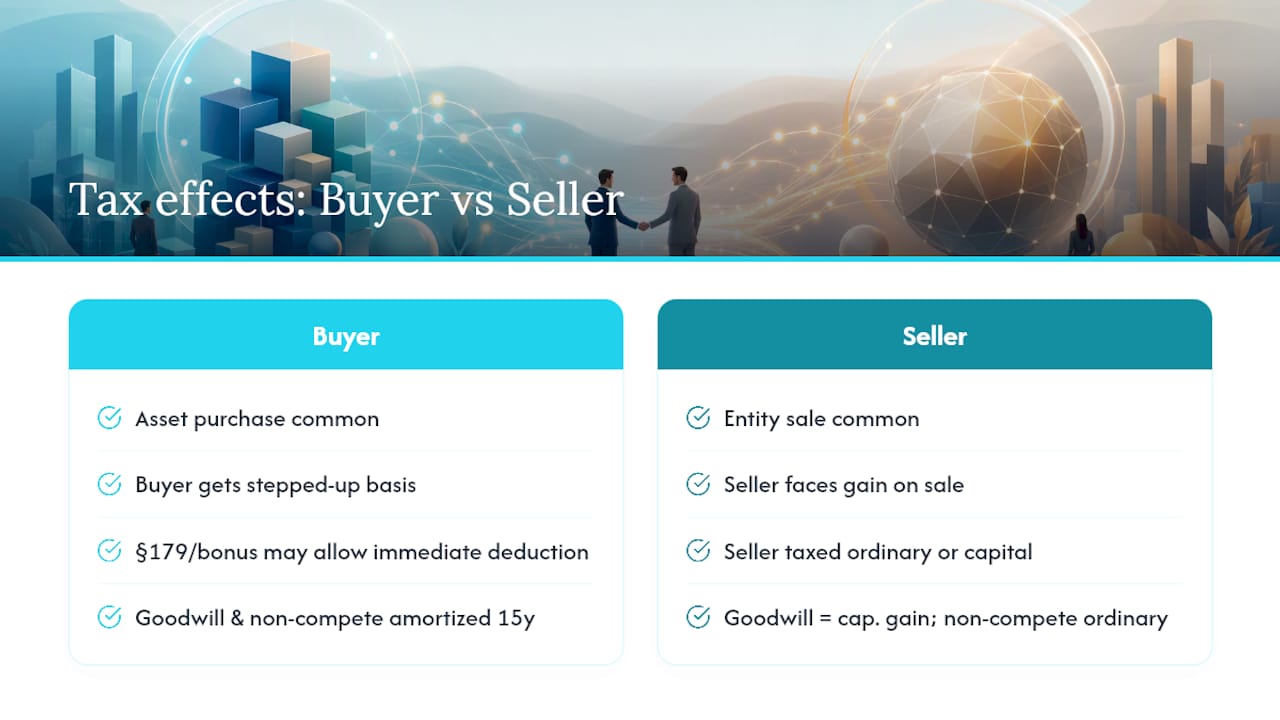
Asset sale vs. entity sale. Most TSP acquisitions are structured as asset purchases rather than stock or membership interest purchases. In an asset sale, the buyer gets a stepped-up tax basis in the acquired assets, which generates depreciation deductions against future income. The seller, by contrast, typically faces ordinary income treatment on certain asset classes (equipment, goodwill allocated to a covenant not to compete) and capital gains on others. Buyers generally prefer asset sales; sellers often prefer entity sales. The negotiated allocation of purchase price across asset classes (vehicles, equipment, goodwill, non-compete agreements, customer relationships) determines the tax outcome for both parties.
Section 179 and bonus depreciation. Buyers acquiring a fleet of linehaul tractors can potentially deduct a significant portion of the vehicle purchase price in the year of acquisition under Section 179 or bonus depreciation rules, subject to current IRS limits and phase-down schedules. Consult a CPA before closing to confirm current-year eligibility and optimize the asset allocation in the purchase agreement.
Goodwill and non-compete allocations. The allocation of purchase price to goodwill and non-compete agreements affects both parties differently. For the buyer, goodwill is amortized over 15 years under IRC Section 197. Non-compete payments are also amortized over 15 years. For the seller, goodwill is typically capital gain; non-compete payments are ordinary income. Buyers should negotiate allocations that maximize depreciable basis in short-lived assets (vehicles, equipment) rather than long-lived intangibles.
Self-employment and payroll structure. Post-close, the buyer’s choice of entity structure (S-corp, C-corp, LLC taxed as S-corp) affects self-employment tax exposure on owner compensation. An S-corp structure with a reasonable salary and distributions can reduce SE tax compared to a sole proprietorship or single-member LLC taxed as a disregarded entity. A CPA with small-business M&A experience should review the post-close structure before closing.
State and local tax considerations. California TSP operators face state income tax, employment taxes, and fuel tax (IFTA) obligations that differ from other states. IFTA filings require quarterly reconciliation of miles driven and fuel purchased by jurisdiction, and clean IVMR records are the foundation of defensible IFTA returns.
This section covers general information about tax considerations and is not a substitute for advice from a qualified tax professional. Confirm current rules with a CPA or tax attorney before closing.
KPI benchmarking: how does this route compare to industry standards?
Knowing your numbers is one thing. Knowing whether they’re good is another. These are the KPIs that experienced TSP buyers and operators track, and the benchmarks that separate a well-run operation from one that’s masking problems.
Revenue and margin benchmarks:
- Revenue per loaded mile: A healthy linehaul TSP operation should generate competitive per-mile rates on its primary lanes. Rates vary by lane, distance, and FedEx contract terms, but significant underperformance versus comparable lanes in the same terminal network is a flag worth investigating.
- Operating ratio (operating expenses divided by revenue): Lower is better. A well-managed linehaul operation typically targets an operating ratio below 90%, meaning at least $0.10 of operating profit per dollar of revenue before owner compensation adjustments.
- Driver cost as a percentage of revenue: Driver wages and benefits typically represent the largest single operating cost. Tracking this ratio over time reveals whether labor cost inflation is eroding margins.
Operational efficiency KPIs:
- Miles per truck per week: Measures asset utilization. Underutilized trucks represent either capacity the seller hasn’t filled or lanes that have been reduced.
- On-time performance rate: FedEx tracks service reliability at the load level. A history of late deliveries or missed pickups shows up in settlement deductions and can signal terminal friction or driver reliability issues.
- Maintenance cost per mile: Tracks fleet health over time. A rising trend signals aging equipment or deferred maintenance.
- Driver retention rate: High turnover (above 25–30% annually) increases recruiting and training costs and creates operational continuity risk.
Financial health KPIs:
- Adjusted EBITDA margin: The normalized operating profit as a percentage of revenue. For a well-run TSP, this typically falls in a range that supports a reasonable acquisition multiple after accounting for vehicle replacement reserves.
- Days to settlement payment: Tracks FedEx settlement lag and its impact on working capital. Longer lags require more cash on hand.
- Vehicle replacement reserve coverage: Are the seller’s actual reserves adequate to fund the replacement cycle, or has the business been running lean on capex?
When benchmarking, compare the target business against its own trailing history first (trend matters more than a single-period snapshot), then against comparable TSP operations in the same terminal network where data is available.
Exit strategies and resale considerations for TSP owners
Buying a TSP business with no exit plan is like buying a house with no idea what neighborhood it’s in. The exit shapes the hold period, the capital structure, and which operational improvements actually add value at resale.
Common exit paths:
Strategic sale to another operator. The most common exit for TSP owners is a sale to another operator, either an existing TSP looking to expand capacity or a new buyer entering the market. Strategic buyers typically pay the highest multiples because they can capture synergies (shared dispatch, combined fleet maintenance, terminal relationships). Maintaining clean records, stable drivers, and strong FedEx performance metrics maximizes value at this exit.
Sale to a financial buyer or search fund. Individual buyers and small search funds are active in the FedEx route market. They typically underwrite to a cash-on-cash return and are sensitive to working capital requirements and vehicle replacement cycles. A clean, well-documented operation with 2–3 years of stable adjusted EBITDA commands a premium over a business with messy records or deferred maintenance.
Consolidation into a larger TSP platform. As the linehaul market consolidates, larger TSP operators are acquiring smaller businesses to build scale. If your operation covers a strategically valuable lane or terminal relationship, a platform buyer may pay above-market multiples for the right fit.
Value drivers that improve resale multiples:
- Clean, auditable settlement records for the trailing 3+ years
- Low driver turnover and documented training programs
- Modern, well-maintained fleet with remaining useful life
- Strong FedEx performance metrics and no history of service penalties
- Documented operating procedures that don’t depend on the owner personally
- Transferable terminal relationships and a designated FedEx contact
Hold period planning. Most TSP buyers target a 3–7 year hold. The first 1–2 years typically involve stabilization and operational improvement. Years 3–5 are the value-building phase where clean records accumulate and driver stability compounds. Exiting before year 3 often means selling into a thin market without the track record that commands a premium.
One practical note: start building your exit documentation from day one. The buyer who inherits your business will run the same diligence process you ran. Every maintenance record you keep, every IVMR you retain, and every driver file you maintain is a future negotiating asset.
What most buyers get wrong about TSP due diligence
The conventional wisdom in FedEx route acquisitions focuses heavily on the financial model: get the settlement data, normalize the EBITDA, apply a multiple, and negotiate the price. That framework isn’t wrong, but it consistently underweights the two things that actually determine whether a deal succeeds after closing.
The first is FedEx approval. Buyers treat the application as administrative, something to handle after the deal is essentially done. That’s backwards. FedEx approval is a gating event with a 6–12 week timeline that you cannot compress by working harder. Starting the pre-qualification process before you sign the LOI, not after, is the single highest-leverage timing decision in the entire transaction. A buyer who enters the approval process with a complete application, strong financials, and a credible business plan moves faster and negotiates from a stronger position than one who submits a reactive package under time pressure.
The second underweighted factor is seller dependency. A TSP business where the seller personally dispatches, drives, manages the terminal relationship, and handles FedEx communications is not a business. It’s a job with a purchase price attached. The diligence question isn’t just “can I run this?” but “can I run this on day one, without the seller, if the transition goes badly?” If the answer requires the seller to stay for six months, price that dependency into the deal structure with a consulting agreement, a seller note tied to performance, or a holdback conditioned on a clean handover.
The buyers who do this well treat diligence as a value-creation exercise, not just a risk-reduction checklist. They’re modeling expansion potential, driver capacity headroom, and lane optimization alongside the trailing numbers. That’s the framing Dentons recommends for modern acquisition due diligence, and it applies directly to TSP transactions.
RJR Worldwide offers buyers direct acquisition support and transition management
Buyers who want experienced hands on the diligence and transition process have a concrete option: RJR Worldwide’s FedEx linehaul acquisition services cover the full transaction cycle, from initial route evaluation through FedEx pre-qualification, operational audit, deal structuring, and first-90-day integration.
RJR Worldwide operates directly from California terminals, which means acquisition advisory is grounded in real operating experience, not just financial modeling. The services include acquisition advisory and document review, operational audits covering vehicles and driver files, FedEx approval support and application preparation, financing introductions to lenders with TSP transaction experience, and integration planning with documented handover procedures. For buyers also managing supply chain needs, RJR Worldwide’s chemical sourcing division handles industrial and specialty chemical procurement under multi-year, index-linked contracts, a useful capability for buyers whose post-close operations intersect with manufacturing or distribution.
Contact RJR Worldwide directly through RJR Worldwide to discuss your acquisition timeline, route target, and qualification status.
Sources
- The New Due Diligence: How to Assess Growth Potential and Return on Investment in Franchise Acquisitions
- FedEx company overview
- Free cash flow definition — Investopedia
- How to Buy a FedEx Route: 2026 Buyer’s Guide & Costs
- Contracting with FedEx Ground -> Contracting Standards — BuildAGroundBiz
- Quick Reference Guide - Candidate Packages