Close a U.S. FedEx TSP Sale in 60–150 Days with RJR Worldwide

Selling or buying a FedEx TSP operation is an asset-style business transfer that always requires FedEx’s consent to assignment before it can close. Deals typically run 60 to 150 days from listing to funds transfer, and the FedEx approval step alone often eats 30 to 60 days of that window. Buyers almost always need to operate through a C-Corp or S-Corp, and the deal itself is nearly always structured as an asset purchase rather than a stock sale.
TL;DR:
- The FedEx approval process for route transfers typically delays closing by 30 to 60 days, with incomplete paperwork or lack of terminal relationships causing most holdups.
- Buyers must have a fully formed C-Corp or S-Corp and pass background and financial checks, while lenders want two to three years of verified financial statements and proof of working capital.
- Valuations depend on route specifics such as fleet age, route density, and contract stability, with most deals financed through SBA loans and seller notes rather than all-cash payments.
- Building a comprehensive data room before listing reduces diligence delays, including financial, driver, vehicle, and compliance documents, to prevent last-minute renegotiations.
- Personal introductions to terminal management before official FedEx submission and clear contingency clauses in LOI significantly increase the chances of a smooth, timely approval.
Table of Contents
- The FedEx TSP Sale Process: A Seller’s Step-by-Step Guide
- What Buyers and Lenders Expect From FedEx Approval
- Valuation, Pricing, and How Buyers Actually Fund the Deal
- Due Diligence: Building a Data Room That Doesn’t Slow You Down
- LOI, APA, and Structuring the Deal Documents
- Closing Day and the First 90 Days of Transition
- What Actually Slows Down FedEx Consent Approval
- Legal and Compliance Issues Unique to FedEx TSP Sales
- Negotiation Tactics and the Real Risks in a FedEx TSP Deal
- What a FedEx TSP Sale Actually Costs
- Why the Standard TSP Sale Checklist Isn’t Enough
- How RJR Worldwide Corp Simplifies Your FedEx TSP Sale
- Sources
The FedEx TSP Sale Process: A Seller’s Step-by-Step Guide
Selling a FedEx TSP contract is not like selling a used truck. It’s a business sale with a regulatory gate in the middle, and the sellers who move fastest are the ones who prepare for that gate before they even list.
Here’s the sequence that actually works:
- Engage a broker or qualified buyer network early, and put a confidentiality agreement in place before sharing route-level financials or driver counts.
- Build a realistic valuation using EBITDA multiples common to route sales, adjusted for fleet age, stop density, and contract tenure. Buyers weight recurring linehaul revenue differently than they weight one-off spot work.
- Pre-qualify buyers for FedEx approval before you sign an LOI. A buyer with no operating history, no corporate entity formed, or a shaky background check will stall your timeline by weeks.
- Negotiate the LOI with the real terms locked in: purchase price, asset purchase structure, a consent-to-assignment contingency, and any escrow or holdback language tied to post-close performance.
- Run diligence and FedEx submission in parallel, not sequentially.
While the route is on the market, smart sellers run three tracks at once:
- Build the data room (financials, driver files, titles, telematics reports).
- Start preliminary financing conversations with the buyer’s likely lender so underwriting isn’t a surprise later.
- Introduce the prospective buyer to the terminal team informally, well before the formal FedEx submission.
That last point gets skipped constantly, and it’s the single biggest unforced error in this process. FedEx contractor opportunities research shows that terminal rapport and complete driver and vehicle records are frequently the difference between a smooth approval and a stalled one.
What Buyers and Lenders Expect From FedEx Approval
Buyers carry most of the paperwork burden in a FedEx TSP transaction, and that burden starts with the entity itself. FedEx requires a corporate structure, either a C-Corp or S-Corp, and won’t approve an LLC as the contracting entity. Background checks on principals, proof of working capital, and evidence of relevant operational experience all factor into the review.
Lenders add their own layer on top of that. SBA 7(a) underwriters, in particular, want to see:
- Two to three years of clean financials that reconcile against FedEx settlement statements
- A defined use-of-funds breakdown separating vehicles, goodwill, and working capital
- Evidence the seller isn’t walking away entirely (a note or short transition period reassures underwriters)
Station-level dynamics matter just as much as paperwork. Because FedEx handles contract negotiations individually rather than collectively, local terminal management has real influence over how smoothly a consent request moves. A formal buyer introduction to the station manager before the official submission is not optional in practice, even though nothing in the process requires it on paper.
Pro Tip: Write the FedEx approval contingency into the LOI and APA with a specific outside date, and spell out what happens to earnest money if approval is delayed past that date. Vague consent language is where deals fall apart during closing week.
Valuation, Pricing, and How Buyers Actually Fund the Deal
Route valuation isn’t guesswork, but it isn’t a single clean formula either. Buyers typically triangulate using EBITDA multiples, revenue-per-stop, and stops-per-day, then adjust for what’s actually included: trucks, trailers, terminal relationships, and contract tenure.
Pricing ranges move based on a handful of factors:
- Fleet age and condition (newer equipment supports a higher multiple)
- Route density and mileage efficiency
- Length and stability of the underlying FedEx contract
- Driver retention and safety record
On the financing side, most buyers aren’t paying all-cash. The common pattern combines an SBA 7(a) loan or conventional bank financing with a seller note carrying 10 to 20 percent of the purchase price. That note does double duty: it bridges a valuation gap and signals to the lender that the seller has confidence in the business’s forward performance.
Earnouts and holdbacks show up when there’s a gap between what the seller believes the route is worth and what the buyer can verify. Tying a slice of the price to FedEx consent, or to a short post-close performance window, protects both sides without killing the deal over a pricing disagreement.
Due Diligence: Building a Data Room That Doesn’t Slow You Down
Buyers and lenders will ask for the same core documents almost every time. Sellers who assemble them before listing avoid the mid-diligence scramble that kills momentum and invites price renegotiation.
- Financials: two to three years of profit and loss statements, tax returns, and the actual FedEx settlement statements, which serve as the non-negotiable source of truth for revenue verification during underwriting.
- Driver and personnel files: employment records, certifications, and safety history.
- Vehicle records: titles, maintenance logs, and telematics data covering utilization and incident history.
- Insurance and compliance: current policies, incident reports, and any open claims.
Organize all of it in a read-only, access-logged data room rather than emailing spreadsheets back and forth. It looks more professional, and it prevents sensitive driver information from circulating further than it needs to.
Pro Tip: Pull your telematics and maintenance history before a buyer asks for it. Unresolved equipment issues, discovered mid-diligence, are one of the most common triggers for last-minute price cuts.
LOI, APA, and Structuring the Deal Documents
Almost every FedEx TSP transaction closes as an asset purchase, not a stock sale, because it lets the buyer acquire trucks, contracts, and goodwill without inheriting the seller’s liabilities. It also fits how FedEx wants the buyer entity structured: a fresh C-Corp or S-Corp rather than an LLC carried over from the seller.
The LOI sets the framework, but its most important job in this specific transaction is spelling out the consent-to-assignment contingency in plain terms, including what happens if FedEx says no or takes too long.
When an earnout is part of the deal:
- Set a measurement window, typically 12 to 24 months.
- Use operational metrics like stops-per-day or revenue-per-stop rather than EBITDA, which a buyer running the route can influence.
- Cap and floor the payout so neither side is exposed to a runaway swing.
- Draft transition or consulting support as a separate agreement from the earnout itself, since mixing the two is one of the most common sources of post-close disputes.
Closing Day and the First 90 Days of Transition
Closing checklists in this industry are unforgiving. Miss a title transfer or a vendor notice, and the route can be sitting idle while paperwork catches up.
- Transfer vehicle titles and update registrations.
- Confirm insurance is bound under the new entity before the first day of operation.
- Notify vendors, fuel card providers, and payroll processors of the ownership change.
- Set up new bank accounts and settlement routing with FedEx.
A transition period of 30 to 180 days, with the seller available for questions, gives the buyer room to learn terminal relationships without leaning on the seller forever. On day one, the priorities are introducing the buyer to the station manager, confirming telematics and dispatch system access, and locking in driver continuity so nobody quits mid-transfer.
Pro Tip: Build a “FedEx denial” clause into your APA specifying what happens to the deposit and the timeline if consent doesn’t come through. It’s an uncomfortable conversation to have upfront, but far less uncomfortable than discovering there’s no plan for it after the fact.
What Actually Slows Down FedEx Consent Approval
FedEx’s consent-to-assignment isn’t a rubber stamp, and it isn’t purely bureaucratic either. It functions as FedEx’s own vetting of who’s about to run one of its contracted lanes.
The review typically covers the buyer’s corporate formation documents, background checks on principals, proof of working capital, and confirmation that the buyer entity meets FedEx’s structural requirements. Because FedEx negotiates and reviews contracts on an individual basis rather than through any collective process, there’s no shortcut through a broker or association that speeds up the actual FedEx-side review.
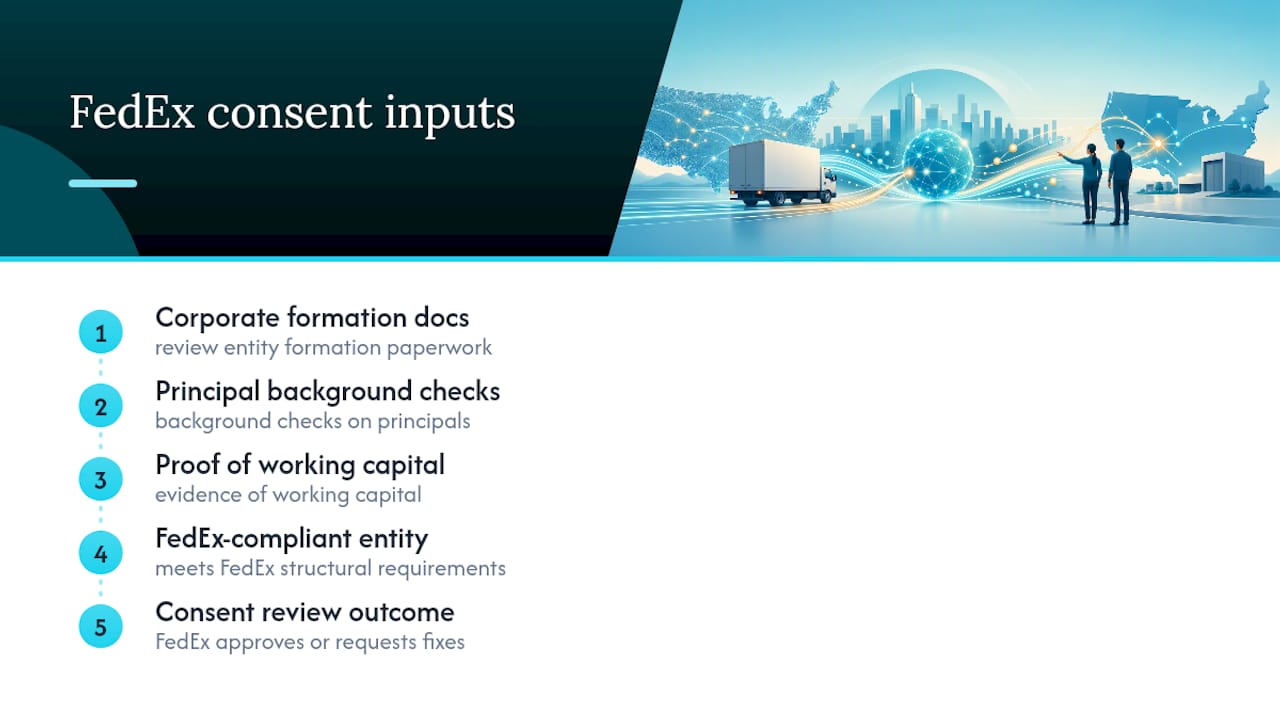
Most delays trace back to one of three things: incomplete buyer paperwork, a corporate entity that isn’t fully formed yet, or a station manager who’s never met the buyer before the formal request lands on their desk. That last one is fixable weeks in advance, and it’s the cheapest insurance a buyer can buy in this entire process.
Timelines vary by station and by how clean the submission is, but budgeting 30 to 60 days for this step alone is realistic. Anything faster is a bonus, not a baseline.
Legal and Compliance Issues Unique to FedEx TSP Sales
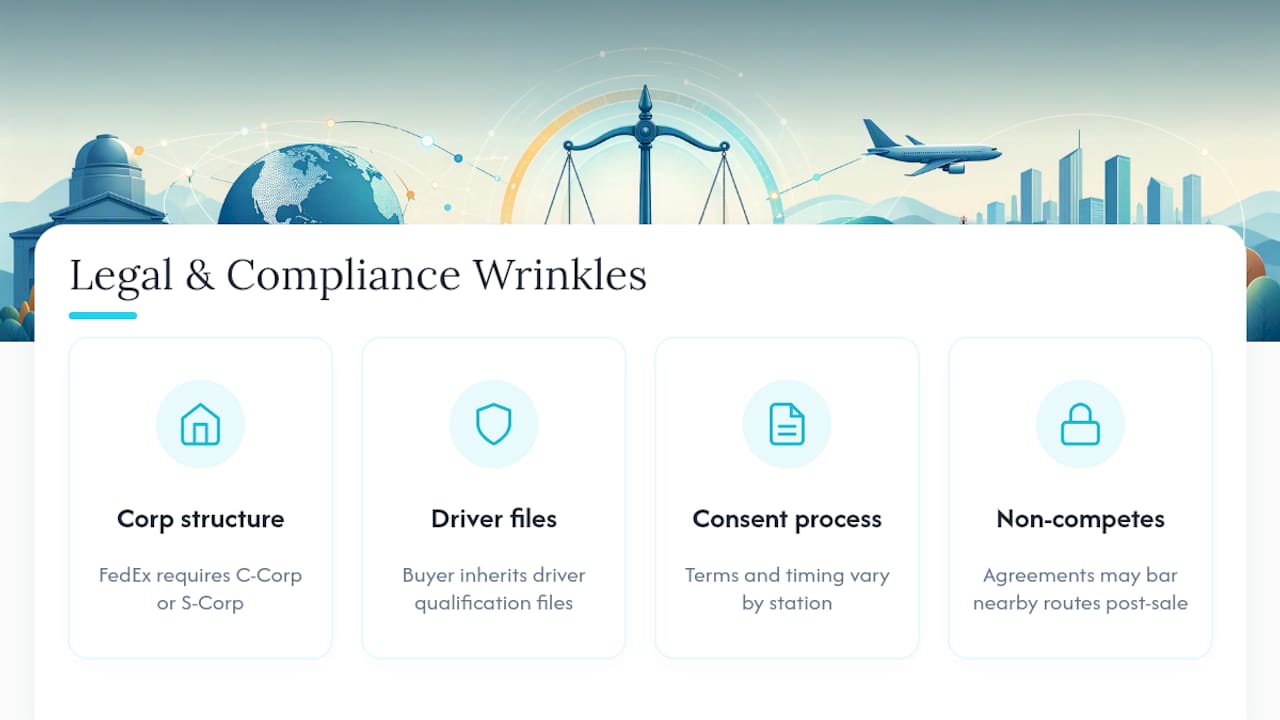
FedEx TSP sales carry a few compliance wrinkles that don’t show up in a typical small-business acquisition. The corporate structure requirement is the first one: FedEx expects a C-Corp or S-Corp, and a buyer who shows up with an LLC will need to re-form before the deal can even be submitted.
The second wrinkle involves driver classification and safety compliance. Buyers inherit operational responsibility for driver qualification files, hours-of-service compliance, and DOT-related recordkeeping, and any gaps discovered post-close become the new owner’s problem to fix immediately.
Third, because FedEx treats contract terms as individually negotiated rather than collectively bargained, sellers and buyers can’t rely on a “standard” consent process that applies uniformly across every station. Terms and timing can vary based on the specific station and the buyer’s own history with FedEx, if any.
Finally, non-compete and non-solicitation language in the existing contractor agreement needs review before marketing the route. Some agreements restrict a seller from operating a competing route nearby for a period after sale, and that restriction should be disclosed to buyers upfront rather than surfacing during diligence.
Negotiation Tactics and the Real Risks in a FedEx TSP Deal
The leverage in these negotiations shifts constantly, and the side that understands where the actual risk sits usually gets the better terms.
Sellers hold leverage on route quality and documentation completeness. A seller with clean settlement statements, current telematics data, and no outstanding compliance issues can push back hard on lowball offers, because that buyer knows the diligence process will confirm the numbers.
Buyers hold leverage on financing and approval risk. Since the deal can’t close without FedEx consent, buyers reasonably ask for contingencies, extended due-diligence windows, and price protection if station-level issues surface late.
The biggest deal risk isn’t usually price. It’s timeline slippage caused by incomplete buyer paperwork or a station manager who’s never been introduced to the incoming owner. A close second is earnout ambiguity, where vague performance language turns a handshake agreement into a legal dispute six months after closing.
The best negotiation tactic on either side is boring but effective: over-document everything, set explicit outside dates on every contingency, and get the buyer in front of the terminal manager as early as the LOI stage.
What a FedEx TSP Sale Actually Costs
Fees in a TSP transaction add up from a few predictable sources, and both sides should budget for them before negotiating price.
Broker fees, when a broker is involved, typically run as a percentage of the sale price, similar to other small-business transactions. Legal fees cover LOI drafting, the asset purchase agreement, and any earnout or transition documents, and they scale with how complex the deal structure gets.
There’s no standardized public fee schedule for FedEx’s own consent-to-assignment review, so buyers should confirm current costs directly with FedEx or through their contractor compliance resources rather than assume a flat number.
Financing carries its own costs too. SBA loans come with guarantee fees and closing costs on top of interest, and a seller note, while flexible, still needs proper legal drafting to be enforceable. None of these costs are large enough to derail a well-priced deal, but they do shift the effective return on both sides, so build them into the offer price conversation early rather than discovering them at closing.
Why the Standard TSP Sale Checklist Isn’t Enough
Most guidance on selling a FedEx TSP treats the process like a checklist: get your documents, sign an LOI, wait for FedEx, close. That’s not wrong, but it undersells how much of the outcome depends on relationships that never appear in any contract.
The conventional advice underweights the terminal introduction almost entirely. Buyers and sellers who treat the station manager relationship as a formality, rather than a genuine gating factor, are the ones who watch a 45 day approval stretch into 90. The paperwork matters, but paperwork alone doesn’t get a buyer approved faster.
The other place standard advice falls short is earnout design. Too many deals get papered with EBITDA-based earnouts because it’s familiar language from other industries, when operational metrics tied to route control hold up far better under dispute.
If you’re preparing to sell or buy, prioritize two things above everything else: get the buyer in front of the terminal team before the formal submission, and separate every transition obligation from every earnout metric in writing. Everything else on the checklist is important. Those two things are what actually determine whether the deal closes on schedule.
— RJR Worldwide
How RJR Worldwide Corp Simplifies Your FedEx TSP Sale
If you’re weighing a broker listing or a direct sale versus working with an operator who already runs terminal-based linehaul lanes, that distinction matters more than most sellers realize. Certain buyers operate FedEx Linehaul TSP businesses directly from California terminals, providing operational familiarity with dedicated lanes, driver continuity, and the documentation FedEx requires.
That operational familiarity cuts through a lot of the friction described above: fewer surprises during diligence, a transition plan built around keeping your drivers and your customers stable, and a team that has already sat across the table from station managers on prior linehaul acquisitions. Sellers may receive transparent terms and a clear transition timeline instead of a vague promise of “support.”
If you’re considering a sale, the next step is a confidential conversation, not a public listing. Reach out to discuss your route and find out whether a direct sale fits your timeline better than the broker route.