Hazmat Shipping Documentation for Chemical Buyers

Every hazmat shipment you tender must be accompanied by a shipping paper that satisfies 49 CFR Part 172, Subpart C — and that paper must be physically within the driver’s reach, legible, and backed by a continuously monitored emergency response phone number. PHMSA sets the classification and documentation standards; FMCSA enforces accessibility in the cab. The Hazardous Materials Table at 49 CFR 172.101 is your starting point for every entry. Miss a column 1 code or skip an Appendix A reportable quantity notation, and you have a citation waiting to happen.
Act now:
- Pull the HMT entry for every chemical you ship and confirm the UN/NA number, proper shipping name, and hazard class.
- Verify your emergency response phone is staffed around the clock — an answering machine does not meet the requirement.
- Confirm drivers store papers within immediate reach while belted in, visible to anyone entering the cab.
- Check your retention policy: two years for most hazardous materials, three years for hazardous waste.
Table of Contents
- What must legally appear on a hazardous materials shipping paper?
- How to prepare and hand off compliant hazmat shipping papers
- Common documentation mistakes that draw inspector attention
- Other documents you must manage alongside the shipping paper
- How RJR Worldwide reduces your documentation risk
- Key Takeaways
- Why integration is the real compliance advantage
- RJR Worldwide handles the documentation so your shipment moves
- Authoritative regulations and guidance worth bookmarking
What must legally appear on a hazardous materials shipping paper?
The Hazardous Materials Regulations do not require a special form. A bill of lading, invoice, manifest, or plain paper all qualify — provided the content and sequence are correct. What matters is what the paper says and how it says it.
The required elements under 49 CFR §172.200–172.203
Every shipping paper for a regulated material must include:
- Identification number (UN or NA number, e.g., UN1230)
- Proper Shipping Name exactly as listed in the HMT
- Hazard class or division (and subsidiary hazard class where applicable)
- Packing group in Roman numerals (I, II, or III) where the HMT assigns one
- Quantity and type of packaging (number of drums, cylinders, IBCs, etc.)
- Emergency response telephone number with area code, monitored at all times during transport — an answering machine or beeper does not satisfy this requirement
- Shipper’s certification statement signed by a named individual (not a company name alone)
- Date the paper was prepared or given to the carrier
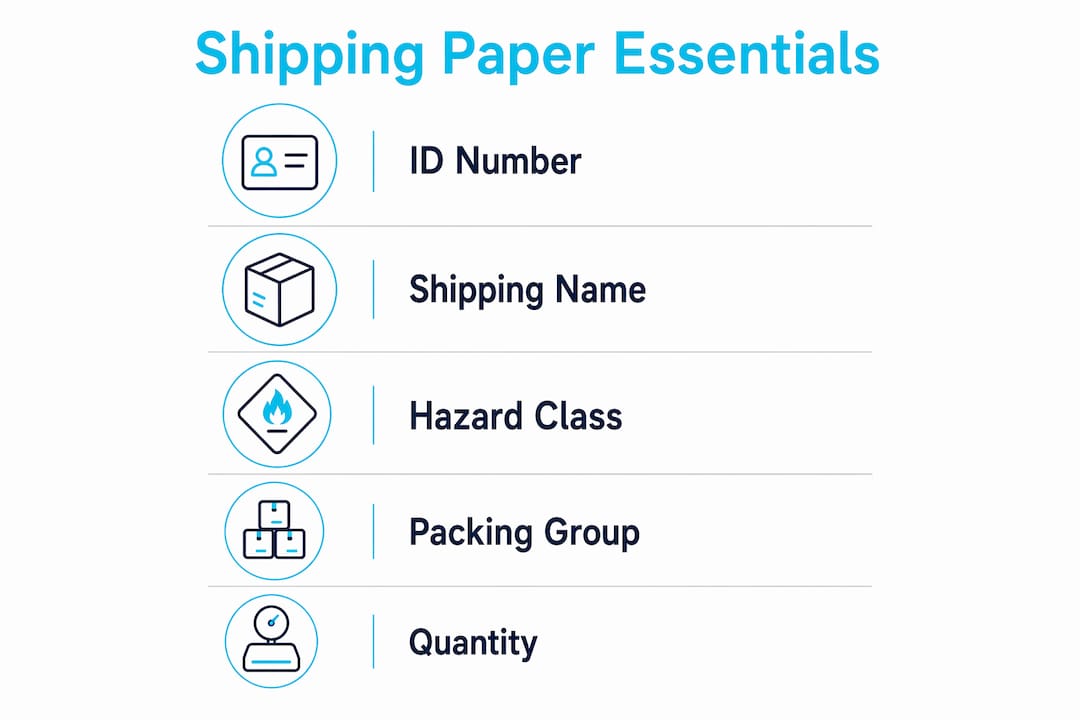
The sequence for the basic description follows the ISHP order: Identification number, Shipping name, Hazard class, Packing group. A correctly formatted line looks like this:
UN1230, Methanol, 3 (6.1), PG II, 4 drums, 200 L
Column 1 and column 7 triggers you cannot skip
The ISHP sequence is only the starting point. Column 1 of the HMT carries letter codes that impose additional duties. A “G” in column 1 means the proper shipping name must be supplemented with the technical name in parentheses — your SDS or chemical manufacturer is the source for that name. Column 7 special provision codes can require additional entries on the paper itself.

Beyond the columns, check both appendices. Appendix A lists hazardous substances with reportable quantities (RQ); if your per-package quantity meets or exceeds the RQ, the letters “RQ” must appear on the shipping paper. Appendix B covers marine pollutants and triggers a “marine pollutant” notation for vessel shipments.
How to prepare and hand off compliant hazmat shipping papers
Pre-tender verification steps
- Look up the HMT entry at 49 CFR 172.101 and confirm the UN/NA number, proper shipping name, hazard class, and packing group.
- Check column 1 for letter codes — if “G” appears, pull the technical name from the SDS.
- Review column 7 special provisions and note any additional description requirements.
- Check Appendix A: calculate whether your quantity meets the RQ threshold and add “RQ” if it does.
- Check Appendix B if the shipment moves by vessel.
- Confirm packing specification and count the number and type of packages.
- Verify the emergency response phone is staffed continuously — not just during business hours.
Sample shipping-paper line-item template
| Field | Example / Placeholder |
|---|---|
| Identification number | UN1230 |
| Proper Shipping Name | Flammable liquids, n.o.s. |
| Technical name (if column 1 “G”) | (Acetone, Toluene) |
| Hazard class / subsidiary hazard | 3 |
| Packing group | PG II |
| Quantity and packaging | 4 drums, 200 L |
| Emergency response phone | 1-800-XXX-XXXX (24-hr monitored) |
| Shipper’s certification | “I hereby certify…” + printed name |
Carrier handoff and electronic papers
Forward the shipping paper to the carrier before the shipment moves, unless the carrier prepares it. Both parties must have a documented verification procedure confirming the transmitted information is accurate. Electronic shipping papers are permitted under 49 CFR Subpart C when the carrier-offeror verification procedure is in place and a printed copy can be produced on demand.
Pro Tip: Store the printed paper in a clearly labeled pouch on the seat back or on the driver’s clipboard. Locked glove boxes or seat pockets that require moving items to access them fail the driver’s reach requirement.
Retention: Under §172.201, retain a copy or electronic image at your principal place of business for two years after carrier acceptance (three years for hazardous waste). Motor carriers running repeated identical loads may keep a single representative shipping paper plus shipment-specific records showing name, ID number, quantity, and date.
Common documentation mistakes that draw inspector attention
FMCSA motor-carrier inspections and PHMSA investigations consistently surface the same errors. Knowing them is cheaper than learning from a citation.
- Incorrect or missing UN/NA number — using an outdated entry or transposing digits
- Wrong proper shipping name — using a trade name instead of the HMT-listed name
- Missing or unstaffed emergency response phone — the single most operationally disruptive finding
- Wrong units or quantity — listing weight when volume is required, or vice versa
- Buried or inaccessible papers — papers locked in a compartment or under cargo
- Missing shipper’s certification wording — omitting the statement or listing only a company name
- Omitted RQ notation — Appendix A omissions are among the most common PHMSA citation triggers
- Missing technical name — failing to add the parenthetical when column 1 requires it
Enforcement consequences range from out-of-service orders that strand a load to civil penalties assessed per violation per day. PHMSA can also refer cases for criminal prosecution when violations are willful.
Mitigation checklist: Use automated HMT lookup tools, run dual verification between your chemical supplier and your shipping team, standardize your templates, train every document preparer on ISHP sequence and column triggers, and document your retention policy in writing.
Other documents you must manage alongside the shipping paper
The shipping paper is the anchor document, but it does not travel alone.
- Safety Data Sheet (SDS): Required to be accessible during transport; provides the technical name, subsidiary hazards, and first-aid information that feed directly into the shipping paper.
- Hazardous waste manifest: Required for regulated waste shipments; retention is three years, and the manifest must track the chain of custody from generator to disposal facility.
- Emergency Response Assistance Plan (ERAP): Certain high-hazard materials require an approved ERAP on file; the ERAP reference number and phone must appear on the shipping paper.
- Special permits: Some materials or packaging configurations require a DOT special permit number noted on the paper.
- Import/export paperwork: International shipments add customs declarations, and air shipments require an IATA Dangerous Goods Declaration prepared to IATA DGR standards. Vessel shipments trigger IMDG Code requirements and the marine pollutant notation from Appendix B.
When classification is ambiguous, the technical name is unclear, or you are crossing borders, contact PHMSA directly or engage a qualified hazardous-materials specialist before tendering. A wrong classification on an international shipment can trigger customs holds that dwarf any domestic citation.
How RJR Worldwide reduces your documentation risk
Chemical buyers who source through RJR Worldwide get documentation support built into the supply chain, not bolted on afterward. RJR Worldwide’s integrated model — vetted suppliers, California terminal operations, and dedicated FedEx linehaul lanes — compresses the handoff chain where most documentation errors originate.
- HMT validation against each chemical’s SDS before a shipping paper is assembled
- Pre-tender shipping-paper preparation with ISHP sequencing and column trigger checks
- Managed emergency response phone coverage for shipments in transit
- Printed and electronic document handling with carrier verification sign-off
- Record retention support aligned with §172.201 requirements
Buyers who have moved their industrial chemical supply through RJR Worldwide’s integrated sourcing workflow report fewer inspection findings and faster carrier acceptance at tender, because the paper is right the first time.
Key Takeaways
Compliant hazmat shipping documentation requires a correctly sequenced ISHP description, a continuously monitored emergency response phone, driver-accessible papers, and a documented retention policy — every element is mandatory, none are optional.
| Point | Details |
|---|---|
| ISHP sequence is mandatory | List Identification number, Shipping name, Hazard class, and Packing group in that exact order on every line item. |
| Column triggers add obligations | Check HMT columns 1 and 7 plus Appendices A and B before finalizing any shipping paper. |
| Emergency phone must be live | The number must be monitored at all times during transport; voicemail does not satisfy 49 CFR requirements. |
| Retention: 2 or 3 years | Keep copies two years for most hazmat, three years for hazardous waste, accessible at your principal place of business. |
| RJR Worldwide integrates documentation | RJR Worldwide’s sourcing-to-linehaul workflow validates HMT entries and assembles shipping papers before tender, reducing inspection findings. |
Why integration is the real compliance advantage
Most compliance guides treat documentation as a checklist problem. It is actually a data-flow problem. The technical name that belongs in parentheses on the shipping paper lives in the SDS your supplier generated. The RQ threshold that triggers an Appendix A notation is buried in a table most shipping clerks never open. When sourcing, documentation, and freight operations run through separate teams with separate systems, those data points get lost in translation.
The operations that consistently produce clean shipping papers are the ones where the supplier’s technical data reaches the document preparer without a manual re-keying step. Dedicated lanes help too — when a carrier runs the same lane repeatedly, both parties know the verification procedure cold, and the paper gets accepted faster. That is not a compliance theory. It is what happens when the feedback loop between supplier data and shipping-paper preparation is short enough to catch errors before the truck leaves the yard.
RJR Worldwide handles the documentation so your shipment moves

RJR Worldwide gives industrial chemical buyers something most sourcing arrangements do not: a single point of contact that covers compliant shipping-paper preparation, emergency response phone management, and dedicated linehaul capacity out of California terminals. You get food, technical, and pharmaceutical-grade chemicals sourced from vetted suppliers in China and India, paired with the freight infrastructure to move them compliantly from day one. No separate logistics vendor to coordinate, no documentation gaps between your supplier and your carrier. Request pricing or a compliance review through RJR Worldwide’s chemical sourcing page and get your documentation workflow right before your next shipment tenders.
Authoritative regulations and guidance worth bookmarking
- 49 CFR Part 172, Subpart C: The primary legal authority for shipping-paper content, sequence, electronic acceptability, and retention. Use this to verify every required element and the carrier-offeror verification procedure.
- §172.201 — Preparation and retention: Governs retention periods (two years vs. three for hazardous waste) and the representative-paper option for recurring identical loads.
- FMCSA Hazardous Materials Shipping Papers: FMCSA’s plain-language overview of driver accessibility rules and motor-carrier obligations; the best single reference for cab-storage compliance.
- FMCSA Shipping Paper Guide with Examples: Worked examples of correctly formatted shipping papers, common citation patterns, and emergency response information requirements.
- DOT Shipping Papers Guide — RAMPAC/DOE: The most practical field guide for interpreting HMT column codes, technical name requirements, and Appendix A/B triggers. Bookmark this for daily use.
- 49 CFR 172.101 Hazardous Materials Table: The master lookup for UN/NA numbers, proper shipping names, hazard classes, packing groups, and column codes. Available through the eCFR at ecfr.gov.
- PHMSA Resources (phmsa.dot.gov): PHMSA publishes classification guidance, special permit information, and enforcement data; use it when a material’s classification is unclear or when you need to verify an RQ threshold.