LCL vs FCL for Chemical Shipments: A Practical Guide

For most industrial and specialty chemical shipments moving into the U.S., FCL is the right call. A sealed container means fewer hands on your cargo, cleaner compliance with 49 CFR and PHMSA hazmat rules, and a single customs entry that cannot be derailed by a co-shipper’s paperwork error. LCL makes sense below a moderate volume threshold for market samples, or when cash flow rules out paying for a full box upfront — but only after you have added CFS fees, consolidation surcharges, and the transit-time penalty to the comparison.
Three factors drive that verdict:
- Security and handling: FCL containers are sealed at origin and stay that way until delivery, cutting handling events to a minimum. LCL cargo passes through Container Freight Stations twice, multiplying damage and loss exposure.
- Regulatory and hazmat suitability: Many CFS facilities restrict or outright ban certain hazardous classes, and practical groupage reefer service is rare. For temperature-sensitive or classified chemical cargo, FCL is often not a preference but a requirement.
- Cost breakeven: The crossover sits around 10–15 CBM on most lanes, though on busy routes with congested CFS facilities, FCL can become more economical at volumes as low as 8–10 CBM. If your shipment is hazmat-classified, temperature-controlled, or above 10 CBM, request an FCL quote from RJR Worldwide before comparing base freight rates alone.
Table of Contents
- How do LCL and FCL compare for chemical shipments?
- What does FCL actually mean for your chemical operation?
- What is LCL shipping and what does it actually cost?
- Why regulatory and hazmat rules often make FCL mandatory
- How to calculate whether FCL or LCL is cheaper
- How to decide: checklist and questions to ask your forwarder
- RJR Worldwide handles the FCL complexity so you do not have to
- Key Takeaways
- Why FCL is the right default for chemical supply chains
- Request a compliant FCL quote from RJR Worldwide
- Authoritative sources for further reading
How do LCL and FCL compare for chemical shipments?
The table below maps the six dimensions that matter most to chemical buyers and FedEx Linehaul operators.
| Dimension | FCL | LCL |
|---|---|---|
| Security / handling points | Sealed at origin; low handling events | Multiple CFS touchpoints; higher damage exposure |
| Hazmat / temperature-sensitive suitability | Preferred or required; reefer FCL available | Many CFS restrict hazmat classes; groupage reefer rare |
| Typical cost drivers | Flat container rate + drayage + THC | Per-CBM freight + CFS fees $150–$300 + consolidation surcharge |
| Transit time & predictability | Direct; no consolidation wait | Adds several days for CFS consolidation/deconsolidation |
| Documentation & customs risk | Single B/L; one customs entry | House B/L under Master B/L; co-shipper error can hold entire container |
| Minimum economical volume | Typically 10–15 CBM (lane-dependent) | Below 10 CBM or sample volumes |
For FedEx Linehaul operators, the practical implications stack up quickly:
- FCL drayage is predictable: one container, one pickup, one terminal slot.
- LCL deconsolidation at destination CFS adds queue time that ripples into linehaul scheduling.
- Terminal dwell costs money whether the delay is yours or a co-shipper’s.
What does FCL actually mean for your chemical operation?
Full Container Load means you book the entire container, whether it is a standard 20-foot dry box, a 40-foot or 40-foot high-cube, a reefer unit for temperature-sensitive cargo, or a flat rack or open-top for oversized equipment. The container is stuffed, sealed, and does not open again until it reaches the consignee.
For chemical buyers, that seal is the operational core of FCL’s value. Chain of custody is clean. There is one bill of lading, one customs entry, and no exposure to a stranger’s mislabeled pallet. Hazmat declarations, UN numbers, and SDS documentation travel with a single consignee’s name on the paperwork, which is exactly what PHMSA and CBP want to see.
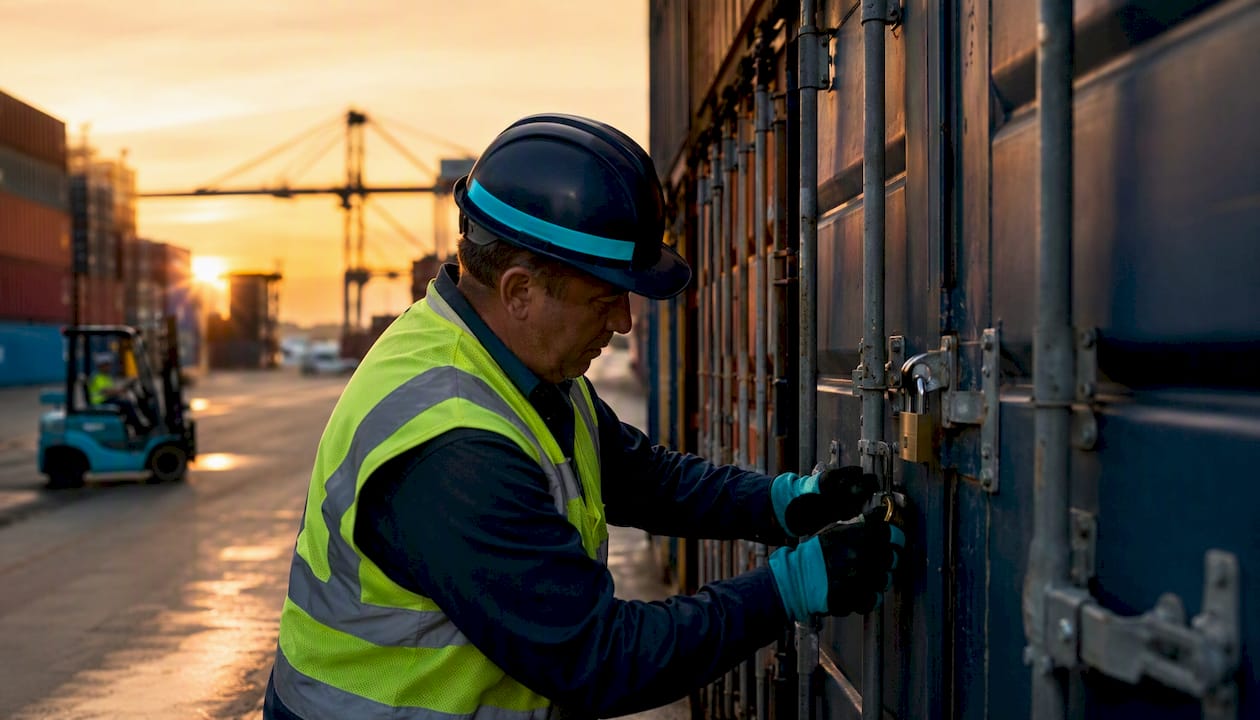
FedEx Linehaul operators benefit in a different but related way. A sealed FCL container arriving at a California terminal has a predictable drayage window and a defined slot. RJR Worldwide’s direct FedEx linehaul acquisitions and terminal operations in Southern California mean the drayage-to-linehaul handoff is managed internally, cutting the dwell time that typically bleeds cost from third-party coordination.
Pro Tip: If your volume does not quite fill a 20-foot container, consider buyer-managed consolidation: you arrange groupage from your own suppliers under a single shipper name. You get FCL-like chain-of-custody controls without paying for unused space, and your hazmat documentation stays clean because every pallet in the box is yours.
What is LCL shipping and what does it actually cost?
Less than Container Load means your cargo shares a container with other shippers. A consolidator at the origin Container Freight Station groups your freight with others heading to the same destination port, and a deconsolidator at the destination CFS breaks it apart again. You pay per cubic meter or per ton, whichever is greater.
The base freight rate looks attractive. The full picture rarely is.
Hidden costs that erode LCL savings:
- CFS handling fees per shipment, applied at origin and sometimes destination
- Consolidation surcharges layered on top of the per-CBM rate
- Demurrage and detention exposure if the CFS queue backs up
- Insurance complexity: when a claim spans consolidator, ocean carrier, and CFS warehouse, determining liability takes time and rarely resolves cleanly
For chemical shipments specifically, the risks compound. If any co-shipper in the container triggers a customs exam or has incomplete paperwork, CBP can hold the entire container. Every consignee inside waits, regardless of how clean their own documentation is. That is not a theoretical risk; it is a documented operational pattern with LCL consolidations. Add the fact that many CFS operators restrict hazardous classes entirely, and LCL stops being an option for a wide range of chemical products before the math even matters.
CFS fee reality check: LCL handling fees of $150–$300 per shipment are the floor, not the ceiling. On congested lanes or during peak season, consolidation surcharges and CFS queuing can push the all-in LCL cost well above a comparable FCL rate even at volumes below 10 CBM.
Why regulatory and hazmat rules often make FCL mandatory
Under 49 CFR and PHMSA guidance, hazardous materials in ocean transport require specific packaging, labeling, placarding, and documentation. A single-consignee FCL container makes compliance straightforward: one shipper, one set of declarations, one emergency response contact.
LCL consolidation introduces structural compliance friction. The consolidator must manage hazmat declarations across multiple shippers, and many simply refuse. Practical groupage reefer service is rare enough that temperature-sensitive chemicals should default to FCL reefer as the operational baseline.
Compliance checklist for chemical FCL shipments:
- Complete SDS/MSDS for every product in the container
- UN numbers and hazard class declarations on the commercial invoice and packing list
- Properly labeled and packaged cargo per IMDG and 49 CFR requirements
- Emergency response information (CHEMTREC or equivalent) on the B/L
- Single-consignee B/L to simplify CBP entry and avoid shared customs risk
RJR Worldwide’s terminal operations and chemical sourcing experience mean documentation packages for hazmat FCL moves are built to this standard from the start, not assembled after a customs query.
How to calculate whether FCL or LCL is cheaper
Start with every line item, not just base freight.
| Cost component | FCL | LCL |
|---|---|---|
| Ocean freight | Flat container rate | Per CBM/ton (W/M) |
| Terminal handling (THC) | Per container | Per CBM |
| CFS origin fee | Not applicable | $150–$300 typical |
| CFS destination fee | Not applicable | $150–$300 typical |
| Drayage | Per container | Per CFS pickup |
| Insurance | Straightforward warehouse-to-warehouse | Complex; shared liability |
| Documentation | Single B/L | House + Master B/L |
| Consolidation surcharge | None | Varies by consolidator |
| Demurrage / detention | Standard free time | CFS queue adds exposure |
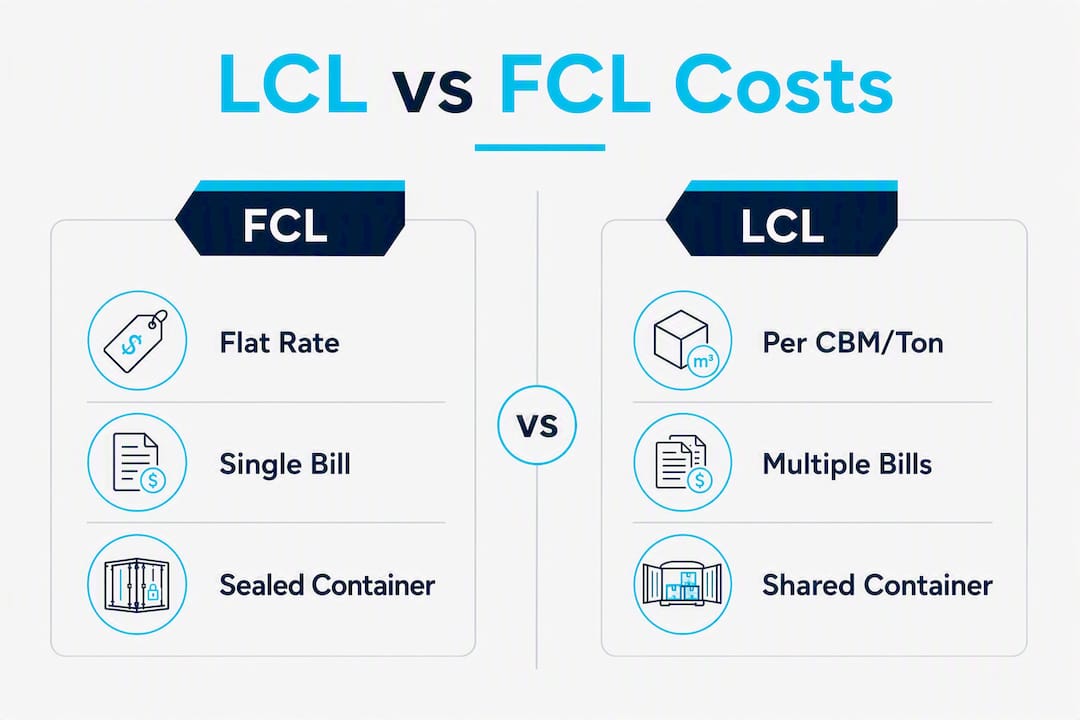
A quick worked example: a 12 CBM shipment of industrial solvent. LCL base freight might come in at $900. Add $250 origin CFS, $250 destination CFS, and a $150 consolidation surcharge, and you are at $1,550 before drayage. A 20-foot FCL on the same lane might quote $1,800 all-in including drayage. The gap is $250, and LCL still adds 5–10 days to transit.
Pro Tip: Dense chemical products are often billed on weight rather than volume (W/M billing). If your cargo weighs more than one metric ton per CBM, the chargeable weight calculation shifts the LCL rate up sharply, pulling the FCL breakeven lower than the standard 10–15 CBM guideline suggests. Always ask your forwarder to run both calculations.
How to decide: checklist and questions to ask your forwarder
Decision checklist:
- Calculate your CBM and chargeable weight (volume vs. weight, whichever is greater).
- Confirm hazmat status: UN number, hazard class, and whether your product is restricted at CFS.
- Check your lead time: can you absorb 5–10 extra days if LCL consolidation runs slow?
- Evaluate destination receiving capacity: can your facility handle a full container, or do you need CFS delivery?
- Assess cargo value: above $20,000, the insurance and liability simplicity of FCL is worth the premium.
Questions to ask your forwarder before booking:
- What is the all-in door-to-door cost, including origin and destination CFS fees?
- What is the average consolidation wait time on this lane right now?
- Does your LCL consolidator accept my hazard class?
- What insurance coverage applies during CFS handling, and who holds liability?
- What is the demurrage free-time policy at the destination CFS?
Red flags that push you to FCL: any hazmat class restriction at the consolidator’s CFS; a required reefer service; cargo value above $20,000; or a replenishment schedule that cannot absorb unpredictable delays.
For consolidated shipment documentation flows where LCL genuinely fits (samples, sub-10 CBM test volumes), make sure the paperwork package is complete before the container closes. A missing SDS from any co-shipper can hold the entire box.
RJR Worldwide handles the FCL complexity so you do not have to
Chemical buyers who have priced FCL and LCL side by side know the base freight comparison is the easy part. The hard part is finding a partner who controls the full chain: compliant sourcing, correct documentation, and a linehaul operation that does not add dwell time at the terminal.
RJR Worldwide operates directly from California terminals with dedicated FedEx linehaul lanes, which means the drayage-to-linehaul handoff is internal, not a third-party coordination problem. The company secures long-term, multi-year agreements for food, technical, and pharmaceutical-grade chemicals from vetted suppliers in China and India, with full US and EU compliance documentation included. Pricing is index-linked and transparent: no surprise CFS fees buried in a quote, no ancillary charges discovered at delivery.
For chemical buyers who need FCL-capable sourcing with hazmat and reefer competency built in, the practical next step is a door-to-door quote from RJR Worldwide’s chemical sourcing division. Attach your SDS, commercial invoice, UN numbers, preferred container type, and required delivery window, and the quote will include all-in charges, insurance options, and linehaul optimization.
Key Takeaways
FCL is the default choice for industrial and specialty chemical shipments above 10 CBM, for any hazmat or temperature-sensitive cargo, and whenever cargo value or compliance risk makes CFS handling unacceptable.
| Point | Details |
|---|---|
| Hazmat and reefer default to FCL | CFS facilities often restrict hazardous classes; groupage reefer is rarely available. |
| Breakeven is 10–15 CBM, lane-dependent | On busy routes, FCL can become cheaper at 8–10 CBM once CFS fees are included. |
| LCL adds transit time | Consolidation and deconsolidation at CFS add transit time on most lanes. |
| Include CFS fees in every LCL quote | Origin and destination CFS handling fees of $150–$300 each must be in the all-in comparison. |
| RJR Worldwide for compliant FCL sourcing | RJR Worldwide combines chemical sourcing, hazmat documentation, and FedEx linehaul control from California terminals. |
Why FCL is the right default for chemical supply chains
The conventional wisdom treats LCL as the budget option and FCL as the premium one. That framing misses the point for chemical shipments. The real question is not which mode costs less on base freight; it is which mode keeps your cargo compliant, intact, and on schedule.
Every additional handling point in an LCL consolidation is a moment where a chemical shipment can be damaged, mislabeled, or delayed by someone else’s paperwork. The 5–10 day transit penalty is not just a scheduling inconvenience; for temperature-sensitive products, it can be a product-loss event. For hazmat cargo, a customs hold triggered by a co-shipper is a compliance incident, not just a delay.
Owning linehaul capability, as RJR Worldwide does through its FedEx linehaul acquisitions, changes the calculus further. When the same operator controls the terminal slot and the linehaul lane, the dwell-time variable that quietly inflates FCL costs for most buyers disappears. That is the operational advantage that rarely shows up in a freight quote comparison but shows up clearly in total landed cost.
Request a compliant FCL quote from RJR Worldwide
To get a door-to-door FCL quote, send RJR Worldwide the following: your SDS/MSDS for each product, the commercial invoice, UN numbers and hazard class, your preferred container type (20-foot dry, 40-foot, reefer), and your required delivery window.
RJR Worldwide’s quote will include:
- All-in ocean freight, THC, and drayage charges
- CFS exposure assessment (and how to avoid it)
- Insurance options with clear liability scope
- Linehaul optimization from California terminals
Contact RJR Worldwide through the chemical sourcing division to start the process.
Authoritative sources for further reading
- FCL and LCL: Why the differences matter — Drip Capital: strong on handling-event comparisons and security rationale for FCL.
- FCL vs LCL: How to Choose the Right Mode — Suaid Global: best source for CFS fee ranges, transit-time penalties, and breakeven guidance.
- FCL vs LCL shipping — International Logistics Group: covers documentation complexity, customs contamination risk, and LCL use cases.
- Understanding ocean freight (FCL vs LCL) — Maersk: authoritative on CFS operational mechanics and handling touchpoints.
- FCL vs LCL — Which shipping method to choose — Sitthi Global: covers hazmat CFS restrictions, reefer groupage limitations, and insurance claim complexity.
- FCL vs LCL — Complete guide for importers & exporters — Trace Container: detailed breakeven analysis including lane variability and the 8–10 CBM threshold on high-volume routes.