A Logistics Acquisition Integration Plan That Actually Protects Value

An effective logistics acquisition integration plan delivers uninterrupted operations, measurable synergies, and a clear Day One to 12 month roadmap. It has to protect the operations you just paid for, turn the synergies you underwrote into deliverables with owners and dates, and sequence systems and people changes so nothing breaks in the process.
Three priorities decide whether the deal thesis survives contact with reality:
- Day One continuity: customer service, billing, and terminal access run without interruption.
- Measurable synergies: every target has an owner, a baseline, and a deadline, not a slide.
- Safe systems and data cutover: staged migrations, not a weekend gamble on live freight.
Get these three right and you protect the revenue, service levels, and cash conversion the acquisition was priced on.
Pro Tip: If you can only fully resource one workstream in the first 30 days, make it systems and data. A missed synergy is a bad quarter. A failed cutover on a live linehaul network is a lost customer.
Key Takeaways
A logistics acquisition integration plan succeeds when it protects Day One operations, assigns measurable synergy ownership, and sequences systems cutover around operational fit rather than speed.
| Point | Details |
|---|---|
| Start before close | Translate diligence findings into scope, baselines, and owners while the deal is still pending. |
| Stand up an IMO | Give it clear decision rights and a monthly reporting cadence tied to the finance close. |
| Protect, don’t absorb | Standardize transactional functions fast; ring-fence the processes that actually drive value. |
| Stage the systems cutover | Migrate by segment or lane with reconciliation checkpoints, not a single weekend flip. |
| Partner for continuity | RJR Worldwide operates linehaul and chemical-sourcing acquisitions directly, applying Day One readiness and TSA discipline to its own deals. |
Table of Contents
- Logistics Acquisition Integration Plan Checklist and Timeline
- Start Integration Planning During Diligence
- Integration Governance: Standing Up the IMO
- Program Setup: Workstreams and Functional Charters
- Operating Model: What to Standardize, What to Protect
- Network Rationalization for Logistics and Distribution
- Sourcing and Procurement: Supplier Consolidation Strategy
- Systems and Data Integration: Cutover Without Chaos
- Follow the Money: Tracking Synergy Realization
- Day One Readiness and Closing Scenario Planning
- People, Culture, and Change Management
- Management Operating System and Performance Dashboard
- Common Pitfalls in Logistics Integration and How to Avoid Them
- Operational Fit Beats Pure Absorption
- Templates and Next Steps for the First 30 Days
- Business and Functional Integration Across the Supply Chain
- Post-Integration Review and Continuous Improvement
- Legal and Compliance Considerations Unique to Logistics Acquisitions
- Cross-Functional Coordination Between Logistics and Other Operations
- Detailed Risk Assessment for Logistics Integration
- What Actually Breaks Logistics Integrations
- How RJR Worldwide Supports Logistics Acquisition Integrations
- Sources
Logistics Acquisition Integration Plan Checklist and Timeline
The first 12 months break into three distinct phases, each with a different job.
| Timeframe | Primary goal | Major deliverables |
|---|---|---|
| Days 1–90 | Stabilize | Governance live, payroll/billing cutover confirmed, critical licenses secured, customer notices sent |
| Days 91 to 12 months | Align and capture | Synergy tracking operational, systems consolidation begins, supplier contracts renegotiated |
| — | Optimize | Network rationalization decisions executed, MOS fully operational, TSAs exited |
Ranked actions for week one:
- Announce IMO governance and name workstream owners.
- Confirm all safety-critical and regulatory licenses transfer cleanly.
- Lock payroll and billing cutover dates with a fallback date if systems aren’t ready.
- Issue the first customer communication on service continuity.
- Freeze non-essential system changes until the cutover plan is approved.
Pro Tip: Lock payroll, billing, and safety-critical compliance before close, not after. Everything else, including branding and org charts, can wait 30 days without damaging the business.
Start Integration Planning During Diligence
Waiting until close to start integration planning is the single most common reason mid-market logistics deals lose value in the first quarter. Diligence findings need to become an integration scope document before signatures dry, not after.
That means translating whatever diligence turned up on fleet condition, vendor contracts, and technology into a defined list of what changes, who owns it, and by when. Logistics due diligence for M&A has to evaluate fleet condition, regulatory compliance, vendor contracts, and WMS/TMS platforms specifically because those findings become the actual roadmap, not background reading.
Every synergy claim from the deal model needs a baseline before close:
- Named owner accountable for delivery.
- A specific metric (cost per mile, inventory turns, headcount ratio).
- A measurement method both finance and operations agree on.
- A realistic timeline, not the optimistic one from the pitch deck.
Four things should exist before close:
- An interim org chart covering the first 100 days.
- A critical retention list for people whose knowledge keeps freight moving.
- Draft transition service agreements (TSAs) for anything that can’t cut over Day One.
- A systems access plan so the right people can log in on day one, not day five.
Pro Tip: Protect customer service and cash flow first. Everything else in the integration plan is negotiable on timing; those two are not.
Integration Governance: Standing Up the IMO
An Integration Management Office exists to make decisions fast and keep them consistent with the deal thesis. Without one, workstreams improvise, and improvisation is how a logistics acquisition integration plan quietly drifts into chaos.
| Role | Core responsibility |
|---|---|
| Integration lead | Owns the overall plan, timeline, and escalation resolution |
| Workstream leads | Deliver functional plans (logistics, IT, HR, procurement, finance) |
| Finance owner | Tracks synergy realization and ties it to monthly close |
| Operations liaison | Protects Day One continuity across terminals and customer accounts |
| Steering committee | Approves major decisions and resolves cross-workstream conflict |
Draw a hard line early on what the IMO decides versus what stays with parent leadership or local management:
- IMO decides: sequencing, resource allocation across workstreams, cutover timing.
- Parent leadership decides: capital spend above threshold, org structure at the executive level.
- Local management retains: day-to-day customer relationships and terminal operations during transition.
Set a monthly reporting cadence and a same-week escalation path for anything blocking Day One readiness.
Program Setup: Workstreams and Functional Charters
Standard integration programs need five to seven functional workstreams, but logistics acquisitions require substreams the generic M&A playbook skips entirely.
| Workstream | Logistics-specific substreams |
|---|---|
| Operations | Fleet condition, terminal operations, dedicated lane continuity |
| Technology | WMS/TMS consolidation, EDI/API mapping, telematics |
| Procurement | Carrier contracts, fuel agreements, maintenance vendors |
| HR | Driver retention, union agreements, payroll cutover |
| Finance | Synergy tracking, billing system reconciliation |
Every charter needs the same five elements regardless of workstream:
- Clear scope boundaries (what’s in, what’s explicitly out).
- A single accountable owner.
- Two or three KPIs that prove the workstream is working.
- Critical success factors tied to Day One or the 90 day mark.
- Documented dependencies on other workstreams.
Map dependencies before you sequence anything. A common failure: the IT team schedules a TMS cutover before procurement finalizes carrier contract terms, and drivers show up to a system that can’t generate the right rate confirmations. Sequencing errors like that don’t show up in a Gantt chart until freight stops moving.
Operating Model: What to Standardize, What to Protect
Not everything should look like the parent company by day 90. Premature standardization is one of the most cited causes of M&A integration failure, particularly when the acquired business gets forced into a mirror image of the buyer before anyone understands what made it valuable.
Use a simple filter: standardize transactional functions fast (payroll systems, expense policy, basic HR processes) because customers never see them and the cost savings are real. Ring-fence anything that drives the value you paid for, whether that’s a dispatcher’s carrier relationships or a proprietary routing process nobody documented.
Org design checklist for the first 90 days:
- Grade roles across both organizations using one consistent framework.
- Map every critical role to a named person, not a job title.
- Identify retention levers (bonuses, equity, career path) for flight-risk talent.
- Plan talent mobility paths so good people see a future, not just a transition.
Preserve legacy operating rhythms wherever they touch customers directly. A dispatch team’s informal Friday check in with key accounts might look unstructured, but killing it on day one for the sake of consistency can cost you the account by day 45.
Network Rationalization for Logistics and Distribution
Combining two logistics networks means mapping every node, lane, and inventory policy before touching a single facility decision. Rush this step and you’ll close a terminal that was actually your best cost-to-serve lane in disguise.
Build the combined network map first:
| Input | What it tells you |
|---|---|
| Node locations | Overlap and redundancy across both networks |
| Lane volumes | Which routes justify dedicated versus spot capacity |
| Inventory policies | Where safety stock assumptions conflict between the two businesses |
| Lead times | Service level risk if a node closes or consolidates |
Cost versus service tradeoffs come down to a few real inputs: deadhead miles, inventory carrying cost, and the service windows customers actually contracted for, not the ones in the original network design. Supply chain integration strategy work confirms that operational integration requires mapping activity nodes and resource requirements consistently across both organizations, not assuming the acquirer’s network logic simply overlays cleanly.
Practical sequencing: pilot one consolidation in a low-risk lane before committing to a full network redesign. Treat any facility closure decision as reversible for the first two quarters, and set explicit triggers (utilization thresholds, customer complaint volume) before pulling the trigger on anything permanent.
Sourcing and Procurement: Supplier Consolidation Strategy
Not every overlapping supplier should be consolidated, and rushing consolidation is how you strand costs instead of cutting them. Segment suppliers first.
| Segment | Action |
|---|---|
| Strategic, high-switching-cost suppliers | Retain, renegotiate volume terms only |
| Commodity, high-overlap suppliers | Consolidate quickly for quick-win savings |
| Single-source, high-risk suppliers | Dual-source before touching the contract |
| Legacy, low-value suppliers | Exit on contract expiration, don’t renew |
Before renegotiating anything, audit every contract for four risk items: evergreen renewal clauses, one-sided termination rights, assignment restrictions that could block the deal itself, and service level terms that don’t match your new volume.
Use short-term TSAs with explicit exit criteria for anything you can’t consolidate immediately, and go after indirect spend categories (office supplies, maintenance, non-critical software) for quick procurement wins in the first 90 days.
Pro Tip: Never let a supplier consolidation decision get made by whoever answers the phone first. Route every contract through the procurement workstream lead, even the small ones. Assignment clauses have killed more than one deal at the eleventh hour.
Systems and Data Integration: Cutover Without Chaos
Technology decisions in a logistics acquisition carry more operational risk than almost any other workstream, because a bad cutover doesn’t just cost money, it stops freight from moving. Technical due diligence has to examine operational behavior under load, not just whether a system exists on paper, because customizations embedded in daily workflows and brittle external integrations define the real cost of consolidation.
Build a systems inventory scored on operational fit, not vendor reputation:
- Catalog every system touching freight movement (WMS, TMS, EDI, telematics, billing).
- Score each for how much manual reconciliation keeps it running today.
- Flag any system with undocumented customizations baked into daily operations.
- Rank consolidation targets by risk, not by contract renewal date.
Cutover sequencing matters more than cutover speed. Stage migrations by customer segment or lane rather than attempting a single flip, build in reconciliation checkpoints at each stage, and run a full dress rehearsal on a live data set before the actual cutover weekend.
Data governance needs a canonical data model agreed before migration starts, a documented map of every API and integration point that touches the new system, and an exception handling process for the records that don’t map cleanly, because some never will. One phased TMS consolidation case saw a a substantial reduction in missed deliveries after prioritizing platforms by operational fit rather than forcing an immediate full merge.

Follow the Money: Tracking Synergy Realization
A synergy target without a baseline, an owner, and an accounting treatment is a wish, not a deliverable. Synergy goals must be measurable and specific, or they rarely survive contact with the first monthly close.
| Tracker element | Purpose |
|---|---|
| Baseline | Pre-deal metric value, agreed by both finance teams |
| Owner | Named individual accountable for realization |
| Metric | Specific, auditable measure (cost per unit, headcount, cycle time) |
| Accounting treatment | How and where the saving shows up in the P&L |
| Timeline | Realistic date, not the deal model’s optimistic one |
Tie synergy reporting directly into the monthly finance close so realized savings show up in cash conversion, not just in a slide deck nobody revisits after quarter one.
Three traps sink most synergy programs: targets that were never made measurable in the first place, double-counting the same saving across two workstreams, and confusing an operational milestone (system live) with the financial timing of when the saving actually hits the P&L.
Day One Readiness and Closing Scenario Planning
Day One success comes down to a handful of non-negotiables:
- Customer notice sent on a fixed cadence, not ad hoc.
- Billing systems tested and confirmed operational.
- Payroll cutover verified with a fallback date.
- Safety-critical compliance documentation transferred and accessible.
- Terminal access confirmed for every employee who needs it.
Deals rarely close exactly on schedule, so build scenario playbooks for at least three outcomes:
- Best-case close on schedule with full systems readiness.
- Delayed close requiring extended interim operating agreements.
- Partial transition where some assets or contracts close later than others.
Use TSAs as time-bound bridges with explicit exit dates, not indefinite conveniences. Treating TSAs as rigid tools with clear exit criteria prevents the dependency drift that turns a 90 day bridge into a permanent operational crutch nobody planned for.
People, Culture, and Change Management
Retention planning has to start before close, not after the first resignation letter arrives. Identify the roles where losing one person breaks a customer relationship or a piece of institutional knowledge, and time retention offers to land before uncertainty peaks, usually right after the announcement, not three months later.
- List critical roles by operational impact, not org chart seniority.
- Extend retention offers within the first two weeks post-announcement.
- Integrate HR and payroll systems fast enough that paychecks never become a trust issue.
Communication rhythm matters as much as content. Leadership messages set direction, local town halls answer the questions people are actually afraid to ask in front of executives, and a living FAQ document catches everything in between. In union or works council contexts, build in extra lead time for consultation requirements before announcing operational changes.
Clear leadership sponsorship and structured change programs measurably reduce cultural friction, particularly when incentives tie directly to integration KPIs instead of vague performance language that lets behavior drift back to old habits within a quarter.
Pro Tip: Tie at least one incentive metric directly to a synergy target for every workstream lead. People optimize for what gets measured, not what gets announced in a town hall.
Management Operating System and Performance Dashboard
A Management Operating System turns integration goals into a weekly habit instead of a quarterly surprise. For logistics integrations, the dashboard needs to track a specific set of KPIs that generic M&A templates usually miss.
| KPI category | Example metric |
|---|---|
| Service | On-time delivery rate by lane |
| Asset efficiency | Inventory turns, fleet utilization |
| People | Retention rate for critical roles |
| Financial | Synergy realization against baseline |
Structure the MOS around a fixed cadence: weekly operational reviews at the workstream level, monthly steering committee reviews tied to the finance close, and a quarterly executive readout that ties every KPI back to the original deal thesis.
Align MOS metrics with both finance reporting and IMO governance so nobody sees three different versions of “how the integration is going” depending on which meeting they attend. When the numbers match across functions, corrective action happens faster because nobody wastes a meeting arguing about whose data is right.
Common Pitfalls in Logistics Integration and How to Avoid Them
The risks that sink logistics integrations rarely show up in the deal model. They surface in daily operations, usually under load.
| Risk | Mitigation | Monitoring frequency |
|---|---|---|
| Brittle system integrations | Stress test under peak volume before cutover | Weekly during transition |
| Stranded assets from over-consolidation | Phase facility closures with reversal triggers | Monthly |
| Safety and compliance gaps | Assign a named compliance owner Day One | Weekly |
| Vendor disruption during renegotiation | Maintain dual-source options during transition | Monthly |
| Cultural mismatch and talent loss | Track retention against critical role list | Biweekly |
Manual reconciliation processes and workarounds are one of the clearest warning signs of a brittle integration. If a system only works because someone manually double-checks it every morning, that’s hidden operational debt, and it tends to surface exactly when volume spikes, which is usually the worst possible time.
Treat TSAs and legacy customizations as risk line items with expiration dates, not as convenient patches you’ll get around to eventually. An open-ended TSA has a way of becoming permanent infrastructure nobody budgeted for.
Operational Fit Beats Pure Absorption
The instinct to force an acquired logistics business into the buyer’s existing systems and processes on day one is understandable and usually wrong. Modular scalability works better: protect the processes that actually drive value, and standardize only what genuinely needs to work the same way across the combined organization.
Operational fit decision rules for systems and processes:
- Minimize customization; a platform that needs heavy modification to fit real workflows is the wrong platform.
- Test against actual daily operations, not a demo environment.
- Score fit numerically (workflow match, integration complexity, training burden) rather than relying on a gut call from IT.
One documented case of phased, requirements-driven TMS consolidation delivered a a substantial reduction in missed deliveries, because the rollout prioritized operational fit instead of forcing every location onto the same platform on the same day.
Pro Tip: Run a small operational fit score, even a simple 1 to 5 scale across workflow match, integration complexity, and training time, before picking a winning platform. It takes an afternoon and saves months.
Templates and Next Steps for the First 30 Days
A logistics acquisition integration plan is only as good as the documents behind it. Five templates need to exist before day 30:
- IMO charter defining decision rights and escalation paths.
- Individual workstream charters with scope, owner, and KPIs.
- Synergy tracker with baseline, owner, metric, and timeline.
- Systems cutover checklist with reconciliation checkpoints.
- TSA exit plan with hard dates for every temporary agreement.
| Role | Recommended staffing |
|---|---|
| Integration lead | 1 full-time, dedicated |
| Workstream leads | 5 to 7 workstreams, part-time |
| Systems/data contractor | 1 to 2, full-time through cutover |
| Change management support | 1, part-time |
First 30 day actions, in order:
- Finalize IMO charter and name every workstream lead.
- Build the systems inventory and score operational fit.
- Lock the synergy tracker template and assign baselines.
- Confirm Day One readiness checklist against the actual close date.
By day 90, hand governance from the IMO to standing business-as-usual leadership, with the MOS dashboard as the connective tissue that carries forward.
Business and Functional Integration Across the Supply Chain
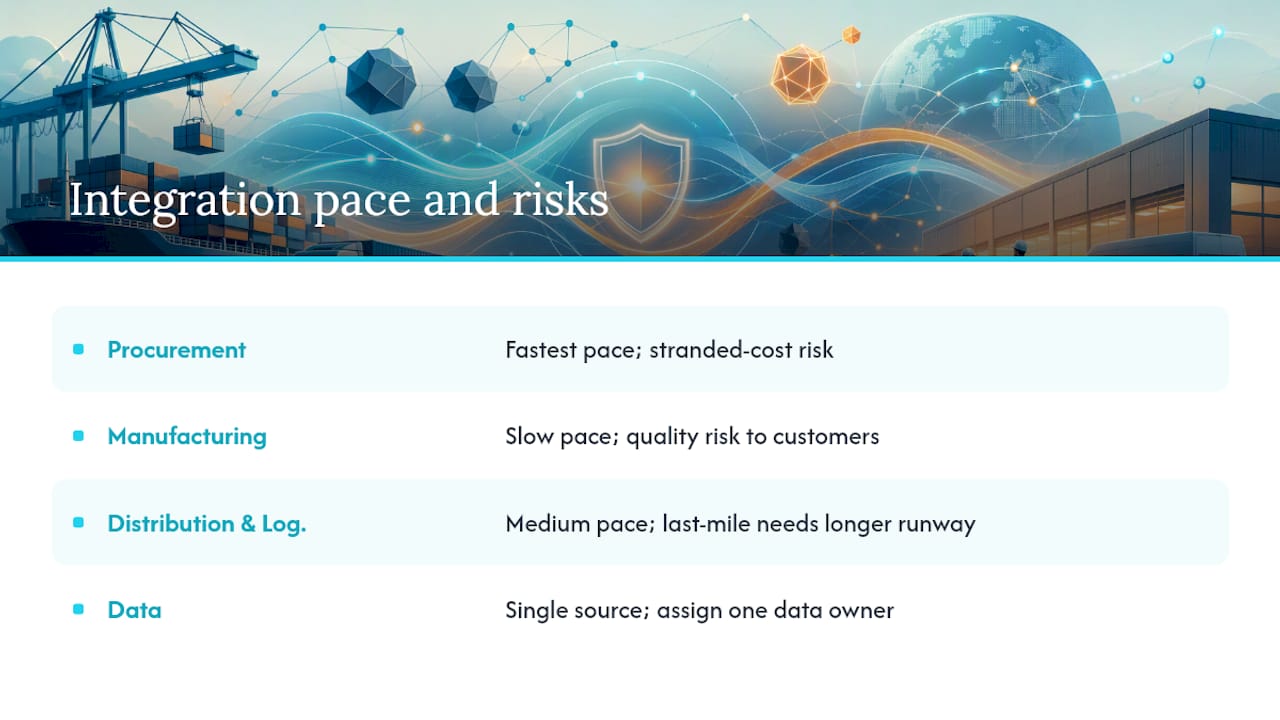
Procurement, manufacturing, distribution, and logistics rarely integrate at the same pace, and treating them as one undifferentiated workstream is a common planning mistake. Each function has a different tolerance for disruption.
Procurement integration usually moves fastest because contract consolidation delivers visible savings early, but it also carries the highest risk of stranded costs if evergreen contracts or assignment clauses get missed during the rush. Manufacturing integration, where it applies, tends to move slower because production line changes carry direct customer-facing risk if a quality issue slips through during transition.
Distribution and logistics sit in the middle. Warehouse consolidation can happen relatively fast if inventory systems are compatible, but the linehaul and last-mile network usually needs a longer runway because customer service commitments are tied directly to specific lanes and delivery windows that took years to optimize.
The connective thread across all four functions is data consistency. If procurement’s supplier master data doesn’t match what manufacturing or distribution systems expect, every downstream integration decision inherits that error. Build a single source of truth for supplier, product, and location data before attempting cross-functional process alignment, and assign one data owner across all four functions rather than letting each workstream maintain its own version. Cross-functional handoffs, especially between procurement’s contract terms and logistics’ carrier assignments, need explicit documentation so nothing falls into a gap between two workstream charters.
Post-Integration Review and Continuous Improvement
Integration doesn’t end when the IMO disbands. The most common failure after a successful Day One is assuming the job is done once systems are stable and the org chart settles, then letting the improvement discipline lapse entirely.
Schedule a formal post-integration review at the 12 month mark, comparing actual synergy realization against the original baseline targets set during diligence. This review should answer three questions directly: which synergies hit their timeline, which slipped and why, and which targets turned out to be unrealistic from the start. Being honest about the third category matters as much as celebrating the first two, because it sharpens how the next acquisition gets modeled.
Build a lessons-learned repository that captures what actually happened during the integration, not just what the plan said should happen. Specific gaps, like a systems cutover that took three weeks longer than scheduled or a supplier renegotiation that stalled on an assignment clause nobody flagged early, become institutional knowledge for the next deal instead of getting rediscovered the hard way.
Hand the MOS dashboard to standing operations leadership as a permanent fixture, not a temporary integration artifact. The KPIs that mattered during transition (on-time delivery, retention, synergy realization) usually remain the right KPIs for ongoing operational health, just reviewed less frequently once the business stabilizes into its new normal.
Legal and Compliance Considerations Unique to Logistics Acquisitions
Logistics acquisitions carry a specific compliance burden that generic M&A checklists tend to underweight. Operating authority, safety ratings, and carrier registrations don’t transfer automatically just because a purchase agreement closes, and gaps here can idle a fleet even when every other part of the deal goes smoothly.
Confirm early in diligence whether operating authority and any required licenses transfer directly to the buyer or require a new application process, because the timeline difference between those two paths can run into months. Regulatory compliance items identified during logistics due diligence, including fleet safety ratings and licensing status, need a dedicated compliance owner inside the IMO structure, not a shared responsibility that falls between workstreams.
Contract assignment clauses deserve particular scrutiny in logistics deals because carrier agreements, customer contracts, and facility leases often contain change-of-control provisions that trigger renegotiation rights or termination options the moment ownership changes. A contract that looked stable during diligence can become a liability the day the deal closes if nobody flagged the assignment language early.
Union agreements and works council obligations, where they apply, carry their own consultation timelines that need to be built into the integration schedule from day one, not treated as an HR afterthought once operational planning is underway. Environmental compliance for any facilities handling regulated materials, and driver qualification files for any acquired fleet, round out the areas where a generic integration checklist misses logistics-specific exposure. Route every one of these through a named compliance owner with a hard deadline, not a general “legal will handle it” assumption.
Cross-Functional Coordination Between Logistics and Other Operations
Logistics integration doesn’t happen in isolation, and the handoffs between logistics and adjacent functions are where most sequencing errors actually occur. A dependency map between workstreams only works if there’s also a live coordination mechanism, not just a document that gets updated once a month.
Weekly cross-functional syncs between the logistics, IT, and finance workstream leads catch the issues that a monthly steering committee review would miss until it’s too late to adjust cheaply. If IT plans to migrate the TMS the same week finance is closing the books on the first post-close month, that collision needs to surface in a Tuesday meeting, not in a Friday postmortem.
A shared dependency tracker, visible to every workstream lead rather than siloed inside each team’s own project plan, keeps procurement’s contract timelines, logistics’ cutover schedule, and finance’s synergy reporting calendar visible to everyone who needs to plan around them. When a workstream lead can see that procurement’s carrier renegotiation deadline sits two weeks before the planned TMS cutover, they can flag the sequencing risk before it becomes an operational fire.
Assign a single cross-functional coordination role, distinct from any individual workstream lead, whose only job is watching for collisions between workstreams and escalating them to the IMO before they cause a service disruption. This role doesn’t own delivery for any function; it owns the seams between them, which is exactly where logistics acquisitions tend to lose value that no individual workstream charter was ever going to catch on its own.
Detailed Risk Assessment for Logistics Integration
A generic M&A risk register misses the failure modes specific to logistics, so build a dedicated risk assessment that scores likelihood and operational impact separately for each item, rather than a single blended risk score that hides which risks threaten service versus which threaten cost.
Score these categories explicitly: fleet and asset condition risk (deferred maintenance surfacing post-close), technology integration risk (systems that only work under current, not combined, transaction volume), contract risk (assignment clauses and evergreen terms that surface after signing), talent risk (concentrated knowledge in a small number of people), and regulatory risk (licensing and compliance gaps specific to the acquired operating authority).
For each risk, assign a named owner, a monitoring frequency, and a trigger point that forces escalation rather than letting a yellow flag quietly turn red over several weeks. A fleet maintenance risk with a trigger of “breakdown rate exceeds baseline by 15%” gives the operations liaison something concrete to watch, instead of a vague instruction to “monitor fleet health.”
Revisit the risk register at every MOS review cycle, not just at kickoff. Risks specific to logistics integration shift fast: a technology risk that looked contained during diligence can escalate the moment combined transaction volume hits a system that was only ever tested at pre-acquisition scale. Building that review discipline into the standing MOS cadence, rather than treating risk assessment as a one-time diligence exercise, is what keeps the mitigation plan current instead of stale by month three.
What Actually Breaks Logistics Integrations
The plans that fail rarely fail on the big, visible decisions. They fail on a manual workaround nobody flagged, a TSA that quietly became permanent, or a customer relationship that lived entirely in one dispatcher’s head.
One recurring pattern: a systems cutover gets scheduled around IT’s calendar instead of peak volume periods, and the “minor” reconciliation issues that showed up in testing turn into a multi-day service disruption the first time real freight volume hits the new platform. The fix isn’t more testing time; it’s testing under conditions that actually resemble combined post-close volume, not the pre-acquisition baseline either company used in isolation.
Another: a TSA gets signed with vague exit language because everyone’s focused on getting to close, and eighteen months later the acquired business still depends on the seller’s payroll system because nobody set a hard deadline. Every TSA needs an exit date treated as seriously as the close date itself.
A few lessons worth applying immediately:
- Test system cutovers against combined volume, not either company’s historical baseline.
- Put a hard exit date on every TSA before signing it, not after.
- Document the informal relationships and workarounds that keep operations running before you touch them.
How RJR Worldwide Supports Logistics Acquisition Integrations
RJR Worldwide operates directly from its own California terminals, running dedicated linehaul lanes and long-term chemical supply contracts, which means the integration challenges in this guide aren’t theoretical for us. We’ve built our own operations around the same principles: protect continuity first, standardize only what needs to scale, and never let a TSA drift past its exit date.
If you’re integrating a FedEx Linehaul acquisition or a chemical-sourcing operation, our capabilities map directly to the workstreams covered above:
- Day One operational continuity for acquired linehaul lanes and terminal access.
- Support for TMS and dispatch consolidation without disrupting active freight.
- Structured transition service agreements with clear exit criteria, not open-ended dependency.
- Procurement consolidation for chemical sourcing, backed by index-linked, multi-year supplier agreements across China and India with full US and EU compliance documentation.
If you’re evaluating a FedEx Linehaul acquisition or need a partner who can step in and operate a business through transition rather than just advise on paper, reach out through RJR Worldwide’s chemical sourcing division or our main site to talk through your specific timeline and get a concrete next step scoped for your deal.
Sources
- Logistics Due Diligence for M&A | ClearlyAcquired
- M&A Technical Due Diligence in Logistics & Supply Chain | Zartis
- Managing Logistics Tech Chaos After an Acquisition | Nuvizz