Compliance First: 2 to 4 Hour Chemical Batch Traceability for QA

Batch traceability for chemicals links supplier lot IDs to production batch records so you can run instant forward and backward queries the moment a quality problem surfaces. A compliant program delivers three things: bidirectional queries in hours instead of days, certificate of analysis (COA) and safety data sheet (SDS) linkage that survives an audit, and a recall simulation you’ve actually rehearsed. The NIST supply-chain traceability meta-framework and ISCC PLUS chain-of-custody rules are the two reference points worth building against.
TL;DR:
- Effective batch traceability requires linking supplier lot IDs to production batches through four key checkpoints: receipt, production, packaging, and dispatch.
- Building a flexible data model that connects existing supplier records with minimal reformatting improves participation and bidirectional query reliability.
- Using RFID or tamper-evident seals on drums and totes enhances tracking security, especially across multiple custody transfers, while QR codes suffice for cartons.
- Rapid recall response demands software with instant query capabilities, full lot genealogy, and a recall workbench, not just dashboards or basic lot tracking.
- Maintaining complete, linked documentation including COA, SDS, and sustainability declarations is essential for regulatory compliance and audit readiness.
Table of Contents
- What Are the Core Components of Chemical Batch Traceability?
- How Do You Build a Data Model That Connects Records Without Reformatting Suppliers?
- Should You Use QR Codes, RFID, or Tamper Seals for Chemical Containers?
- Which ERP Features Actually Speed Up a Recall?
- How Do You Run a Mock Recall Drill?
- What Does ISCC PLUS Chain-of-Custody Mean for Your Documentation?
- What Regulatory Requirements Govern Chemical Batch Traceability?
- How Do You Keep Batch Traceability Data Accurate?
- How Does Traceability Connect to Quality Control and Testing?
- How Should You Handle Exceptions and Data Discrepancies?
- How Do You Secure Batch Traceability Data?
- What Do Real Traceability Implementations Look Like?
- RJR Worldwide’s Operational Perspective: What Buyers Should Require From Sourcing Partners
- How RJR Worldwide Supports Recall-Ready Sourcing
- Sources
- FAQ
What Are the Core Components of Chemical Batch Traceability?
Most traceability failures trace back to a gap between two records that never should have been separate: the lot that came in the door and the batch that went out. NIST’s meta-framework treats lot tracking and batch tracking as distinct functions that must be deliberately linked, not assumed to connect on their own. Get that link wrong, and a backward query during a recall stalls at the loading dock.
A working program captures data at four checkpoints:
- Receiving: lot creation, supplier lot ID, COA, expiration date, and a pointer to the certificate itself, not just a filename.
- Production: the batch record, the formulation version used, every raw-material lot consumed, and in-process QC results.
- Packaging, splitting, and merging: parent and child container relationships, plus tamper-evidence data for anything repackaged into smaller units.
- Dispatch: shipment records that tie the batch to a specific customer and invoice, with SDS distribution logged at the same time.
The COA and SDS have to travel with the digital record, not sit in a separate shared drive somebody has to hunt down. Auditors and cross-border customs officers both expect to pull a batch number and get documentation attached, not a promise that it exists somewhere. When food-grade or pharmaceutical-grade material crosses a border, a missing document pointer can hold a shipment at customs longer than a missing test result ever would.
How Do You Build a Data Model That Connects Records Without Reformatting Suppliers?
The mistake most manufacturers make is trying to force every supplier onto one system. It doesn’t work, and it slows qualification down for no real gain. NIST’s meta-framework argues for the opposite approach: link existing event records, whatever format they arrive in, rather than mandate a single structure. A pragmatic framework that connects supplier records as they are, instead of demanding reformatting, tends to get higher supplier participation than a rigid template ever does.
To make bidirectional queries actually work, your data model needs a minimum set of connected elements:
- Lot ID and batch ID as the two anchor identifiers, each with a timestamp.
- A COA pointer attached at the point of receipt, not added later.
- Event source tagging, so you know whether a record came from a supplier, an internal scan, or a carrier.
- Quantity and parent/child relationships, so splits and merges don’t break the chain.
Trusted-supplier status is worth building into procurement. Suppliers who consistently provide linked COAs and clean event pointers earn faster onboarding and lighter incoming inspection. NIST’s guidance notes that trusted-supplier status can be earned through linked historical data that proves provenance without exposing proprietary formulas or equipment logs, which matters because most suppliers won’t hand over process secrets just to satisfy a traceability audit.
Pro Tip: Ask new suppliers for three months of linked COA history before you finalize a contract. If they can’t produce it cleanly, that’s a preview of how painful a real recall trace will be.
Should You Use QR Codes, RFID, or Tamper Seals for Chemical Containers?
The physical identifier you choose has to match the risk and handling profile of the container, not just the budget line. QR codes and barcodes work fine for cartons, drums in low-risk settings, and anything scanned in a controlled warehouse. RFID and tamper-evident seals earn their higher cost on drums and totes moving through multiple handoffs, where a barcode could be peeled off, copied, or simply not scanned at a busy dock.
- Use QR or barcode labeling for visible, low-cost tracking on packaged goods and cartons.
- Use RFID or tamper-evident seals on drums and totes that pass through several custody transfers before reaching production.
- Tag at the container level for solids and packaged goods; for bulk liquids, tag the transfer event and the storage tank instead, since per-unit tagging isn’t physically practical.
- Build a receiving workflow that scans the identifier, verifies the COA link resolves, and inspects the seal or RFID signature before the lot is accepted into inventory.
Discrepancies at receiving deserve a documented action path, not an informal phone call to the supplier. A warehouse traceability approach that ties serial identifiers directly to inventory records cuts down on exactly the kind of silent data gaps that only surface once you’re mid-recall and can’t find which pallet actually holds the affected lot.
Which ERP Features Actually Speed Up a Recall?
Software choice determines whether a recall takes hours or days. The features that matter aren’t flashy dashboards. They’re the boring plumbing that lets a query resolve instantly instead of requiring someone to cross-reference three spreadsheets.
- Formulation-linked batch production with full lot-to-batch genealogy, so every consumed raw material traces to its finished batch automatically.
- FEFO enforcement (first-expired, first-out) rather than plain FIFO, since chemical shelf life often matters more than receipt order.
- COA and SDS attachments stored against the batch record itself, plus clean handling of splits, merges, and rework batches.
- Electronic batch records paired with a forward and backward recall workbench, the single feature that turns a multi-day trace into a same-shift task.
Set operational KPIs before you need them: a mock recall time target of a few hours, a documentation completeness rate you track monthly, and a time-to-isolate-inventory metric for affected stock. Industry ERP guidance for chemical manufacturers and BatchMaster’s chemical-industry feature set both point to the same conclusion: bidirectional lot traceability and a built-in recall workbench are baseline requirements, not premium add-ons. Sort vendor options into entry-level field apps, full enterprise ERP, and custom integrators, and match the category to your actual production complexity rather than your budget alone.
How Do You Run a Mock Recall Drill?
A traceability system nobody has stress-tested is a traceability system you don’t actually have. Run the drill before a real incident forces you to.
- Pick scope and stakeholders ahead of time. Confirm COAs and batch records are pulled and accessible before the clock starts.
- Select a test lot and run a backward trace to identify every batch that consumed it.
- Run a forward trace from those batches to generate the full customer list who received affected material.
- Confirm on-hand inventory and isolate any remaining affected stock in the warehouse.
- Score the drill against your KPIs: time-to-list against a 2 to 4 hour target, percentage of affected items correctly identified, and every data gap surfaced along the way.
NIST’s forward and backward traceability guidance frames this exactly as the goal: backward queries find the raw lots in a batch, forward queries find the customers who received it. Most gaps show up at split/merge points or in supplier records that never got a COA pointer attached.
Pro Tip: Run your first mock recall on a lot you know is clean. You want to test the process, not discover a real problem while your team is still learning the drill.
What Does ISCC PLUS Chain-of-Custody Mean for Your Documentation?
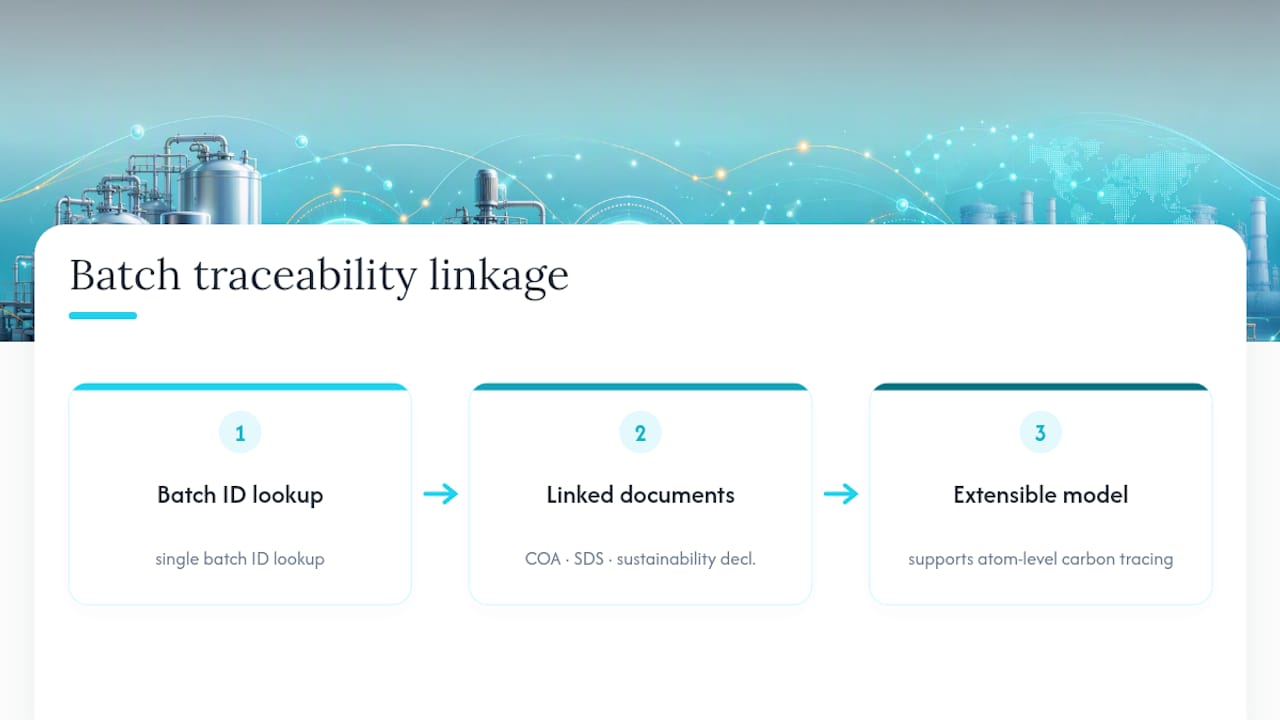
ISCC PLUS requires a sustainability declaration and chain-of-custody record attached to each delivery, meaning each batch, so that certified sustainability characteristics carry forward through every hand that touches the material. The certification specifically requires documentation tied to each delivery to maintain forward and backward traceability of certified material, which puts it in the same operational lane as your COA and SDS linkage.
Practically, that means your batch record needs three linked documents, not one: the COA proving identity and purity, the SDS covering handling and hazard information, and a sustainability declaration where certified material is involved. All three should resolve from the same batch ID lookup. If a customer or auditor pulls a batch number and only gets the COA, the chain is incomplete even if the material itself is fully compliant.
This linkage matters even more as sustainability reporting expands beyond simple certification. Newer work on atom-level carbon tracing shows how a traceability data model can be extended to support biogenic carbon-content reporting and other elemental-attribute tracing, layering additional attributes onto the same lot-to-batch backbone you’ve already built for compliance. Design your data model with room for that extra layer now, because retrofitting a traceability system to carry a new attribute type later is far more painful than building the extensibility in from the start.
What Regulatory Requirements Govern Chemical Batch Traceability?
FDA regulations for pharmaceutical-grade and food-grade chemical inputs require documented batch production records, lot traceability back to raw materials, and the ability to execute a recall within a defined timeframe once a hazard is identified. REACH, governing chemical substances sold into the EU, requires supply-chain communication of safety information, including SDS data, at each point of transfer, plus substance identification that ties back to registration data.
Neither framework tells you exactly how to build your database. Both assume you can produce a clean answer fast when asked: what’s in this batch, where did it go, and who has it now. That’s the bidirectional query capability this entire article is built around, and it’s why lot tracking alone consistently fails under regulatory pressure. Trade commentary on this exact gap notes that lot tracking by itself doesn’t handle recall simulation or the customer and country context a real recall demands, which is a fair description of what happens when companies confuse having lot numbers with having traceability.
For companies sourcing across US and EU markets simultaneously, the practical move is designing one data model that satisfies the stricter of the two requirements everywhere, rather than maintaining separate compliance logic per region. It’s more work upfront and considerably less work every time a customer in a different jurisdiction asks a documentation question.
How Do You Keep Batch Traceability Data Accurate?
Data accuracy in batch traceability comes down to capturing information at the point of the event, not reconstructing it afterward. A receiving clerk who scans a lot and enters the COA link immediately produces cleaner data than one who logs the details from memory at the end of a shift.
Three practices consistently separate accurate systems from unreliable ones. First, validate at entry: reject a receiving transaction that lacks a resolvable COA pointer rather than accepting it and flagging the gap for later cleanup. Second, single-source your identifiers: a lot of number should mean exactly one thing across your ERP, your warehouse management system, and your supplier portal, never three slightly different formats that require manual reconciliation. Third, audit sample batches quarterly, pulling a handful of finished batches and manually verifying every linked record resolves correctly, the same way you’d audit financial records.
Discrepancies between physical counts and system records are the clearest early warning sign of a traceability integrity problem. If your cycle counts consistently show variance on high-volume SKUs, that’s usually a sign the split/merge logic in your ERP isn’t capturing container transfers correctly, not a physical inventory problem. Fix the data model before you fix the count.
How Does Traceability Connect to Quality Control and Testing?
Batch traceability and quality control should run on the same record, not two records that happen to reference each other. When in-process QC data, lab test results, and the batch record live in separate systems, someone has to manually match them during an audit or investigation, and that’s exactly where errors creep in.
The stronger design attaches QC results directly to the batch record at the moment testing completes, so the finished COA generates from data already tied to that batch ID rather than being assembled separately afterward. This also solves a common audit problem: when a regulator or customer asks for the test data behind a specific COA, you want that answer to be a lookup, not a research project involving your quality lab’s archive.
Out-of-specification results need the same linkage. If a batch fails testing, that failure record should attach to the same batch ID and automatically flag every downstream record, including any packaging or shipment records already created from that batch, before those get released. Systems that separate QC from traceability tend to catch this too late, sometimes after material has already shipped.
How Should You Handle Exceptions and Data Discrepancies?
Every traceability system generates exceptions eventually: a mislabeled drum, a supplier COA that doesn’t match the received quantity, a scan that fails at receiving. What separates a resilient program from a fragile one is having a defined path for these cases instead of an ad hoc workaround.
Set a clear rule: any transaction with an unresolved discrepancy gets held, not force-completed. Force-completing a receiving transaction with a missing COA pointer, just to keep production moving, is exactly how gaps end up buried until a recall exposes them. Document every override decision, including who approved it and why, because that log becomes critical evidence if an auditor later questions why a batch shipped without complete documentation.
Build a discrepancy category system rather than treating every exception the same way. A quantity mismatch, a document mismatch, and a physical inspection failure each need different resolution owners and different acceptable resolution times. Track how often each category occurs. A rising trend in COA mismatches from one supplier is an early signal worth escalating in a supplier review, well before it becomes a compliance incident.
How Do You Secure Batch Traceability Data?
Traceability records carry commercially sensitive information: supplier pricing context, formulation details, and customer distribution patterns. That makes access control as much a compliance issue as a competitive one.
Restrict formulation data to production and QA roles, while giving customer-facing and logistics teams access to shipment and lot data without exposing recipe details. This separation matters most when suppliers request visibility into their own material’s downstream use. NIST’s meta-framework specifically addresses this tension, noting that trusted-supplier relationships can be built on linked historical data without requiring suppliers to expose proprietary formulas or equipment logs in either direction.
Audit trails need to be immutable. Once a batch record, COA link, or QC result is finalized, changes should create a new version with a timestamp, not overwrite the original. Regulators reviewing a recall investigation will ask for the record as it existed at the time of shipment, and a system that allows silent edits can’t produce that with confidence.
Data retention policy deserves attention too. Chemical batch records often need to survive well beyond typical IT retention schedules, particularly for pharmaceutical-grade material with extended shelf life or delayed-use applications. Set retention rules by grade and end-use, not a single blanket policy across your entire catalog.
What Do Real Traceability Implementations Look Like?
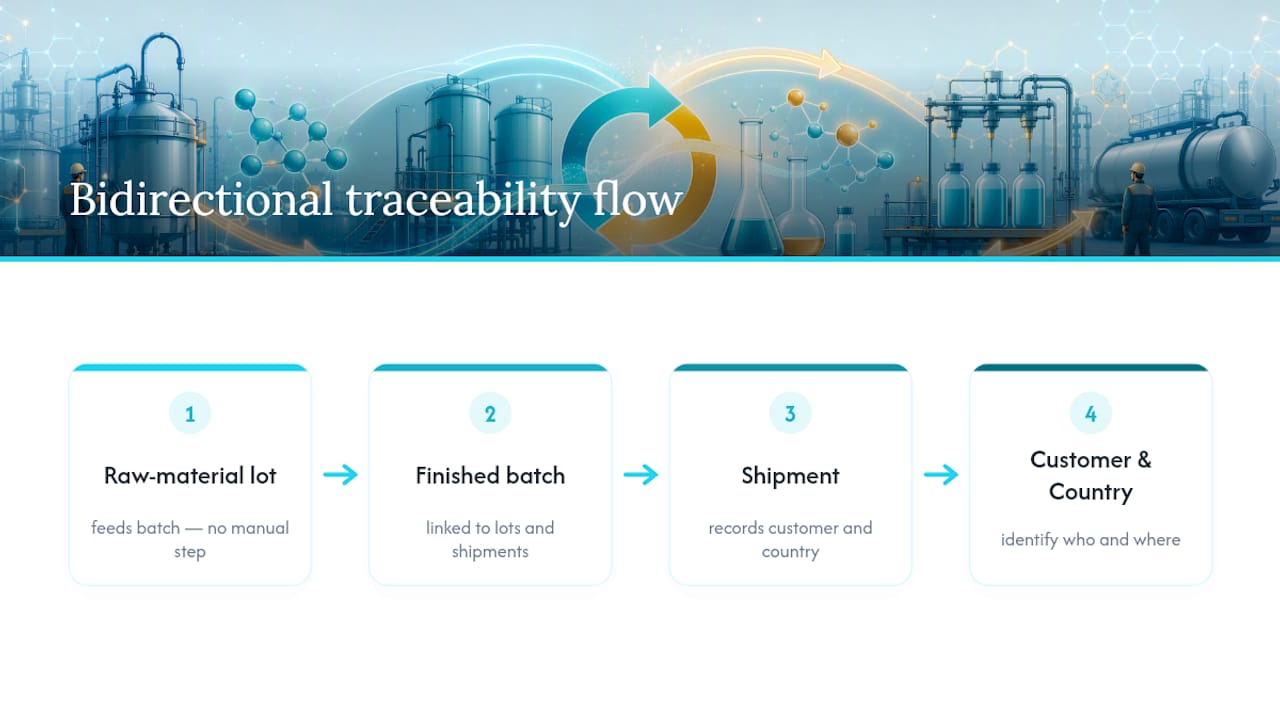
The clearest illustration of why bidirectional traceability matters shows up not in a specific company’s numbers, but in the pattern industry commentary keeps flagging: companies that treat lot tracking as sufficient consistently discover gaps only when a recall forces the question. Trade analysis on chemical traceability gaps points to a recurring failure mode: a company can identify what lot went into a batch, but can’t quickly answer which customers received the affected material or in which countries, because forward tracing was never built into the system.
The manufacturers that avoid this trap share a common trait. They treat the recall workbench as a feature they test regularly, not a capability they assume exists because the software vendor listed it. A chemical ERP’s recall and batch traceability features only deliver value if procurement, QA, and IT jointly validate the forward and backward query actually works against real production data, not just demo data during the sales process.
The lesson scales down to smaller manufacturers too. A mid-size specialty chemical producer doesn’t need enterprise-grade software to get this right. It needs a data model that connects lot to batch to shipment without a manual step in between, and a documented mock recall drill run at least annually to confirm the connection still holds as suppliers, formulations, and customers change.
RJR Worldwide’s Operational Perspective: What Buyers Should Require From Sourcing Partners
Most traceability advice treats sourcing and logistics as someone else’s problem. It isn’t. A sourcing and logistics partner that operates directly from its own terminals and manages dedicated lanes, rather than handing freight off to a broker network, can maintain the physical custody chain and the documentation chain under one roof instead of splitting across multiple parties who each hold a piece of the record.
Some sourcing partners maintain long-term, multi-year agreements for food, technical, and pharmaceutical-grade chemicals with vetted suppliers in China and India, built around compliance with US and EU standards. That structure matters for traceability specifically: a supplier relationship measured in years produces cleaner COA history and more consistent lot documentation than a spot-market purchase ever will. Transparent, index-linked pricing and complete documentation help remove the unpredictability that makes traceability audits painful in the first place.
If you’re qualifying a sourcing partner, ask for three things before you sign: a sample COA paired with its batch linkage report, a copy of terminal-handling standard operating procedures, and confirmation of the documentation format your audit team requires. A partner who can’t produce a clean sample of all three in advance will struggle to produce them on demand during a real recall.
— RJR Worldwide
How RJR Worldwide Supports Recall-Ready Sourcing
Most manufacturers solve traceability with better software and then discover their real exposure sits upstream, in the sourcing relationship itself. RJR Worldwide Corp. is the alternative to piecing together documentation from multiple spot-market brokers: one long-term supply relationship, complete COA and documentation package, and freight handled through RJR’s own California terminals instead of a chain of subcontractors who each add a gap to your record.
RJR resells Sodium Metabisulfite, Xanthan Gum, Bio Glass, and Calcium Hypochlorite sourced from vetted suppliers in China and India, backed by index-linked pricing and full documentation built for US and EU compliance requirements. If you’re building or auditing a traceability program, put mock-recall assistance directly into your sourcing scope of work, and confirm how terminal handling and carrier documentation feed into your batch linkage records before you commit volume.
Visit the chemical sourcing division to review product categories and documentation practices, or reach out for a traceability discovery call to walk through what a sample COA and batch linkage report actually look like before you qualify a new supply relationship.
Sources
- Supply Chain Traceability Principles: A Manufacturing Meta-Framework
- ISCC PLUS Traceability v1.1
- CarAT: Carbon atom tracing framework for BCC
FAQ
What Is the Difference Between Lot Tracking and Batch Tracking?
Lot tracking identifies groups of incoming raw material from a supplier, while batch tracking identifies a specific production run. Effective traceability, per NIST’s meta-framework, requires linking the two so you can query in either direction during a recall.
How Long Should a Mock Recall Drill Take?
A well-designed traceability system should support a mock recall time-to-list of roughly 2 to 4 hours, based on the forward and backward query targets in NIST’s traceability guidance. If your drill takes longer, the gap usually sits at a split, merge, or unlinked supplier record.
What Documents Need to Link to Every Batch Record?
Every batch record should link a COA, an SDS, and, where certified material is involved, an ISCC PLUS sustainability declaration and chain-of-custody record. ISCC PLUS requires this documentation attached to each delivery to preserve forward and backward traceability of certified characteristics.
Do I Need RFID Tags on Every Container?
No. QR codes and barcodes handle most packaged goods and cartons adequately. Reserve RFID and tamper-evident seals for drums and totes that pass through multiple custody transfers, where the higher security justifies the added cost.
What Should I Ask a Chemical Supplier About Traceability Before Signing a Contract?
Request a sample COA linked to its batch record, proof of consistent lot documentation over time, and confirmation of the documentation format your compliance team needs for audits. RJR Worldwide Corp. structures its multi-year supply agreements around exactly this kind of documentation, sourced from vetted suppliers across its chemical sourcing division.