USP Grade Compliance: An Audit-Ready Checklist for QA Teams

USP grade compliance means a raw material or finished product meets the identity, assay, impurity limits, labeling, and method requirements set out in its applicable USP–NF monograph, plus any relevant General Chapters and General Notices. That standard applies for the life of the article, from the day it’s manufactured to the day it expires, not just at the moment of shipment.
If you’re staring down an incoming lot of an excipient or API right now, here’s what to do before you sign off on it. First, pull the exact monograph the material is supposed to meet, not a similar one, not last year’s version. Second, confirm the Certificate of Analysis references the monograph tests by name and method, not a generic in-house spec. Third, check that the reported results include impurity limits, not just identity and assay. Fourth, retain a sample large enough for independent retesting if something looks off later. Fifth, flag any high-risk material, propylene glycol, glycerin, and similar hygroscopic excipients among them, for third-party verification rather than trusting the paperwork alone.
That’s the floor. The rest of this guide covers what sits underneath each of those steps, and why skipping any one of them is how contaminated glycerin ends up in cough syrup.
48-hour action list for an incoming lot:
- Look up the current USP–NF monograph number and revision date for the material.
- Compare CoA test parameters line by line against the monograph’s identity, assay, and impurity requirements.
- Verify the CoA cites a method (USP chapter reference or validated equivalent), not just a pass/fail result.
- Request the supplier’s batch record and any change notifications tied to this lot.
- Decide, based on risk category, whether this lot needs independent lab confirmation before release.
Key Takeaways
USP grade compliance depends on matching every lot against its current monograph, requiring documented methods rather than pass/fail claims, and verifying high-risk materials independently instead of trusting a CoA alone.
| Point | Details |
|---|---|
| Match the current monograph | Confirm the USP–NF edition and pull every identity, assay, and impurity test it specifies. |
| Demand method-level CoAs | Reject certificates that state “conforms” without numeric results and a cited test method. |
| Independently verify high-risk lots | Send hygroscopic excipients and materials with a contamination history for third-party testing. |
| Build change notification into contracts | Require advance notice of manufacturing changes under USP <1195>, not after-the-fact disclosure. |
| Source through documented, dual-region agreements | RJR Worldwide’s multi-year contracts and dedicated linehaul lanes keep documentation and traceability intact from origin to receiving dock. |
Table of Contents
- What “USP Grade” Actually Means
- How to Prove Compliance With Testing, CoAs, and Records
- How USP Standards Tie Into FDA Enforcement
- USP vs. FCC vs. Food Grade: Which Standard Applies
- Building a Compliance Program That Holds Up to Audit
- Red Flags That Signal a Compliance Failure
- USP Programs and Resources Worth Using
- Supply-Chain Practices That Lower Compliance Risk
- Why Compliance Is a Program, Not a Checkbox
- How RJR Worldwide Supports USP-Grade Sourcing
- Frequently Asked Questions
- Sources
What “USP Grade” Actually Means
A USP–NF monograph is not a marketing label. It’s a legal specification document with five working parts: an identity test, an assay range, impurity and limit tests, required analytical methods, and packaging and labeling requirements. A material either passes every applicable test in that monograph or it isn’t USP grade, regardless of what the drum label says.
General Notices govern how the whole system works, and General Chapters fill in procedural detail the individual monographs assume you already know. Chapter <1> covers injections and implanted drug products. Chapter <1197> addresses good distribution practices for bulk pharmaceutical excipients. Chapter <1074> deals with excipient biological safety evaluation. Chapter <800> governs handling of hazardous drugs, relevant if your facility processes cytotoxic APIs. Chapter <1078> lays out good manufacturing practices specifically for excipients, covering everything from supplier qualification to change control, which is why it comes up constantly in general chapter guidance for excipients.
USP Reference Standards are the other piece most QA teams underuse. These are highly characterized, authenticated materials the USP itself sells specifically so labs can calibrate instruments and confirm identity against something more rigorous than an internal retained sample. If your lab is running an HPLC assay against a monograph method, the reference standard is what makes that result defensible in an audit rather than just plausible.
Quick clarification: USP writes the standards. USP does not inspect your facility, audit your suppliers, or issue citations. That’s the FDA’s job, and the two roles get confused constantly by people newer to compendial work.
- A monograph identity test confirms the substance is what the label claims, usually via spectroscopy or chromatography.
- An assay range specifies acceptable potency, often expressed as a percentage of labeled content.
- Impurity limits cap specific known contaminants, and increasingly name unknown impurities requiring general screening methods.
- Packaging and labeling sections dictate container material and required label statements, which matter more than most manufacturers assume during inspection.
How to Prove Compliance With Testing, CoAs, and Records
Lot release isn’t a single check. It’s a sequence, and skipping steps out of order is how bad material slips through with a clean-looking paper trail.
- Pull the current monograph. Confirm you’re checking against the active USP–NF edition, not an archived version. Monographs get revised, and a supplier citing an outdated spec is a red flag on its own.
- Map required tests to the CoA. Every identity, assay, and impurity test named in the monograph should appear on the certificate with a specific numeric result, not a bare “conforms” statement.
- Confirm the method used. The CoA should state whether testing followed the monograph’s specified method or a validated alternative. If it’s an alternative, your quality system needs documented proof of method equivalence on file, not just a supplier’s word.
- Review the batch record. Cross-check manufacturing dates, lot numbers, and any deviation reports against what the CoA claims.
- Pull and label a retention sample. You need enough material held under proper conditions to support independent retesting months later if a downstream problem surfaces.
On method equivalence: USP monographs specify methods for a reason, reproducibility across labs. A supplier using a faster in-house method isn’t automatically wrong, but you need a validation study on file showing that method produces results statistically consistent with the compendial one. Without that paperwork, an FDA investigator has every reason to disregard the result entirely.
Here’s something that trips up a lot of newer QA hires: USP doesn’t set testing frequency. The General Notices state that compendial standards apply continuously, from manufacture through expiration, but how often you actually test a given material is left to your own quality system and GMP program. That means your internal risk assessment, not a USP chapter, decides whether you test every lot or run a reduced sampling plan on a well-established supplier relationship.
Pro Tip: A clean CoA tells you what the supplier chose to test, not necessarily what the monograph requires. Excipients that make up the bulk of a drug’s volume deserve routine third-party confirmation against the full impurity panel, because supplier CoAs often reflect a narrower test slate than the monograph specifies, and that gap is exactly where contamination incidents have historically hidden.
Picture the flow in practice: material arrives, QA pulls the monograph and compares it against the CoA, any gap triggers a hold, retained samples move to either internal or third-party testing, and only a full match against monograph limits clears the lot for use. Build that sequence into your LIMS workflow once and it stops being a judgment call every time.

How USP Standards Tie Into FDA Enforcement
USP standards carry legal weight because Congress built them into food and drug law going back over a century, and that relationship hasn’t loosened with time. Under current statute, if a drug is recognized in the USP–NF and doesn’t conform to the applicable compendial standard, it can be deemed adulterated or misbranded, regardless of what the label promises. That’s not a guideline. It’s the legal test FDA investigators apply during an inspection.
For drugs and biologics, “recognized in USP–NF” isn’t optional once a monograph exists for your product. For dietary supplements, the picture is more conditional: manufacturers can voluntarily meet USP standards, and many do to signal quality, but the compliance obligation runs primarily through Dietary Supplement GMP regulations rather than mandatory compendial conformance. Know which category your product falls into before you assume USP compliance is legally required versus strongly advisable.
Investigators lean on specific Code of Federal Regulations citations during inspections, and having those on hand speeds up every conversation. A CFR search for the section relevant to your material category gives you exact regulatory language rather than a paraphrase, which matters when you’re drafting a response to a Form 483 observation. Recent FDA commentary on quality and regulatory predictability also confirms the agency is actively collaborating with USP on standards development, not treating compendial monographs as a static reference from decades past.
- Batch records and CoAs tied to compendial materials should be retained per your facility’s GMP recordkeeping schedule, typically well beyond product expiration.
- Labeling claims referencing “USP” or “NF” grade require the material to actually meet the current monograph, not a historical or superseded version.
- Packaging materials themselves sometimes carry compendial requirements, particularly for injectables, so container qualification deserves its own documented review.
USP vs. FCC vs. Food Grade: Which Standard Applies
The decision comes down to intended use, and getting this wrong is more common than most procurement teams admit. If a material goes into a drug product, a biologic, or a medical device, USP is generally the governing compendium. If it goes into food, the Food Chemicals Codex is the relevant standard, and it’s a genuinely different document with different monographs, different impurity thresholds, and different regulatory citations, appearing over 200 times across the U.S. Code of Federal Regulations.
The two compendia sometimes cover the same chemical, sodium metabisulfite or xanthan gum are good examples, since both compounds show up in pharmaceutical and food applications alike. But a food-grade CoA meeting FCC limits doesn’t automatically satisfy a USP monograph’s impurity requirements, and the reverse is true too. A material can pass FCC and fail USP on the same impurity test if the pharmaceutical limit is tighter.
| Standard | Primary Scope | Governing Body | Typical Use Case |
|---|---|---|---|
| USP–NF | Drugs, biologics, excipients, medical devices | United States Pharmacopeia | Pharmaceutical manufacturing, compounding |
| FCC | Food ingredients and additives | USP (publisher), FDA-referenced | Food and beverage production |
| Ph. Eur. (EP) | Pharmaceutical materials for EU markets | European Directorate for Quality of Medicines | Products sold or manufactured for EU distribution |
For products destined for both U.S. and European markets, checking material specs against both USP and Ph. Eur. monographs up front saves a painful retest cycle later, since impurity limits and test methods don’t always align between the two. When in doubt, default to the stricter standard for the material’s actual end use rather than assuming a lower-cost food-grade or technical-grade lot will pass pharmaceutical scrutiny.
- Choose USP when the material enters any drug, biologic, or medical device formulation.
- Choose FCC when the material’s sole application is food or beverage manufacturing.
- Require both USP and Ph. Eur. documentation when the finished product ships to EU markets.
- Never assume a “technical grade” or “industrial grade” designation implies any compendial compliance at all.
Building a Compliance Program That Holds Up to Audit
A single clean lot doesn’t make a compliance program. What holds up under FDA scrutiny is a documented system that catches problems before they reach the production floor.
- Qualify suppliers before the first purchase order. Require monograph-referenced CoAs as a condition of the relationship, not an afterthought requested after a shipment already arrived.
- Put a quality agreement in writing. Specify which tests the supplier runs, which methods they use, and what triggers a notification to you, ideally referencing USP <1078> GMP expectations for excipient manufacturers directly.
- Run incoming inspection on every lot, even from long-standing suppliers, at a frequency your risk assessment actually justifies rather than a frequency chosen out of habit.
- Track retest and expiry dates in a system that flags approaching deadlines automatically, since expired-but-unflagged material is one of the most common findings in FDA warning letters.
- Control labeling changes formally. Any shift in grade designation, country of origin, or specification requires a documented change control review before it touches production.
Contract language worth including with every USP-grade supplier:
- Explicit reference to the current USP–NF monograph edition governing the material.
- A requirement that the supplier notify you of any manufacturing process change per USP <1195> significant change guidance, before shipping the changed material, not after.
- Audit rights allowing your QA team, or a designated third party, to inspect the supplier’s facility and testing records.
- Lot-level traceability documentation linking raw material batches to finished shipment records.
Pro Tip: Trigger an increased audit frequency, not just a routine annual review, whenever a supplier reports a facility relocation, a raw material source change, or a new subcontracted testing lab. Those three events correlate more strongly with compliance failures than almost anything else in a supplier relationship.
Align all of this with your existing GMP quality system rather than building a parallel USP compliance track. The monograph requirements should live inside your standard operating procedures for incoming inspection, not in a separate binder someone pulls out only when an auditor asks.
Red Flags That Signal a Compliance Failure
Most USP grade failures don’t announce themselves. They show up as small inconsistencies that get waved through because the paperwork looks fine at a glance.
- A CoA that reports “conforms to USP” without listing individual test results or numeric values against monograph limits.
- Missing or vague method citations, particularly for impurity testing, where the absence of a stated method is itself a warning sign.
- A supplier who notifies you of a manufacturing change after shipment rather than before, a pattern that often precedes larger quality issues.
- Unexpected impurity peaks on independent testing that don’t match anything on the supplier’s CoA, historically how diethylene glycol and ethylene glycol contamination in glycerin has slipped through supply chains.
- Packaging or label inconsistencies, wrong lot number format, mismatched country of origin, altered drum markings, that suggest relabeling or blending upstream.
When a red flag surfaces, the response sequence matters. Quarantine the lot immediately, before running additional tests, so nothing from that batch reaches production while you investigate. Run targeted triage testing against the specific concern, not a full retest of every parameter, to get an answer quickly. Notify the supplier in writing and request their own investigation record. Open a CAPA if the root cause points to a systemic issue rather than a one-off error. And if the material already reached distribution, evaluate regulatory reporting obligations immediately rather than waiting for a formal root-cause conclusion.
The consequences of skipping this sequence aren’t hypothetical. Diethylene glycol contamination in glycerin supply chains has triggered product recalls and fatalities in multiple documented incidents over the decades, almost always traced back to a CoA that reported “conforms” without the specific impurity test that would have caught the substitution.
USP Programs and Resources Worth Using
A handful of USP resources exist specifically to reduce the manual burden of compendial compliance, and most manufacturers use only a fraction of what’s available.
-
USP Reference Standards: authenticated comparison materials for laboratory assays, purchasable directly through USP’s reference standards catalog, essential for any lab running its own identity or assay confirmation rather than relying purely on supplier data.
-
USP Excipient Ingredient Verification Program: a formal program that validates an ingredient meets applicable compendial requirements, which can reduce redundant supplier audits across multiple buyers sourcing from the same manufacturer.
-
USP–NF online subscription: gives your QA team direct, current monograph access rather than relying on supplier-provided excerpts that may reference outdated editions.
-
Bookmark the USP FAQ on standards as a first-stop reference for General Notices questions your team will hit repeatedly.
-
Use the excipient general chapters index whenever a new excipient enters your supply chain, since chapter applicability shifts depending on the material category.
-
Check the FCC directly if any portion of your product line straddles food and pharmaceutical applications, rather than assuming your USP subscription covers both.
Supply-Chain Practices That Lower Compliance Risk
Compendial testing catches problems at the point of receipt. Good sourcing practice prevents a lot of those problems from ever showing up in a lot to begin with.
Long-term supply agreements with vetted manufacturers, rather than spot-market purchasing, give you the leverage to require monograph-referenced documentation as a contract term rather than a request you have to renegotiate with every shipment. Dual sourcing across manufacturing regions reduces the risk that a single facility’s process change or contamination event takes down your entire supply for a critical excipient. Indexed pricing tied to documented quality specifications, rather than opaque quote-by-quote pricing, gives both sides a reason to keep documentation consistent over the life of a multi-year contract.
On the procurement side, a contract checklist worth building into every new supplier agreement includes explicit monograph references by number and edition, a defined CoA content requirement that lists every test the monograph demands, mandatory advance notification of any significant manufacturing change, audit rights extending to the supplier’s own testing lab, and lot-linked traceability documentation that follows the material from manufacture through delivery.
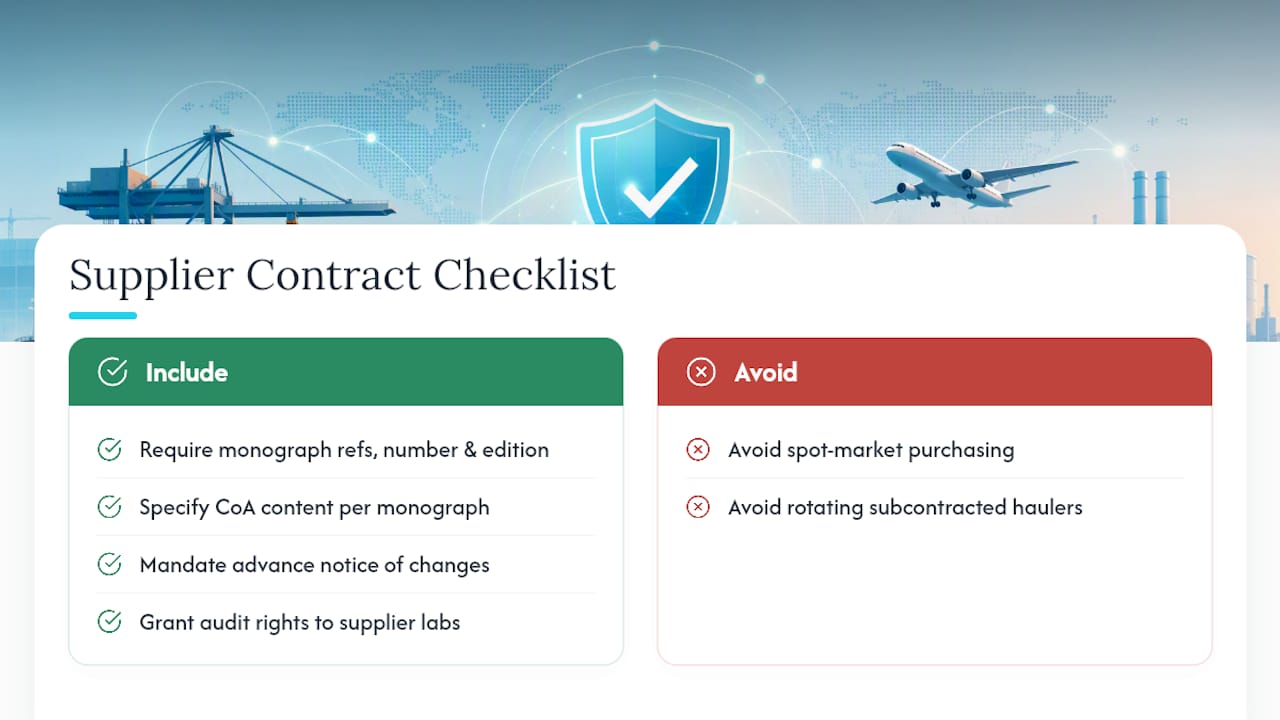
Logistics controls matter more here than most QA teams give them credit for. A shipment that changes hands across multiple freight brokers with inconsistent documentation is a shipment where lot traceability can quietly break down, and a practical traceability framework built for food manufacturing translates directly to pharmaceutical raw material handling. Dedicated freight lanes with a single carrier of record, rather than a rotating set of subcontracted haulers, keep chain-of-custody documentation intact and make it far easier to trace a suspect lot back to its exact transit history if a problem surfaces after delivery.
Pro Tip: When retained samples travel between a supplier’s facility and your lab for independent verification, insist on documented chain of custody for that shipment specifically, not just for the production lot it came from. A sample that sat in an unregulated environment for three days in transit can produce a test result that doesn’t reflect the material your production floor actually received.
Why Compliance Is a Program, Not a Checkbox
Too many manufacturers treat USP grade compliance as something you verify once, at supplier onboarding, and then file away. That approach fails the moment a supplier changes a raw material source, alters a manufacturing process, or gets acquired by a company with different quality controls, none of which show up on a CoA unless someone’s actively watching for it.
The stronger posture is treating every incoming lot as a fresh confirmation rather than a formality against an old approval. That doesn’t mean re-litigating a supplier relationship with every shipment. It means building risk-based sampling into your QMS so the materials most likely to cause harm, hygroscopic excipients, materials with a history of adulteration, anything sourced through a longer or less transparent supply chain, get independent verification more often than a stable API from an established, audited manufacturer.
I’d also push back on the instinct to treat a USP Ingredient Verification Program credential as a substitute for your own judgment. It’s a genuinely useful tool for reducing audit overlap, but it doesn’t replace the value of your own lab confirming identity and impurity limits on the specific lot in front of you. Programs validate a supplier’s general capability. They don’t validate today’s shipment. Audit readiness isn’t a state you reach and then maintain passively, it’s a habit of checking the paperwork against the actual material every single time, because the gap between the two is exactly where the expensive failures happen.
How RJR Worldwide Supports USP-Grade Sourcing
Finding a supplier who can produce clean USP-grade documentation on every lot, not just the first sample batch, is the actual bottleneck for most manufacturers we talk to. RJR Worldwide operates on multi-year, index-linked supply agreements with vetted manufacturers across China and India, built specifically around US and EU compliance documentation rather than spot-market sourcing where paperwork consistency is anyone’s guess.

That structure maps directly onto the compliance checklist covered here. Every contract includes complete documentation aligned to the applicable compendial standard, so your QA team isn’t chasing down a monograph reference after the shipment already cleared customs. Dual sourcing across two manufacturing regions gives you a backup supply path if one facility hits a quality hold. And because RJR Worldwide also operates dedicated FedEx linehaul lanes out of its Southern California terminals, lot-level traceability holds up from the supplier’s dock to your receiving dock, without the documentation gaps that come from routing freight through multiple third-party carriers.
If your current supplier relationships are leaving you to piece together CoA gaps or chase down late change notifications, it’s worth a conversation. Visit the chemical sourcing division to discuss your specific material list and compliance requirements.
Frequently Asked Questions
What does “USP grade” mean for a raw material? It means the material meets every identity, assay, impurity, and labeling requirement specified in its current USP–NF monograph, tested using the monograph’s method or a documented equivalent.
Does USP set how often I need to test incoming materials? No. USP standards apply continuously from manufacture through expiration, but testing frequency is determined by your own quality system and GMP program, not by a USP chapter.
Is a supplier’s Certificate of Analysis enough to prove compliance? Not always. A CoA only shows what the supplier chose to test, which can miss monograph-required impurity screens, so independent verification is worth building into your process for high-risk materials.
What’s the difference between USP and FCC standards? USP governs materials used in drugs, biologics, and medical devices. FCC governs food ingredients. The two sometimes cover the same chemical but with different impurity limits and test methods.
Where can I find the current USP–NF monograph for a specific material? Through a USP–NF online subscription, which gives direct access to the current edition rather than relying on a supplier’s potentially outdated excerpt.
This article provides general information on USP compliance standards and is not a substitute for professional regulatory or legal guidance. Confirm current monograph requirements and enforcement obligations with USP, FDA, or a qualified compliance specialist.
Sources
- FAQs: USP and its Standards | USP
- Excipient General Chapters | USP
- Food Chemicals Codex (FCC) | FCC | Online
- Quality and regulatory predictability: Shaping USP standards | FDA
A USP–NF subscription pays for itself the first time a supplier cites an outdated monograph edition and you catch it before the lot ships.