Capture 6–8% Margin: Chemical Procurement for Buyers Using Visibility

Treat chemical procurement as a financial risk discipline, not a purchasing function. The levers that matter now are category segmentation by volatility and criticality, index-linked contracts sharing price risk, dual-sourcing for anything mission-critical, selective inventory buffering, and governance built around margin, not just savings. RJR Worldwide Corp’s own terminal-managed sourcing model shows how these levers work in practice, and the sections below walk through each one.
TL;DR:
- Category segmentation based on volatility and criticality guides targeted sourcing strategies such as dual sourcing and inventory buffering.
- Specification tightening can lock out qualified suppliers; loosening specs may enable more competitive bids and reduce single-source reliance.
- Building a comprehensive documentation package and automated compliance system prevents regulatory lapses and supplier disqualification risks.
- Index-linked contracts and flexible pricing models better match material volatility and prevent overpayment during feedstock price swings.
- Focus on total cost of ownership, considering freight, storage, quality, and administrative costs, rather than just negotiating lowest unit price.
Table of Contents
- Building a Chemical Procurement Strategy Around Category Segmentation
- Supplier Qualification and Compliance Requirements That Actually Protect You
- Contract and Pricing Models That Manage Chemical Price Volatility
- Inventory Strategy: When Buffering Beats Just-in-Time
- KPIs, Dashboards, and Governance That Keep Procurement Accountable
- Running RFQs and Negotiations That Actually Protect Margin
- RJR Worldwide: Applied Practices and Proof Points
- Sustainability and Green Procurement in Chemical Sourcing
- Demand Forecasting and Consumption Analysis for Chemical Buyers
- Risk Management Strategies Built for Chemical Supply Chains
- Technology and Digital Tools for Chemical Procurement
- Total Cost of Ownership Beyond the Purchase Price
- Contract Negotiation Best Practices and Pitfalls to Avoid
- Author Perspective: Where Procurement Leaders Should Start
- How RJR Worldwide Supports Your Procurement Implementation
- Primary Sources and Further Reading
- Sources
Building a Chemical Procurement Strategy Around Category Segmentation
Not every raw material deserves the same sourcing effort. A category strategy sorts materials by volatility (how much the price swings), criticality (what happens to production if supply is interrupted), and value (annual spend). Plotting these three factors reveals which materials need active management and which can run on autopilot.
A commodity solvent with dozens of qualified producers and low price swings sits in the “manage efficiently” quadrant. You can single-source it for volume discounts without much risk. A specialty catalyst made by two producers worldwide, with price spikes tied to feedstock shortages, lands in the “protect at all costs” quadrant. That’s where dual-sourcing and index-linked contracts earn their keep. A mid-value technical-grade acid with moderate volatility often falls into a “regionalize” category, where splitting volume between a domestic and an offshore supplier smooths out freight and tariff exposure.
Reframing category strategy around volatility, value, and visibility gives procurement teams a repeatable way to decide where to multi-source, where to hold buffer stock, and where visibility investment pays off faster than negotiation effort.
Sourcing rules by quadrant typically break down like this:
- High volatility, high criticality: Dual-source with at least one domestic backup, and use index-linked or capped pricing.
- High volatility, low criticality: Accept spot buying or short-term contracts; volatility is tolerable when a stockout isn’t catastrophic.
- Low volatility, high criticality: Single-source with strong contractual continuity clauses and long-term agreements.
- Low volatility, low value: Automate purchasing through catalog buying or eProcurement with minimal oversight.
Specification discipline changes the math on every quadrant. Many chemical specs are written tighter than the process actually requires, which locks out qualified suppliers who could otherwise compete. Loosening a purity spec from 99.9% to 99.5%, when the process doesn’t need the extra decimal, can open the field to three more producers overnight and pull a category out of the single-source trap entirely.
Supplier Qualification and Compliance Requirements That Actually Protect You
Before any supplier gets an award, procurement needs a documentation package that survives an audit, not just a sales call. Chemical buyers who skip this step inherit someone else’s regulatory risk the moment product crosses the dock.
The baseline documentation set includes:
- Safety Data Sheets (SDS) formatted to GHS classification standards, current and matched to the exact grade being shipped.
- Certificates of Analysis for each lot, confirming the batch meets the agreed specification, not just a general product spec sheet.
- Facility certifications relevant to the grade, such as food-grade GMP documentation or pharmaceutical-grade quality system records.
- Insurance and liability coverage proof, sized appropriately to the volume and hazard class of material supplied.
- Regulatory compliance mapping, showing how the supplier’s product aligns with the frameworks that matter for your market, including TSCA reporting, REACH registration for EU-bound shipments, and OSHA hazard communication requirements.
Operationalizing this means building a central repository where every document has an expiration date and an automated flag before it lapses. Manual tracking in spreadsheets is how expired certificates slip through. Pair the repository with a fixed audit schedule, quarterly for high-risk categories and annually for stable ones, and a supplier scorecard that tracks compliance alongside quality and delivery. Compliance checks embedded directly into sourcing rather than bolted on after the fact catch problems before they become recalls.
Non-compliance needs a hard gate, not a warning email. A supplier missing a current SDS or a lapsed insurance certificate should be automatically blocked from new purchase orders until the gap closes, regardless of price or relationship history.
Contract and Pricing Models That Manage Chemical Price Volatility
Fixed-price contracts feel safe until the underlying feedstock moves 30% in a quarter and you’re stuck overpaying, or your supplier starts quietly substituting quality to protect margin. Chemical procurement works better when the pricing model matches the volatility of the material.
Index-linked contracts tie your price to a published benchmark, such as a naphtha or ethylene index, plus an agreed conversion margin. This is the standard approach for volatile commodity chemicals, because it removes the need to renegotiate every time feedstock costs move and keeps both sides anchored to a transparent, checkable number. A solid index formula specifies the exact published index, the lag period between index movement and price adjustment, the conversion margin, and a floor or cap to prevent runaway swings in either direction.
Other models worth having in the toolkit:
- Cap-and-floor pricing limits your downside and the supplier’s, useful when both parties want predictability without giving up all the upside of a market drop.
- Blended fixed/indexed pricing covers a base volume at a fixed rate and lets incremental volume float with the index, balancing budget certainty with market responsiveness.
- Cost-plus contracts work when feedstock costs are transparent and traceable, common in tightly regulated pharmaceutical-grade supply.
- Forward buying locks in volume ahead of an anticipated price spike, useful for seasonal or geopolitically exposed materials.
Financial hedges, like swaps tied to a commodity index, let a buyer lock in an effective price without changing the physical supply contract at all. These sit outside the physical purchase agreement and typically require a treasury or risk function’s involvement, but they’re worth understanding conceptually even if execution sits elsewhere.
Pro Tip: Before signing an index-linked deal, ask the supplier to run the formula backward against the last three years of actual index data. If the math produces a price swing wider than your finance team can absorb, tighten the cap before you sign, not after.
Inventory Strategy: When Buffering Beats Just-in-Time
Holding extra chemical inventory costs money and, for hazardous materials, adds storage and permitting complexity. Holding too little turns a shipping delay into a production stoppage. The right buffer level depends on a value-at-risk calculation weighing the cost of carrying stock against the cost of an outage.
Materials with long lead times, single-source exposure, or geopolitical supply risk justify a buffer; commodity materials with deep, liquid supplier markets usually don’t need one.
Practical inventory levers include:
- Selective stockpiling on the highest-criticality, highest-lead-time items only, not across the board.
- Buy|Hold|Sell frameworks, which treat inventory decisions like a trading desk would, actively deciding whether to build position ahead of a price move or draw it down.
- Third-party storage and financing, where a terminal or logistics partner holds title or physical custody of inventory, freeing up working capital while preserving supply continuity.
Industry practice has shifted toward predictive procurement and inventory orchestration precisely because static buffer rules don’t hold up against volatile feedstock markets.
Logistics constraints compound the inventory question. Hazmat-classified materials need certified carriers, specific packaging, and often longer lead times for permitting and routing approval. A supplier or logistics partner with direct terminal access, rather than a broker coordinating multiple third parties, tends to compress lead times and reduce the handoffs where documentation errors creep in.

KPIs, Dashboards, and Governance That Keep Procurement Accountable
A procurement team without a scorecard is negotiating blind. The metrics that matter for chemical buying go beyond unit price, because unit price alone hides quality risk, delivery risk, and concentration risk.
Core KPIs worth tracking on a standing dashboard:
- Supplier quality rate (percentage of lots passing on-spec on first inspection).
- On-time delivery rate, segmented by supplier and by category criticality.
- Indexed-contract coverage, the share of spend running on transparent pricing formulas versus opaque fixed or spot pricing.
- Supplier concentration, flagging any category where one supplier represents more than a set threshold of volume.
- Documentation compliance rate, pulled directly from the certificate repository.
Chemical raw materials frequently represent 40% to 70% of total production cost in manufacturing businesses, based on industry-wide chemical sector data, which is exactly why these metrics deserve board-level attention rather than a quarterly footnote.
Dashboards work best when they flag exceptions in near real time rather than summarizing everything in a monthly deck. A supplier quality rate that drops below threshold, or an index-linked contract that’s about to renew without a rate review, should trigger an alert the same week it happens, not surface three months later in a retrospective.
Governance cadence matters as much as the metrics themselves. Monthly cross-functional reviews with operations and finance, not just procurement alone, keep the conversation anchored on margin impact instead of isolated savings percentages. Consultancy analysis backs this shift: procurement transformations built around structural margin rather than annual savings tend to produce sustained gains in the 6% to 8% range, well beyond what a typical annual cost-reduction target captures.
Running RFQs and Negotiations That Actually Protect Margin
A weak RFQ produces bids you can’t compare fairly, which leads to a decision based on the loudest sales pitch rather than the best total value.
- Specify the full technical package, including exact grade, tolerance range, packaging, and any regulatory certifications required for your end market.
- Attach the compliance pack requirement upfront, so bidders that can’t produce SDS, certificates of analysis, or facility certifications self-select out before you waste review time.
- Require logistics detail in the bid, including delivered lead time, minimum order quantity, and Incoterms, not just an ex-works price.
- Ask for pricing under multiple models, fixed, indexed, and blended, so you can compare structures rather than just headline numbers.
- Build a should-cost model using raw material and conversion cost estimates to sanity-check bids against a total cost of ownership figure, not sticker price alone.
On negotiation timing, research on first-offer dynamics suggests the party who anchors the conversation with a well-researched opening number often shapes where the final agreement lands. Negotiation research from Harvard’s Program on Negotiation supports opening with a specific, defensible number backed by your should-cost model rather than waiting for the supplier to set the frame. Stage concessions in small increments tied to specific asks, like extended payment terms or index formula adjustments, rather than trading price for price.
RJR Worldwide: Applied Practices and Proof Points
RJR Worldwide Corp runs its chemical sourcing operations directly from California terminals rather than through layers of brokers, which puts the levers described above into daily practice rather than theory.
- Terminal-managed logistics gives direct visibility into inbound shipments and dedicated lane scheduling, cutting the handoff points where documentation and timing errors typically occur.
- Multi-year index-linked contracts across food, technical, and pharmaceutical-grade chemicals give clients the pricing transparency described earlier, without renegotiating every quarter.
- Dual China and India supplier relationships, each vetted against US and EU compliance standards, give clients a working dual-sourcing structure rather than a single point of failure.
- Full documentation packages, delivered as standard rather than requested after the fact, mean the compliance gating described above is already built into the relationship.
Clients transitioning supply relationships also get continuity support through the handoff, which matters most in the highest-criticality categories where a supply gap is expensive.
Sustainability and Green Procurement in Chemical Sourcing
Green procurement in chemicals isn’t a separate initiative bolted onto the sourcing process anymore. It’s a qualification criterion that shows up in the same supplier scorecard as quality and delivery.
Practical sustainability levers include prioritizing suppliers with documented waste-reduction programs, favoring producers who can show a lower-carbon manufacturing route for equivalent-spec material, and building environmental compliance history into the same audit cadence used for safety documentation. Packaging matters too. Bulk delivery formats and returnable containers cut both cost and waste compared to single-use drums, particularly for high-volume commodity chemicals.
The harder sustainability questions involve trade-offs. A greener supplier sometimes costs more per unit or sits farther from your facility, which raises freight emissions even as it lowers production emissions. Total cost of ownership models should account for this rather than treating “greener” and “cheaper” as automatically aligned. Regulatory pressure is also tightening steadily under frameworks like REACH in the EU, which means suppliers with weak environmental documentation today are the ones most likely to trigger a scramble when a regulation shifts. Building sustainability criteria into supplier qualification now is cheaper than retrofitting compliance under a deadline later.
Demand Forecasting and Consumption Analysis for Chemical Buyers
Forecasting chemical demand well starts with separating true consumption from noise in the ordering pattern. Production schedules, batch yields, and seasonal demand swings all drive real consumption, but panic-buying during a supply scare or year-end budget flush inflates order history without reflecting actual need.
A practical forecasting approach layers three views: historical consumption by SKU and grade, production plan alignment pulled directly from operations rather than finance forecasts, and external signal tracking, like feedstock index trends or regional capacity announcements, that hint at coming price or availability shifts.
Consumption analysis also reveals hidden substitution opportunities. If two production lines are ordering slightly different grades of the same base chemical because of legacy specs nobody revisited, consolidating those grades under one specification, tied back to the specification discipline point from category strategy, can unlock volume pricing that neither line qualifies for alone.
The forecasting horizon should match the contract structure. A category running on an index-linked annual contract needs a longer forecasting window to negotiate volume commitments intelligently, while a spot-buy category benefits more from short-term, rolling forecasts updated monthly. Getting this mismatched, forecasting short-term needs for a long-term contract or vice versa, is a common source of either overcommitment or missed volume discounts.
Risk Management Strategies Built for Chemical Supply Chains
Chemical supply risk rarely announces itself in advance. A plant explosion at a single feedstock producer, a port closure, or a sudden export restriction can remove supply within days, and the categories most exposed are usually the ones nobody flagged as risky because prices had been stable for years.
Effective risk management starts with mapping single points of failure across every category, not just the obviously volatile ones. A material with a stable price history but only one qualified global producer carries more real risk than a volatile commodity with a dozen suppliers competing for your business.
Geopolitical exposure deserves its own review layer. Shifts in chemical trade flows tracked by trade analysts show how quickly sourcing regions can become less viable due to tariffs, export controls, or capacity shifts, which is exactly why a category strategy built around regional diversification, not just supplier-count diversification, holds up better under geopolitical stress.
Scenario planning rounds out the toolkit. Running a tabletop exercise on “what happens if our primary supplier goes offline for 90 days” for your top five criticality-one categories surfaces gaps in contingency planning far cheaper than discovering them during an actual outage. Insurance and contractual continuity clauses, like guaranteed minimum volumes from a backup supplier, close the gap between identifying a risk and actually being protected against it.
Technology and Digital Tools for Chemical Procurement
eProcurement platforms have moved well past simple purchase-order automation. Modern systems handle supplier scorecarding, automated compliance document tracking, and contract renewal alerts in one interface, which matters most for procurement teams managing dozens of index-linked contracts with different renewal dates and formula terms.
AI-driven forecasting tools add real value specifically in consumption pattern recognition, flagging when a production line’s ordering behavior diverges from its historical baseline in a way that signals either a process change or a data entry problem worth investigating. These tools work best layered on top of clean historical data. A forecasting model built on inconsistent SKU naming or inconsistent unit-of-measure tracking will produce confident-looking predictions that are quietly wrong.

Digital tools also support the compliance gating discussed earlier. A well-built repository doesn’t just store documents, it cross-references expiration dates against active purchase orders and blocks new orders automatically when a certificate lapses, removing the manual review step that’s most likely to get skipped under deadline pressure.
The practical adoption path for most chemical procurement teams starts narrow: digitize the compliance repository and scorecard first, since that closes the highest-risk gap fastest, then layer in forecasting and index-tracking automation once the underlying data is clean enough to trust.
Total Cost of Ownership Beyond the Purchase Price
Unit price is the number everyone negotiates over, and it’s often the wrong number to optimize. A total cost of ownership model for chemical purchasing needs to account for freight and hazmat surcharges, packaging and container deposits or returns, demurrage charges when shipments sit at port or terminal, quality-related costs like rework or scrap from off-spec lots, and the administrative cost of managing a supplier relationship that requires constant documentation chasing.
A lower unit price from an overseas supplier can evaporate once you factor in longer lead times that force higher safety stock, hazmat freight surcharges, and the compliance overhead of managing certifications across a longer supply chain. Conversely, a domestic supplier charging a premium on unit price sometimes wins on total cost once freight, lead time, and buffer inventory carrying costs are added back in.
Building a should-cost model that separates raw material cost, conversion cost, freight, and margin gives procurement a way to see exactly where a supplier’s price is coming from, which also strengthens negotiation leverage since vague pricing tends to hide the highest markups. Terminal-managed logistics, where the sourcing partner also controls the physical movement of freight, tends to compress several of these hidden cost categories into a single, more visible line item.
Contract Negotiation Best Practices and Pitfalls to Avoid
The biggest pitfall in chemical contract negotiation is treating price as the only variable worth fighting over, while volume flexibility, index formula terms, and continuity clauses quietly get written by whoever drafted the template.
Best practices worth building into every negotiation:
- Negotiate the index formula terms with the same rigor as the price itself, since a poorly defined lag period or margin band can cost more over a contract’s life than a percentage point on the base price.
- Push for a defined renewal and review cadence written into the contract, not left as an informal understanding, so index rates and volume commitments get revisited on schedule.
- Secure continuity language covering what happens if the supplier faces a force majeure event, including notice periods and backup sourcing rights.
Common pitfalls include locking into long-term fixed pricing on a genuinely volatile commodity, which protects against downside but caps you out of savings when the market drops, and failing to negotiate documentation delivery timelines, which leaves compliance teams chasing certificates after material has already shipped. Contracts that skip a clear dispute resolution and quality rejection process also tend to turn a single off-spec shipment into a drawn-out standoff instead of a fast, defined remedy.
Author Perspective: Where Procurement Leaders Should Start
Start with the map, not the spreadsheet. Before touching a single contract, plot every category by volatility and criticality, because most teams discover their real risk sits somewhere they weren’t watching, not in the categories that already get attention. Fix the highest-risk quadrant first, even if it’s not the biggest spend line.
Specification discipline and dual-sourcing deserve priority over chasing another percentage point on unit price. A tighter spec than the process needs is a self-inflicted supply constraint, and it’s usually the cheapest problem on the list to fix.
The mistake I’d flag hardest: optimizing so hard for unit price that resilience gets treated as a cost center instead of insurance. A single-source category running at the lowest available price looks great in a quarterly savings report right up until that supplier has a plant fire, and the savings evaporate against weeks of lost production.
— RJR Worldwide
How RJR Worldwide Supports Your Procurement Implementation
If you’re mapping out where to apply these levers first, RJR Worldwide Corp gives chemical buyers a shortcut that a broker relationship can’t: direct terminal control instead of a chain of intermediaries between you and the material. That means multi-year, index-linked contracts across food, technical, and pharmaceutical grades, sourced from vetted suppliers in China and India and checked against US and EU compliance standards, with full documentation delivered as part of the relationship rather than requested after the fact.
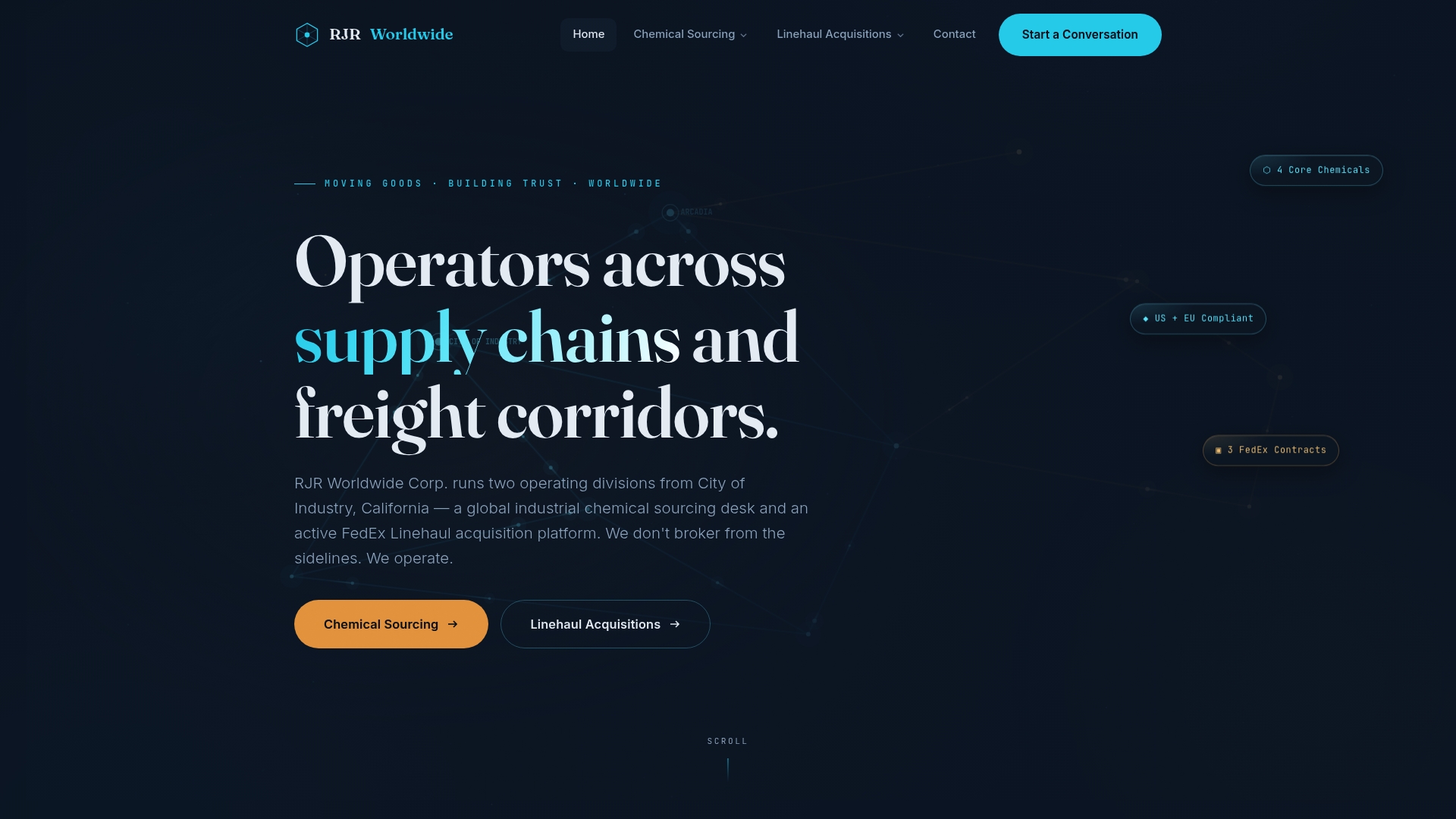
For procurement teams working through category segmentation and looking to convert one or two high-risk quadrants into dual-sourced, index-linked contracts, the Chemical Sourcing Division is the practical next step. Request an assessment of your current sourcing setup and get a direct read on where index-linked pricing or terminal-managed logistics would close your biggest gap fastest.
Primary Sources and Further Reading
- Beroe Inc. on contracting volatile commodity markets, covering index-formula structuring.
- AlixPartners on structural margin in chemical procurement, on governance-driven margin gains.
- ChemEngOnline on volatility, value, and visibility, the article’s core framing.
- AuraVMS on procurement KPIs and compliance, for scorecard detail.
- GEP on procurement trends and inventory orchestration.
Sources
- Volatility, value and visibility: Rethinking raw-material strategies — Chemical Engineering (ChemEngOnline)
- Chemical Procurement: KPIs, Compliance, and Supplier Management Guide for 2026 — AuraVMS