Four Documents That Make Chemical Quality Documentation Audit Ready

Four documents carry the weight of chemical quality: the Safety Data Sheet, the Certificate of Analysis, the controlled specification (or Technical Data Sheet), and the quality agreement. The SDS governs safety and handling, the CoA proves each batch meets spec before release, the controlled specification sets the binding technical contract, and the quality agreement locks in who does what when something goes wrong. Miss one, and you’re not managing chemical quality documentation. You’re gambling with it.
TL;DR:
- Verify that each shipment includes current safety data sheets and controlled specifications aligned with the latest updates, as these are critical for compliance and enforcement.
- Ensure batch-specific certificates of analysis list matching test parameters, actual testing laboratories, and are consistent with the current specifications to avoid false or outdated results.
- Map each regulatory requirement to the corresponding document, noting the risk-based approach for supplier qualification, and retain all records for the appropriate retention periods.
- Use structured naming conventions, change-control processes, and audit trails within the quality management system to maintain document integrity and traceability.
- Assign clear ownership of chemical quality documentation between procurement and QA, integrating logistics checks into incoming inspection to prevent data loss or mismanagement.
Table of Contents
- What Core Documents Should Every Incoming Shipment Include?
- What Regulations Govern Chemical Quality Documentation?
- How Should You Control Documents Inside a Quality Management System?
- How Do You Qualify a New Chemical Supplier?
- How Do You Verify Incoming Chemical Shipments and Track Supplier Performance?
- What Belongs in an Audit-Ready Chemical Supplier Package?
- What Realistic Timelines and Templates Should You Plan Around?
- Who Should Actually Own Chemical Quality Documentation?
- How RJR Worldwide Supports Audit-Ready Chemical Sourcing
- Sources
What Core Documents Should Every Incoming Shipment Include?
An SDS follows a 16-section format covering hazard identification, composition, handling, and disposal, and it isn’t a “file once, forget forever” document. Any change to the formula, a new toxicological finding, or a shift in transport classification triggers a mandatory update, and OSHA requires employers to keep current SDSs accessible to every employee handling the material. If your safety team can’t produce a current SDS in under five minutes during an inspection, that’s a compliance gap, not an inconvenience.
The TDS and controlled specification get confused constantly, and that confusion causes real problems. A TDS is marketing and engineering information: typical properties, suggested uses, general performance ranges. A controlled specification is the binding contract, the exact numeric range for assay, moisture, particle size, or impurity limits that a batch must meet before you accept it. Treat the TDS as informational and the controlled specification as the document you enforce at receiving.
The CoA should accompany every batch and list identity confirmation, assay results, impurity profile, and a batch number that traces back to the manufacturer’s own production records, not just a repackaged lot number assigned by a distributor. Red flags include CoAs with rounded numbers that never vary, test dates that don’t align with shipment dates, and results reported to a different specification version than the one on file.
A fast verification checklist for the receiving team:
- Confirm the batch number on the CoA matches the container label and packing list.
- Check every tested parameter against the current controlled specification, not an old version.
- Verify the CoA lists the actual testing lab or manufacturing site, not a trading company.
- Cross-check test methods against what your own quality agreement specifies.
- Flag any CoA missing a signature, date, or method reference for hold and investigation.
What Regulations Govern Chemical Quality Documentation?
Regulatory pressure doesn’t come from one source. It layers, and each layer adds its own documentation burden.
USP GC1083 frames supplier qualification as risk-based: it wants documentation review, sample testing, and audit evidence proportional to how critical the material is, not a flat checklist applied to every vendor equally. OSHA’s hazard communication rule is narrower but non-negotiable. Every employee working with a hazardous chemical needs access to its SDS, and “we’ll email it eventually” doesn’t satisfy that obligation.
GMP and GxP expectations push further into record retention and release logic. A batch can’t ship without a documented release decision tied to specific test results, and that decision has to be reconstructable years later. For anything touching TSCA registration or controlled substance status, documentation requirements multiply again, because the regulatory record has to prove the material was legally importable or manufacturable in the first place.
- USP GC1083: risk-based supplier qualification tiers
- OSHA Hazard Communication: mandatory SDS access
- GMP/GxP: traceable release decisions and retention schedules
- TSCA/controlled substance rules: legal manufacturing and import status
Pro Tip: Map each regulation to the specific document it touches on one page. When an auditor asks “why do you retain this record for seven years,” you want an instant answer, not a scramble.
How Should You Control Documents Inside a Quality Management System?
A document that nobody can locate or trust in an audit is worse than no document at all. It creates the impression of sloppiness even when the underlying quality is fine.
Every controlled document needs a naming convention that encodes document type, revision number, and effective date, plus metadata showing who authored it, who approved it, and when it took effect. “Spec_v3_final_ACTUAL.docx” is not a version control system. It’s a liability.
- Assign a unique document ID and revision number to every SDS, spec, and quality agreement at creation.
- Define change-control triggers up front, things like a formulation change, a new impurity limit, or a supplier site change, and require them to route through formal review before the old version retires.
- Link every document change to its underlying cause. If a change stems from a CAPA or a requalification event, the record should show that connection explicitly.
- Organize three separate repositories: the supplier quality file, the batch file, and the quality agreement archive, cross-referenced but distinct.
- For electronic records, require an audit trail that logs who changed what and when, restrict edit access by role, and back up the system on a schedule someone actually checks.
Pro Tip: Give every document an “obsolete” stamp with a date the moment it’s superseded. An old spec sitting in a shared drive without that stamp gets used by mistake more often than anyone wants to admit.
How Do You Qualify a New Chemical Supplier?
Qualification isn’t a single event. It’s a phased process, and the phase you land in should depend on how critical the material is to your product, not how eager the supplier is to close the deal.
Start with a desktop review: the supplier questionnaire, covering QMS structure, relevant certifications, regulatory inspection history, and CAPA trend data. For materials touching pharmaceutical or food-grade applications, ask directly whether a DMF or CEP is on file. Desktop review alone is enough for low-risk, non-critical materials.

Medium and high-criticality materials need sample testing next, typically three-batch verification using the same test methods the CoA will eventually report. If your lab’s assay results don’t match the supplier’s CoA on all three batches, that’s disqualifying, not a minor discrepancy to negotiate around. Audits reveal realities that questionnaires never surface, so high-criticality suppliers should get a focused on-site or remote audit before approval, one that confirms the actual manufacturing site rather than trusting the name on the invoice.
The qualification report should document the level assigned, the evidence collected at each phase, and the specific requalification triggers, whether that’s a scheduled interval or an event like a failed batch or a site change.
| Qualification Level | Documentation Collected | Typical Trigger for Use |
|---|---|---|
| Desktop only | Questionnaire, certifications, CoA history review | Low-criticality, non-GMP materials |
| Sample testing | Three-batch verification against CoA methods | Medium-criticality materials |
| Focused audit | On-site/remote audit report, CAPA review, site confirmation | High-criticality or regulated materials |
- Confirm the supplier’s legal entity and manufacturing site before assigning any qualification level.
- Treat the qualification report as a living document, not a one-time approval stamp.
How Do You Verify Incoming Chemical Shipments and Track Supplier Performance?
Incoming inspection should follow the same sequence every time: confirm identity against the packing list, match documentation to the shipment, run a visual check, pull samples per your sampling plan, then test against the controlled specification. Skipping steps to save time is exactly how a bad batch reaches production.
CoA verification means checking the testing lab identity, confirming method references match your quality agreement, and escalating any result reported against an outdated specification version.
Three KPIs belong on every supplier scorecard:
- CoA accuracy, the percentage of CoAs matching independent verification testing.
- On-time delivery, tracked against contracted lead times.
- Right-first-time (RFT) rate, the percentage of shipments accepted without deviation or rework.
What Belongs in an Audit-Ready Chemical Supplier Package?
An auditor doesn’t want to hear that your documentation exists somewhere. They want it in front of them in minutes, indexed and complete.
- Assemble the supplier quality file: qualification report, certifications, and audit history in one place.
- Archive CoAs by batch number, cross-referenced to the purchase order and the batch’s final release record.
- Include CAPA history and sampling records showing test results against specification, not just pass/fail summaries.
- Draft the quality agreement to cover roles and responsibilities, approved test methods, notification requirements for changes, change-control procedures, and transport and handling conditions.
- Index everything so a reviewer can trace a single PO from receipt through testing to final batch release without leaving the room.
Requalification typically runs on a scheduled cadence, often annually for high-criticality suppliers, but a failed batch, a site relocation, or a CAPA trend should trigger an unscheduled review regardless of where that supplier sits in the calendar.
What Realistic Timelines and Templates Should You Plan Around?
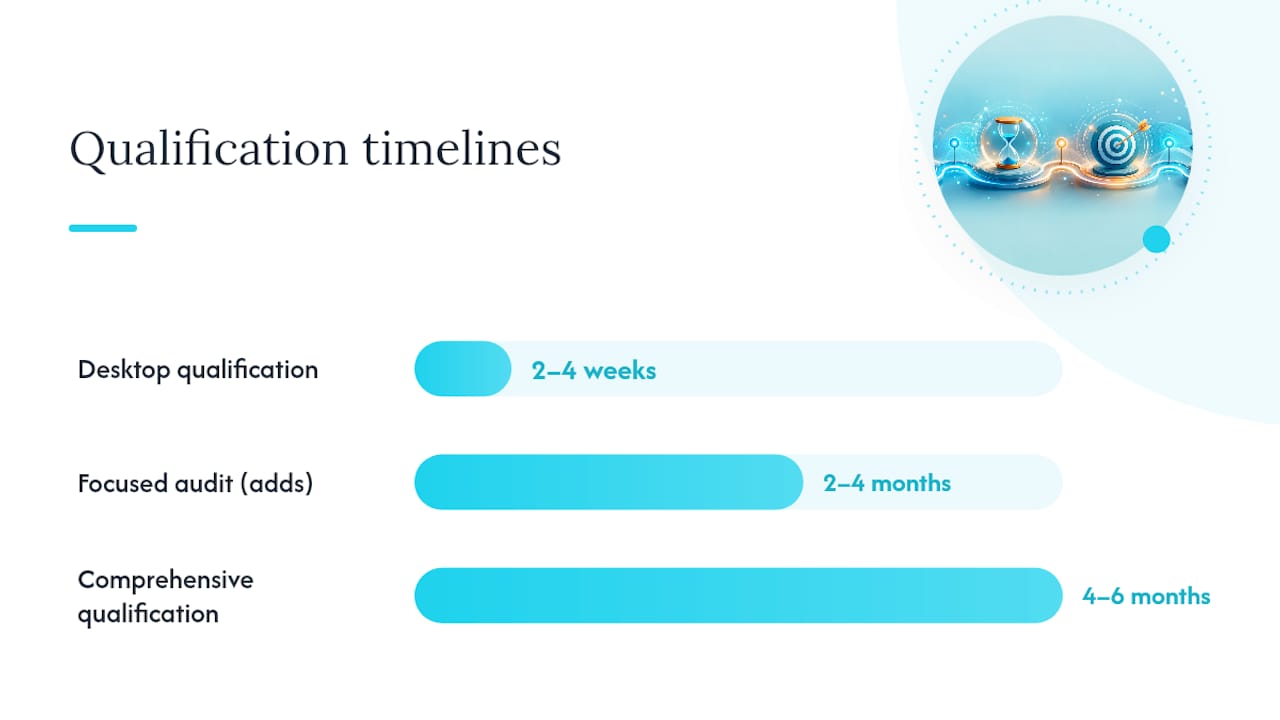
Qualification timing varies by tier and criticality: desktop qualification typically runs 2 to 4 weeks, a focused audit adds 2 to 4 months, and comprehensive qualification for high-criticality materials can run 4 to 6 months once sample testing and site audits are factored in.
Templates worth building once and reusing indefinitely:
- A standardized supplier questionnaire covering QMS, certifications, and CAPA history.
- An incoming inspection worksheet mapping each test to its specification limit.
- A supplier scorecard tracking CoA accuracy, on-time delivery, and RFT over rolling quarters.
RJR Worldwide’s own audit-ready compliance checklist reflects a pattern worth borrowing: integrating logistics documentation into the sourcing relationship from day one cuts the back-and-forth that usually stalls an audit.
Who Should Actually Own Chemical Quality Documentation?
Documentation gaps happen at handoffs, not within departments. Procurement owns the supplier relationship and initial qualification paperwork; QA owns the release decision and the CoA verification. When neither side is explicitly assigned the hold point between “shipment arrives” and “batch releases,” things slip through.
Fix it by naming a single document owner for each supplier file and building logistics checks directly into incoming inspection rather than treating them as a separate step. Scorecards only work if a bad KPI actually triggers a requalification review instead of a quiet shrug.
— RJR Worldwide
How RJR Worldwide Supports Audit-Ready Chemical Sourcing
One alternative to juggling multiple brokers for chemical supply is managing sourcing directly from California terminals, which means supplier qualification, CoA traceability, and specification control happen inside one relationship instead of getting lost between a trading company and a factory you’ve never verified.
Our multi-year, index-linked contracts for food, technical, and pharmaceutical-grade chemicals come from vetted suppliers across China and India, with documentation built to satisfy US and EU compliance from the first shipment. That includes the specification control and CoA audit trail this article walks through, not bolted on after the fact. If your team is tired of chasing CoAs that don’t match your own testing, visit our chemical sourcing division to request a documentation sample package or start a supplier qualification conversation.
Sources
- USP GC1083 — Supplier qualification
- OSHA — Hazard Communication (Worker Right-to-Know)
- Chemical Supplier Qualification Checklist | ChemContract
- Best practices guide for managing suppliers of API manufacturers (APIC/CEFIC)