Avoid 8–12 Day Delays With a 2026 Playbook for Chemical Buyers

The top chemical supply chain risk 2026 planning must address falls into three clusters: chokepoint and energy shocks, cyber and vendor exposure, and compliance documentation tangled up with feedstock price swings. The single highest-leverage move is building N-tier supplier visibility with continuous monitoring and locking audit-ready documentation into every contract. Buyers who wait for the next Red Sea headline or a missing certificate of analysis to force the issue will pay more, wait longer, and fail more audits than those who act now.
TL;DR:
- Weekly monitoring of second- and third-tier suppliers in high-risk categories is crucial, especially when regional disruptions can swiftly cascade down the supply chain.
- Multi-year, index-linked contracts with mandatory, audit-ready documentation ensure pricing transparency and reduce the risk of costly renegotiations during crises.
- Pre-arranged rerouting thresholds, dynamic safety stock levels, and contingency plans help manage longer transit times caused by chokepoint rerouting and climate-driven route shifts.
- Focusing on continuous cyber risk triage using EPSS and KEV data is more effective than manual vendor audits, especially given the rise of targeted exploits and reduced internal oversight.
- Active, direct terminal operations with controlled freight lanes support supply chain continuity and mitigate delays when geopolitical or climate events disrupt traditional shipping routes.
Table of Contents
- Why 2026 Looks Different: Chokepoints, Energy, and Market Structure
- How Do These Risks Hit Compliance, Pricing, and Supplier Reliability?
- Prioritized Mitigation Playbook: What To Do Now
- What Early-Warning Signals Should Trigger a Response?
- How RJR Worldwide’s Services Map to These Mitigation Steps
- Climate Volatility Is Now a Line Item, Not a Footnote
- Where Blockchain and IoT Actually Help (and Where They Don’t)
- Three Near-Term Priorities for Supply Chain Leaders
- RJR Worldwide: A Sourcing Partner Built for Route and Contract Continuity
- Primary Sources and Further Reading
- Sources
- FAQ
Why 2026 Looks Different: Chokepoints, Energy, and Market Structure
Three maritime bottlenecks are doing more damage to chemical logistics than any single trade dispute. Red Sea instability has added 8 to 12 days to Gulf-to-Asia voyages as carriers avoid the Bab el-Mandeb corridor, while Panama Canal drought conditions continue to cap vessel throughput and push tonnage toward the Suez route or around the Cape of Good Hope instead. The Strait of Hormuz remains the wildcard: any disruption there ripples straight into feedstock pricing because so much of the world’s petrochemical energy input transits that single channel.
Energy flow and commodity pricing move together. When chokepoint risk spikes, freight and war-risk insurance premiums rise almost immediately, and that cost transmits directly into landed feedstock prices for anything derived from crude or natural gas liquids.
Layer market structure on top and the picture gets worse. Basic petrochemical producers are running at utilization rates below 75% amid Chinese oversupply and ongoing capacity expansions, which means margins are already thin before a shock hits. Thin margins amplify the consequence of every disruption because suppliers have less room to absorb a cost spike without passing it downstream.
What’s driving elevated exposure this year:
- Rerouting around three separate chokepoints simultaneously, not just one
- Insurance and freight cost transmission into feedstock pricing within weeks, not months
- Producer overcapacity that leaves no buffer to cushion sudden demand or cost shifts
How Do These Risks Hit Compliance, Pricing, and Supplier Reliability?
Macro disruption doesn’t stay macro for long. It becomes a missed shipment, a failed audit, or a contract renegotiation within a single quarter, and procurement teams that treat chokepoint news as background noise get blind sided by the operational fallout.
-
Pricing gets harder to forecast. Rerouted freight and higher war-risk premiums raise landed costs unpredictably, and price models built on last year’s lane assumptions stop working. A shipment that used to clear the Suez route in three weeks might now take a month longer via the Cape, and that extra transit time carries its own freight and inventory-carrying cost.
-
Documentation gaps turn into audit liabilities. Missing batch history, incomplete traceability, or a supplier that can’t produce a clean certificate of analysis on demand can block a shipment at the dock or trigger a failed customer audit. Sphera’s 2026 research points to a confidence paradox in the sector: leaders report high trust in their risk data even as regulatory and N-tier exposures stay elevated, which suggests a lot of that confidence rests on paperwork nobody has stress-tested.
-
Supplier reliability erodes at the deep tiers. Most procurement teams know their tier-one supplier well. Far fewer know who supplies that supplier’s key intermediate, and concentration at those deeper tiers means a single regional disruption can knock out capacity nobody was tracking. Small impurity or specification changes at a substitute supplier can also fail a pharmaceutical or food-grade application outright, so substitution is never as simple as swapping one drum for another.
Prioritized Mitigation Playbook: What To Do Now
Not every fix carries equal weight. Start with the moves that touch compliance, pricing, and reliability at the same time.
N-tier visibility comes first. Map suppliers two and three tiers deep for your highest-risk chemical categories, not your whole catalog. Set a monitoring cadence: monthly for critical feedstocks, quarterly for everything else, and prioritize deep-tier suppliers concentrated in a single region or port.
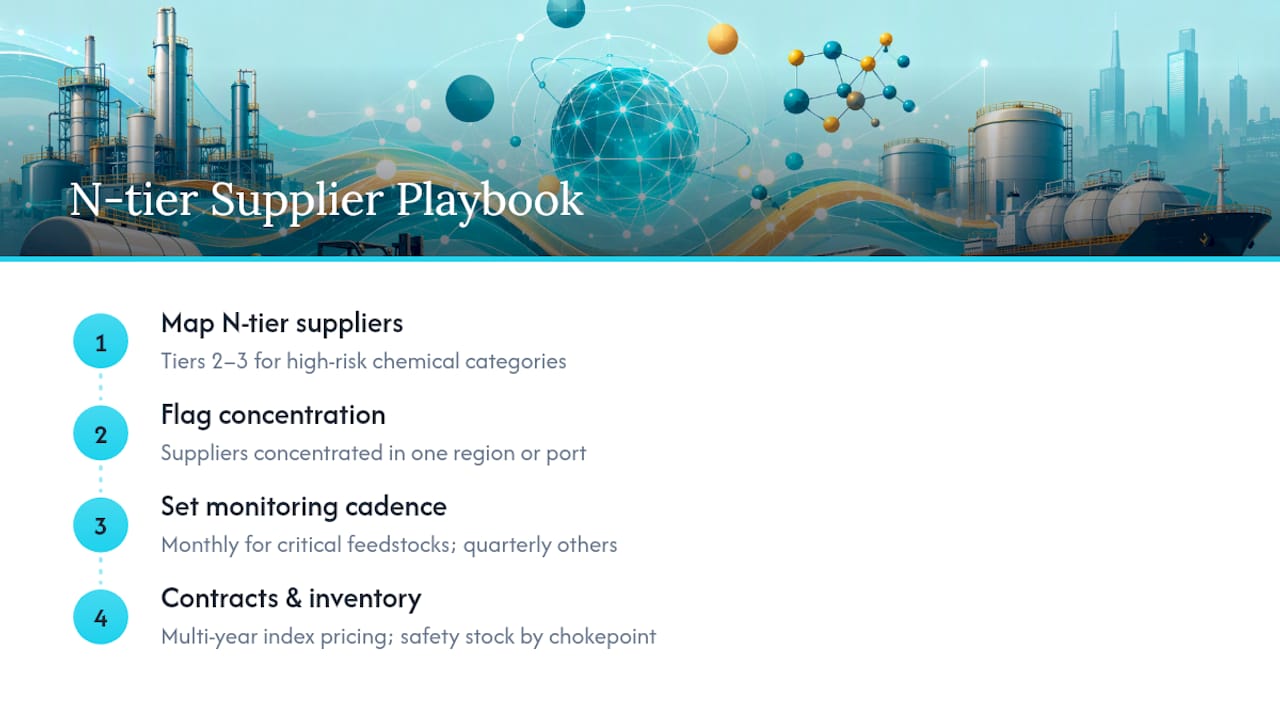
Contract mechanics matter more than most teams realize. Multi-year agreements with index-linked pricing clauses remove a chunk of forecasting uncertainty because the price mechanism is transparent rather than renegotiated on every purchase order. Build mandatory audit-ready documentation and batch traceability clauses directly into the contract itself, since retrofitting compliance evidence after the fact is far costlier than requiring it up front.
Inventory tactics need to be risk-based, not blanket. Set safety stock levels tied to actual chokepoint exposure for each lane, and build dynamic reorder points that respond to transit-time signals rather than a fixed calendar. Establish substitution approval protocols in advance so a mid-crisis supplier swap doesn’t require an emergency committee meeting.
Cyber controls need precision, not more audits. SecurityScorecard found that 67% of organizations still rely on static or manual vendor audits, even though 78% of vendor ecosystems carry less than 50% internal oversight. Adopt EPSS scoring paired with the CISA Known Exploited Vulnerabilities catalog to triage which vendor flaws actually need urgent attention, and require AI-use disclosure from key vendors as part of onboarding.
Logistics tactics should be pre-decided, not improvised. Set rerouting thresholds in advance (a defined number of added transit days triggers automatic modal review), budget for war-risk insurance swings rather than treating them as a surprise, and keep an alternative modal plan on file for your top five lanes.
Pro Tip: Run a tabletop exercise once a quarter where procurement, QA, and logistics walk through a chokepoint closure together. The gaps that surface in a two-hour meeting are far cheaper than the ones that surface during an actual shipment delay.
What Early-Warning Signals Should Trigger a Response?
Waiting for a full-blown crisis to react means you’re already behind. Two scenarios cover most of what 2026 is likely to throw at chemical buyers, and each has distinct triggers.
-
Sustained chokepoint escalation. Watch for transit times that stay elevated for more than two consecutive shipments, war-risk insurance premiums that spike and hold, and supplier delays that repeat rather than resolve. The response: increase safety stock buffers immediately, shift volume to a landbridge or alternate route, and activate a pre-qualified backup supplier rather than starting vetting from scratch.
-
Intermittent flare-ups. These look like short-term freight rate volatility, a brief port outage, or a sudden Code Red exploit flagged through EPSS. The right response is targeted, not sweeping: a rapid documentation audit of the affected supplier, a temporary hold on new orders from that lane, and containment rather than a full network overhaul.
Assign ownership before a crisis hits, not during one. Procurement should own supplier delay triggers, security owns the EPSS and vulnerability signals, QA owns documentation audits, and logistics owns freight rate and routing triggers. A monthly cross-functional review keeps all four groups looking at the same dashboard instead of discovering a problem three weeks apart.
How RJR Worldwide’s Services Map to These Mitigation Steps
RJR Worldwide Corp built its chemical sourcing model around the exact gaps this playbook targets. Multi-year, index-linked contracts remove the price-forecasting guesswork described above, and documentation requirements are embedded into the agreement itself rather than chased down after a shipment ships.
- Index-linked, multi-year contracts that make feedstock pricing transparent instead of renegotiated every cycle
- Full compliance documentation built into every shipment, covering food, technical, and pharmaceutical-grade chemicals sourced from vetted China and India suppliers
- California terminal operations paired with active FedEx linehaul lane management, which supports continuity when a route or carrier disruption hits
- Direct terminal control rather than a brokered handoff, which shortens the chain of custody a buyer has to audit
Climate Volatility Is Now a Line Item, Not a Footnote
Extreme weather used to be a once-a-decade line in a risk register. In 2026, it’s a recurring cost. Panama Canal drought conditions have already forced sustained capacity cuts, and that single climate-driven constraint has pushed volume toward longer, costlier routes for months at a stretch rather than days.
Flooding and heat events at manufacturing sites carry a second-order effect that gets less attention: infrastructure built for a prior climate baseline (cooling systems, storage tank ratings, port dredging schedules) starts failing at the margins first. A regional producer that ran reliably for a decade can suddenly miss delivery windows because a heat wave forced a temporary production curtailment nobody modeled into the original supply agreement.
Resilience planning has to treat climate exposure as a recurring input, not an occasional shock. That means asking suppliers directly about site-level climate risk (flood zones, water access for cooling, heat-related output caps) during qualification, not after a disruption. It also means building climate-driven rerouting into the same threshold framework used for geopolitical chokepoints, since a canal drought and a strait closure produce nearly identical operational symptoms: longer transit times, tighter vessel capacity, and higher landed costs.
Buyers who separate “climate risk” from “geopolitical risk” in their planning documents are missing the point. Both show up in the same place: a delayed shipment and a higher freight bill.
Where Blockchain and IoT Actually Help (and Where They Don’t)
Traceability technology gets oversold constantly, so it’s worth being specific about what actually works. Blockchain-based batch tracking gives every party in a chain of custody a shared, tamper-resistant record of who handled a chemical lot, when, and under what conditions. For pharmaceutical-grade or food-grade chemicals, that shared record can shrink the time it takes to respond to a recall or an audit request from weeks to hours, because nobody has to reconcile competing paper trails across three or four companies.
IoT sensors solve a different problem: real-time condition monitoring. Temperature and humidity sensors on a tanker or storage container flag a deviation the moment it happens rather than at the next scheduled inspection, which matters enormously for temperature-sensitive technical and pharmaceutical grades.

Neither technology fixes a bad contract or a supplier that never had good documentation practices to begin with. Blockchain records are only as reliable as the data entered at each node, and a supplier that manually falsifies a temperature log will produce a falsified blockchain entry just as easily. Treat these tools as an accelerant for good documentation practices already required contractually, not a replacement for the underlying supplier vetting and audit-ready paperwork discussed above.
Three Near-Term Priorities for Supply Chain Leaders
The instinct to fix everything at once is understandable and wrong. Start with N-tier visibility and continuous monitoring, because you can’t manage risk in suppliers you can’t see. Layer in focused cyber triage using EPSS and KEV data rather than chasing every alert equally. Then lock contract documentation and index-linked pricing terms into your critical feedstock agreements before the next chokepoint disruption forces a rushed renegotiation. Sequence matters here more than speed.
— RJR Worldwide
RJR Worldwide: A Sourcing Partner Built for Route and Contract Continuity
A specialized company can be the alternative to a fragmented broker network for chemical buyers who need pricing they can forecast and documentation they don’t have to chase down mid-shipment. Instead of managing five vendor relationships across three tiers, buyers can work through a single, direct terminal operator that controls both the sourcing contract and the freight lane.
The Chemical Sourcing Division handles multi-year, index-linked contracts for food, technical, and pharmaceutical-grade chemicals from vetted China and India suppliers, with full compliance documentation built in at signing rather than assembled after a shipment ships. That documentation package directly operationalizes the audit-ready contract clauses this playbook recommends, and the index-linked pricing structure addresses the forecasting problem that chokepoint volatility keeps creating.
On the logistics side, RJR’s California terminal operations and active FedEx linehaul acquisitions give buyers dedicated lane continuity instead of a spot-market scramble when a route gets disrupted. If your 2026 planning needs a sourcing contract with pricing transparency and documentation built in from day one, start a conversation about your chemical sourcing needs.
Primary Sources and Further Reading
Chemical industry outlook (Deloitte); 2026 Supply Chain Cybersecurity Trends Report (SecurityScorecard); Supply Chain Risk Report 2026 (Sphera); 2026 supply chain vulnerability report (Black Kite); Geopolitical disruptions and supply chain resilience (Springer).
Sources
- Chemical industry outlook (Deloitte)
- 2026 Supply Chain Cybersecurity Trends Report (SecurityScorecard)
- Supply Chain Risk Report 2026: Chemicals Executive Brief (Sphera)
- 2026 supply chain vulnerability report (Black Kite)
- Geopolitical disruptions in the Middle East and global supply chain resilience (Springer)
FAQ
What Is the Biggest Chemical Supply Chain Risk in 2026?
The combination of chokepoint driven transit delays and thin producer margins is the biggest structural risk, since utilization rates below 75% leave little room to absorb cost shocks from rerouting or insurance spikes.
How Much Longer Are Shipments Taking Due to Red Sea Instability?
Red Sea rerouting is adding 8 to 12 days to Gulf to Asia voyages as carriers avoid the Bab el-Mandeb corridor.
Why Are Manual Vendor Audits No Longer Sufficient?
Exploit timelines have inverted, meaning attackers often act before a vulnerability is publicly disclosed, so continuous monitoring with EPSS and KEV triage catches risks that periodic manual audits miss entirely.
Can Index-Linked Contracts Actually Reduce Pricing Risk?
Yes. Index-linked pricing ties cost adjustments to a transparent published benchmark instead of ad hoc renegotiation, which is why sourcing partners like RJR Worldwide Corp build it into multi-year chemical supply agreements.
What Should a Supplier Documentation Package Include?
At minimum it needs batch traceability records, certificates of analysis, and audit-ready compliance evidence built into the contract terms rather than assembled after a shipment request, addressing the confidence paradox Sphera identified between reported confidence and actual regulatory exposure.