China Chemical Sourcing: A Compliance Guide for U.S. Buyers
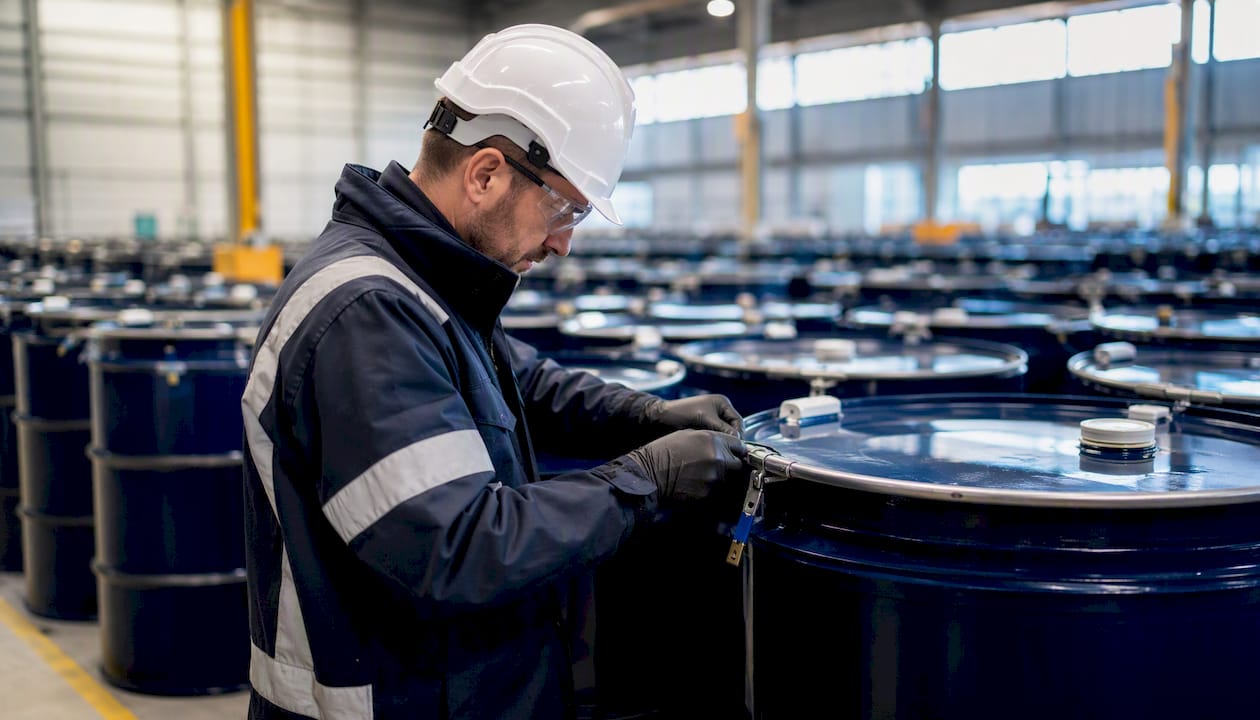
China chemical sourcing is viable for most industrial and specialty chemistries when you verify original manufacturers, require third-party testing with a retained sample policy, and confirm both NRCC registration (for hazardous goods under China’s 2026 Hazardous Chemicals Safety Law) and TSCA compliance before booking freight. For regulated, high-value, or first-time supplier relationships, a managed sourcing partner like RJR Worldwide reduces the compliance burden and freight risk materially.
Your immediate next step: confirm the supplier can provide product-specific NRCC registration details, a recent third-party Certificate of Analysis (CoA) tied to a specific batch, and an English-language SDS/GHS document before you issue a purchase order.
Key pre-qualification signals to request from any Chinese chemical supplier:
- NRCC registration number and traceability code (hazardous chemicals)
- Third-party CoA with batch number, purity, and impurity profile
- English SDS/GHS compliant with OSHA HazCom 2012
- TSCA inventory status confirmation for U.S. import
- ISO 9001 or GMP certificate from a recognized body
Key takeaways
Verified original manufacturers, third-party testing with retained samples, and confirmed NRCC and TSCA compliance are the three non-negotiable foundations of a low-risk China chemical sourcing program.
| Point | Details |
|---|---|
| Confirm NRCC and TSCA status first | Hazardous shipments without NRCC traceability codes can be stopped at Chinese customs under the 2026 law. |
| Require batch-linked CoA and retained samples | Sample-to-bulk mismatch is the most common failure mode; retained samples are your only contractual remedy. |
| Add a brief buffer for NRCC verification | Build this buffer into every hazardous shipment timeline to avoid port holds at origin. |
| Use LCs or conditional payment on first orders | Tie final payment to independent lab confirmation, not to shipment date, for any new supplier. |
| RJR Worldwide for managed supply | RJR Worldwide provides verified supplier screening, documentation packaging, and integrated freight for compliant China chemical supply. |
Table of Contents
- 1. Where China makes which chemicals: production hubs and supplier types
- 2. Why companies source chemicals from China
- 3. Main risks when buying chemicals from China
- 4. How to vet suppliers and enforce quality before placing an order
- 5. U.S.-focused import compliance: TSCA, SDS/GHS, and NRCC traceability
- 6. Shipping, hazmat rules, and realistic lead times for China chemical shipments
- 7. Structuring pricing, contracts, and payment terms to reduce risk
- 8. When to source direct vs. engage a managed sourcing partner
- 9. How an experienced sourcing partner structures a compliant China chemical supply program
- What actually changes after the first failed bulk batch
- RJR Worldwide handles the compliance work so your team doesn’t have to
- Useful resources for procurement managers
- Sources
1. Where China makes which chemicals: production hubs and supplier types
China’s chemical manufacturing is geographically concentrated, and the cluster you source from directly affects price, documentation quality, and compliance risk.
Major production clusters relevant to U.S. buyers:
- Weifang, Binzhou, and Zibo (Shandong): Bulk APIs, inorganic intermediates, and commodity chemicals. High output, competitive pricing, but environmental inspection shutdowns are frequent.
- Lianyungang (Jiangsu): Fine chemicals, CDMO services, and pharmaceutical intermediates. Stronger GMP infrastructure and export documentation experience.
- Taizhou (Zhejiang): Excipients, agrochemical intermediates, and specialty organics. Dense supplier ecosystem with established export channels.
- Huizhou and Dongguan (Guangdong): Hazmat warehousing, specialty coatings, and industrial chemicals with proximity to Shenzhen port.
Cluster choice matters beyond price. Shandong suppliers often face seasonal capacity cuts during environmental inspection cycles, which can push lead times out by three to four weeks with little notice. Jiangsu CDMO clusters tend to have more rigorous internal QA systems and are more accustomed to producing documentation that satisfies U.S. and EU regulatory requirements.
Supplier tiers and what they mean for transparency:
- Original manufacturers (OEMs): Direct production control, best traceability, preferred for regulated chemistries.
- CDMOs: Custom synthesis and scale-up, strong documentation, higher cost.
- Trading houses and brokers: Aggregators with no production control; CoA provenance is harder to verify.
- Small retail clusters (Yiwu-style): Suitable for commodity samples only; not appropriate for regulated or high-volume supply.
Established suppliers in export-oriented clusters often carry ISO 9001 and ISO 14001 certifications as baseline credentials, but verification of the actual production lines behind those certificates is a separate step. A certificate on a website is not the same as a confirmed, audited production capability.
2. Why companies source chemicals from China
The core business case is straightforward: lower ex-factory cost on tonnage grades, access to a wider range of intermediates and specialty chemistries than most Western markets offer, and rapid custom synthesis capability in CDMO clusters.
For procurement managers running medium-to-high annual volumes, the math often favors China. Index-linked pricing on multi-year contracts can lock in predictable costs against commodity price swings. Multi-sourcing within China, across two or three verified manufacturers in different clusters, builds continuity without requiring a second country program.
Custom synthesis is a genuine differentiator. Lianyungang and Taizhou CDMOs can move from bench-scale to pilot batch faster than most European equivalents, which matters when you need a specialty intermediate at scale within a defined timeline.
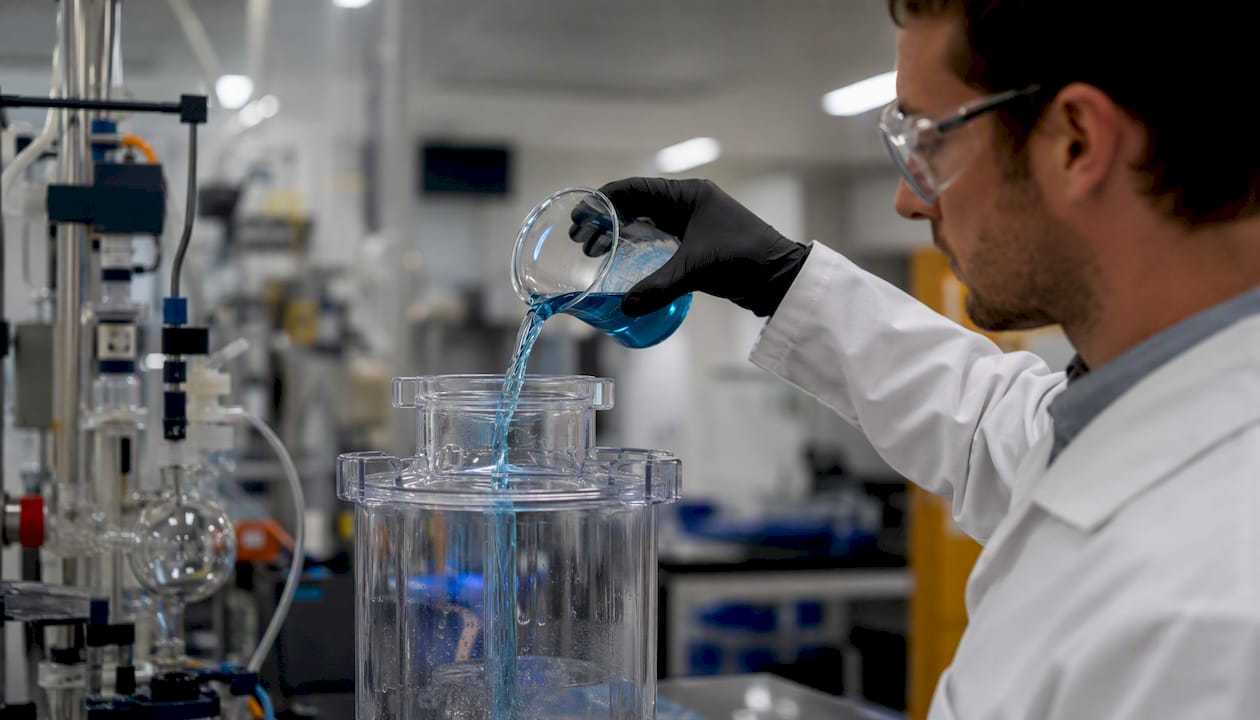
The calculus shifts when volumes are low, documentation costs are not budgeted, or the chemistry is highly regulated. At that point, the cost advantage erodes against the time and expense of proper supplier verification, third-party testing, and compliance documentation.
3. Main risks when buying chemicals from China
The risks are real and specific. Understanding them before you issue an RFQ is what separates a successful program from an expensive lesson.
Quality and specification risk is the most common failure mode. Sample results frequently do not match bulk production, particularly when a trading house provides the sample but a different factory fills the order. Falsified or loosely interpreted CoAs are a documented problem. Hidden impurities, especially in APIs and specialty organics, can cause downstream process failures or regulatory rejection.
Regulatory and compliance risk has increased significantly. China’s 2026 Hazardous Chemicals Safety Law institutes NRCC traceability codes and gives China Customs explicit export supervision authority. On the U.S. side, TSCA obligations require importers to confirm inventory status and, for certain substances, submit pre-manufacture or significant new use notices. SDS/GHS mismatches between Chinese and U.S. standards cause customs holds that can delay shipments by days or weeks.
Logistics and hazmat risk is underestimated by buyers who treat chemical shipping as standard freight. IMDG and 49 CFR requirements govern packaging, labeling, and carrier restrictions. UN-certified containers are mandatory for many chemistries. Port inspection holds for DG shipments without correct documentation can add unpredictable delays.
Commercial and payment risk concentrates around brokers quoting below-market prices. Low quotes from trading houses often signal either a quality compromise or a bait-and-switch on supplier identity. Payment terms matter: wire transfer (T/T) with no escrow on a first order from an unverified supplier is high exposure.
Continuity risk is structural. Environmental inspection cycles in Shandong and other heavy-industry provinces can shut production for weeks. Export controls on certain chemistries shift without much advance notice. Freight disruptions compound all of the above.
4. How to vet suppliers and enforce quality before placing an order
Supplier vetting is not a one-time checkbox. It is a structured process with defined pass/fail criteria at each stage.
Factory audit checklist (minimum requirements):
- Verified business license matching the production entity (not a trading company)
- Evidence of the specific synthesis or process for your chemistry
- On-site testing lab with documented calibration records
- Export experience and familiarity with U.S./EU documentation requirements
- Waste and effluent controls (relevant for environmental inspection risk)
- ISO 9001 or GMP certification from a recognized third-party body
Sample and testing protocol:
- Request sealed reference samples with chain-of-custody documentation
- Send samples to an independent third-party lab (SGS, Eurofins, or equivalent) for purity and full impurity profiling
- Define acceptance criteria in writing before testing, including impurity limits by ppm
- Agree on a retained-sample policy: sealed duplicates held by both parties for 24 months
Documentation to require before any order:
- Batch-specific CoA with lot number, test date, and analyst signature
- Bilingual SDS/GHS (Chinese and English)
- UN packaging certificates for hazardous goods
- NRCC registration evidence if the product appears on China’s Inventory of Hazardous Chemicals
Product-level specification work, such as the kind of handling and transport documentation detailed for calcium hypochlorite, illustrates the depth of product-specific knowledge that should inform your RFQ and acceptance criteria.
Pro Tip: Run a small bench or pre-bulk run with sealed chain-of-custody sample testing before releasing full production. Tie the final payment tranche to independent lab confirmation of the pilot batch, not to shipment date.
5. U.S.-focused import compliance: TSCA, SDS/GHS, and NRCC traceability
Compliance failures at U.S. entry are almost always documentation failures, not chemistry failures. Getting this right starts with the supplier, not the customs broker.
TSCA obligations for U.S. importers:
- Confirm whether the imported substance is listed on the TSCA Chemical Substance Inventory (maintained by the U.S. EPA).
- For new chemicals or significant new uses, pre-import notices and data submissions may be required before the first shipment.
- The importer of record bears TSCA liability, not the Chinese supplier.
China-side export requirements to confirm with suppliers:
China’s 2026 Hazardous Chemicals Safety Law requires NRCC traceability codes for hazardous chemicals listed in China’s inventory. China Customs now has explicit supervisory authority at export, meaning a shipment without a valid traceability code can be stopped at the port of origin. NRCC verification adds a short delay to the production-to-port timeline. Confirm with your supplier whether the product requires NRCC registration and whether they have current whitelist status with local customs.
Documentation checklist for U.S. import:
- English-language SDS/GHS aligned with OSHA HazCom 2012 (not a direct translation of a Chinese SDS)
- Batch-specific CoA matching the shipped lot
- UN packaging and DG shipping papers for dangerous goods
- Documented chain of custody for test samples from factory to lab to port
When a supplier cannot produce NRCC registration evidence or a CoA that matches the bulk lot, treat the order as high risk. Either require a corrective action plan with a defined timeline, or move to a managed sourcing arrangement.
6. Shipping, hazmat rules, and realistic lead times for China chemical shipments
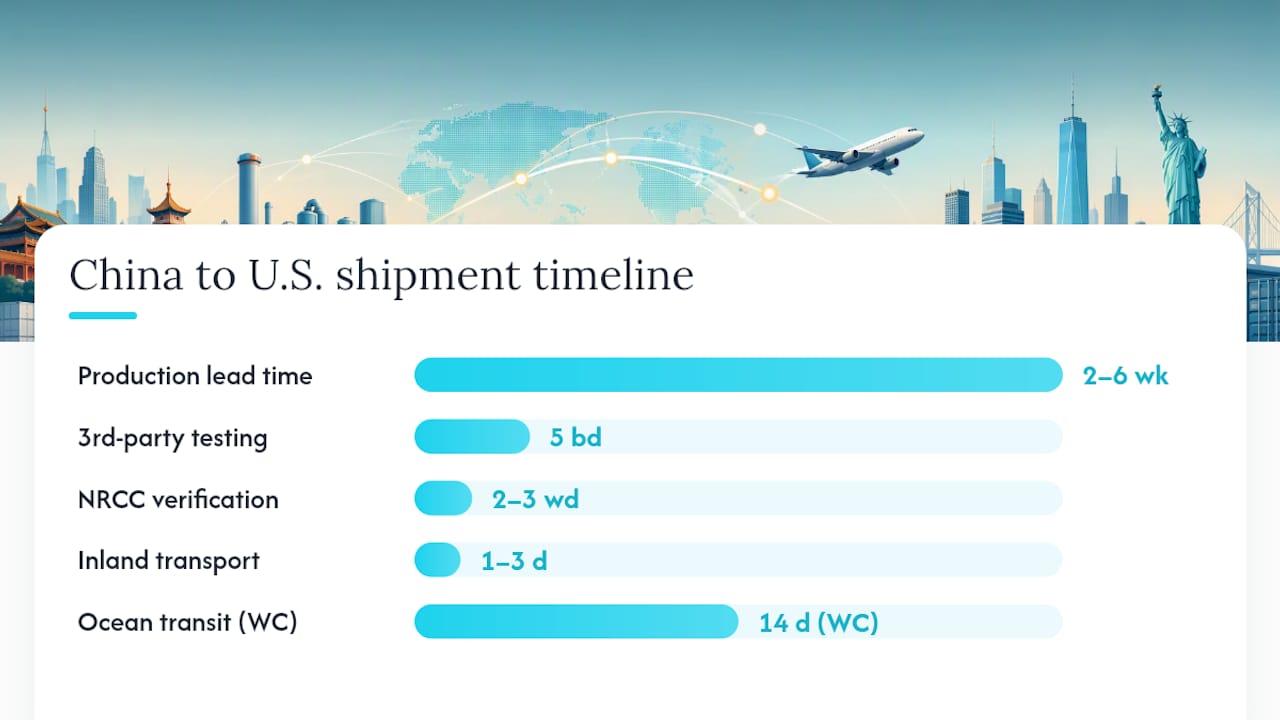
Setting accurate lead-time expectations is one of the most practical things a procurement manager can do. The table below reflects typical timeline components for a standard ocean shipment of industrial chemicals from China to a U.S. port.
| Stage | Typical Duration | Notes |
|---|---|---|
| Production lead time | 2–6 weeks | Varies by chemistry and cluster; longer in Shandong during inspection cycles |
| Third-party testing window | 5 business days | Independent lab turnaround; allow extra time for complex impurity profiles |
| NRCC traceability verification | 2–3 working days | Required for hazardous chemicals under China’s 2026 law |
| Inland transport to port | 1–3 days | Depends on factory location relative to Qingdao, Shanghai, or Shenzhen |
| Ocean transit (China to U.S. West Coast) | 14 days | Add 5–7 days for East Coast ports |
| U.S. customs clearance | 2–5 days | Add buffer for DG inspection or documentation review |
The World Bank Logistics Performance Index provides useful benchmarking on port and customs variability across Chinese export hubs. Performance differences between Qingdao, Shanghai, and Shenzhen are measurable and worth factoring into port selection.
Hazmat shipping essentials:
- IMDG Code compliance for ocean freight; 49 CFR for any U.S. domestic leg
- UN-certified packaging with correct packing group markings
- Accurate DG declarations with UN number, proper shipping name, and hazard class
- Carrier restrictions for certain chemistries (oxidizers, corrosives, flammables) require pre-booking confirmation
Incoterms matter more than most buyers realize. Ex Works places all export compliance, NRCC verification, and DG documentation on the buyer. FOB shifts export clearance to the supplier but leaves U.S. import compliance with the buyer. CIF and DDP can obscure who is responsible for NRCC steps. Specify in the contract exactly who handles export traceability verification and pre-shipment compliance checks.
7. Structuring pricing, contracts, and payment terms to reduce risk
The contract is where procurement managers either protect themselves or leave exposure on the table.
Payment instruments by risk level:
- Letter of credit (LC): Best for first orders with unverified suppliers. Ties payment release to documentary compliance, including CoA and shipping papers.
- Partial T/T with escrow: Workable for repeat orders with a verified supplier track record. Structure as 30% deposit, 70% on independent lab confirmation of the shipped batch.
- Conditional final payment: Tie the last tranche to retained-sample verification results, not to bill of lading date.
Contract clauses to require:
- Batch-specific CoA and sample retention clause (24-month minimum)
- Price index or commodity formula for multi-year contracts (e.g., linked to ICIS or a named index)
- Lead-time definitions and force majeure language that explicitly covers environmental inspection shutdowns
- Documented remedies for off-spec shipments: replacement at supplier cost, credit, or return with freight reimbursement
MOQ and pricing negotiation:
Batch-splitting for initial testing runs is a reasonable ask from any serious manufacturer. Staged deliveries on a multi-year contract reduce inventory carrying cost and give you quality checkpoints at each delivery. Index-linked pricing protects both sides against commodity volatility and is a standard feature of well-structured long-term supply agreements.
8. When to source direct vs. engage a managed sourcing partner
Not every procurement team has the internal capability to run a full supplier verification program, manage DG shipping compliance, and negotiate multi-year contracts in Chinese. The decision to source direct or use a managed partner should be based on honest capability assessment.
Decision checklist:
- Annual spend and volume: below a threshold where verification costs are proportionate, direct sourcing may not be economical
- Regulatory sensitivity: pharma-grade, food-contact, and hazardous chemistries require documentation rigor that most internal teams cannot sustain without dedicated resources
- In-house DG shipping expertise: 49 CFR and IMDG compliance is specialized; errors are expensive
- Acceptable schedule risk: first-time supplier relationships carry higher variability
Questions to ask a prospective sourcing partner:
- Do you verify NRCC/traceability status for hazardous chemistries?
- Do you provide retained-sample testing with chain-of-custody documentation?
- Can you perform on-site or live-video factory audits and issue supplier dossiers?
- Do you integrate freight management for continuity, including linehaul for U.S. domestic legs?
A managed partner is the stronger choice for regulated chemistries, first-time China supplier relationships, high-value contracts, or when internal procurement lacks hazardous-goods export and compliance expertise.
9. How an experienced sourcing partner structures a compliant China chemical supply program
A well-run managed sourcing program removes the guesswork from supplier verification and compliance documentation. Here is how a structured program works in practice.
Service components of a full-service chemical sourcing program:
- Requirement scoping: CAS numbers, purity specifications, impurity limits, and grade (food, technical, pharmaceutical)
- Targeted supplier screening with original-manufacturer verification (not trading house)
- On-site or live-video factory audits with documented findings
- Independent laboratory testing with chain-of-custody sample management
- Documentation packaging: multilingual SDS, batch-specific CoA, UN packaging certificates, TSCA confirmation
- Integrated freight and IOR services, including U.S. domestic linehaul for continuity
Example workflow:
Scoping call → shortlist three verified original manufacturers → sealed sample testing at independent lab → pilot batch with retained sample → contract with index-linked pricing and QA SLAs → scheduled shipments with pre-shipment NRCC and compliance checks before each booking.
RJR Worldwide’s Chemical Sourcing Division structures supply programs along these lines, featuring long-term index-linked contracts for food, technical, and pharmaceutical-grade chemicals from verified Chinese and Indian manufacturers. The integration of FedEx linehaul capability from California terminals means freight continuity is managed alongside sourcing, not as a separate vendor relationship. Pre-shipment NRCC status checks are built into the freight workflow, reducing the risk of last-minute customs holds on hazardous shipments.
Pro Tip: Ask any managed sourcing partner for a supplier dossier from a previous engagement, redacted for confidentiality. The depth of that document tells you more about their verification process than any sales conversation.
What actually changes after the first failed bulk batch
The procurement teams that build the most durable China supply programs are almost always the ones that learned from a failure first. A batch that passes sample testing but fails on bulk delivery is not bad luck. It is a process gap: no retained reference sample, no pre-shipment testing, and a supplier relationship built on price rather than documented capability.
After a failure, the behavioral shift is consistent. Price drops from the primary selection criterion to a secondary one. Documented production capability, audit history, and CoA provenance move to the top of the evaluation. Retained samples go from a “nice to have” to a non-negotiable contract term.
The uncomfortable truth is that most of the verification steps in this guide cost a fraction of one failed batch. A third-party lab test for a specialty chemical runs a few hundred dollars. An on-site audit, even a live-video one, costs less than a day of production downtime. The math is not close.
RJR Worldwide handles the compliance work so your team doesn’t have to
Procurement managers who want verified, documented, compliant chemical supply from China without building an internal China sourcing team have a direct option: RJR Worldwide’s managed chemical sourcing program.
The concrete difference from sourcing direct is this: RJR Worldwide verifies original manufacturers, coordinates independent third-party testing, packages full compliance documentation (SDS/GHS, CoA, UN packaging certs, TSCA confirmation), and structures multi-year index-linked contracts that protect your cost base. The FedEx linehaul integration from California terminals means your domestic freight continuity is managed by the same team handling your import compliance, not handed off to a separate carrier relationship.
For regulated chemistries, food-grade or pharmaceutical-grade supply, or any first-time China supplier engagement, that integration removes the single biggest source of procurement risk: the gap between what a supplier promises and what arrives at your dock.
To start a conversation, visit RJR Worldwide or contact the Chemical Sourcing Division directly to discuss your specific chemistry, volume, and compliance requirements.
Useful resources for procurement managers
Primary references and further reading for U.S. buyers sourcing chemicals from China:
- China Hazardous Chemicals Safety Law 2026 analysis — Carra Globe: detailed breakdown of NRCC traceability requirements and customs supervision changes affecting exporters and importers
- World Bank Logistics Performance Index: benchmarking tool for port and customs performance across Chinese export hubs
- AmoyChem supplier page: example of ISO-certified, export-oriented Chinese chemical supplier documentation for reference during screening
- Calcium Hypochlorite product page: example of product-level specification and handling documentation useful for RFQ preparation
Sources
- China Hazardous Chemicals Safety Law 2026: What Every Importer of DG From China Must Know - Carra Globe
- Lpi
- AmoyChem|Potassium iodide|Undecanedioic Acid|Capsaicin|Sebacic acid