70% Resolve in 6 Months: Escrow & Holdbacks for Logistics M&A

Escrow holdbacks are the funded security buyers use to cover post-closing claims in private logistics M&A, whether that’s a linehaul acquisition or a chemical-supply carve-out. Sellers generally push for third-party escrow because it guarantees payment; buyers lean toward a buyer-held holdback because it keeps them in control of the cash. The amount, the release schedule, and how a claim actually gets triggered are where deals get won or lost.
TL;DR:
- Escrow funds are usually separated into multiple buckets to prevent disputes over unrelated issues from freezing all money set aside.
- Partial releases of escrow typically occur at six and twelve to eighteen months, reflecting the actual resolution timeline of claims.
- Claim procedures must specify clear notice formats, dispute resolution paths, and reserve mechanics to avoid funds sitting unresolved indefinitely.
- Sellers prefer escrow for security, especially in logistics deals with long-tail liabilities like carrier claims, equipment liens, or contract assignments.
- Buyers should negotiate tight claim triggers, staged releases aligned with claim resolution windows, and clarify if escrow is the sole recovery method.
Table of Contents
- Escrow Holdback Logistics M&A: Structure and Credit Risk
- Types of Escrow and Holdback in M&A
- Sizing and Release Schedules That Actually Work
- Claim Procedure and Reserves: Keeping Funds From Freezing Indefinitely
- Coordinating Escrow With RWI, Caps, and Baskets
- Applying This to Linehaul and Chemical-Sourcing Deals
- Negotiation Priorities Every Party Should Walk in With
- How RJR Worldwide Corp Supports Logistics M&A Transactions
- Sources
Escrow Holdback Logistics M&A: Structure and Credit Risk
The difference between escrow and holdback isn’t cosmetic. An escrow account puts disputed funds with a neutral third-party bank or agent under a signed escrow agreement. A holdback keeps that same money in the buyer’s own account, subject only to the purchase agreement’s terms. That distinction determines who bears counterparty risk if things go sideways after closing.
Practical Law notes that sellers generally prefer escrow because it removes the funds from the buyer’s balance sheet entirely, while buyers favor holdbacks since they avoid agent fees and keep operational flexibility over adjustments. When a seller has doubts about a buyer’s staying power, that tension usually gets resolved by converting the holdback into an escrow.
Logistics deals raise this issue more often than most other sectors, for a few concrete reasons:
- Carrier liability claims (cargo damage, DOT violations, driver injury) can surface months after closing, long after the seller has moved on.
- Assignment and consent requirements on customer or linehaul contracts frequently aren’t finalized by closing, leaving a gap that needs funded coverage.
- Driver payroll and workers’ compensation exposure can outlast the transition period if classification disputes emerge.
- Equipment title and lien issues on tractors and trailers sometimes surface only after DMV or lienholder records catch up.
If a buyer’s acquisition vehicle is thinly capitalized, a bank-held escrow is the safer structure for the seller. A holdback sitting inside a shell company with no other assets is only as good as that buyer’s solvency a year later.
Types of Escrow and Holdback in M&A
Sophisticated deals rarely use one lump escrow for everything. Separating funds by purpose keeps a working-capital dispute from draining money set aside for indemnity claims, a structural safeguard CTAcquisitions recommends for exactly that reason. Four buckets show up most often:
- General indemnity escrow. Covers breaches of representations and warranties. Survival periods typically run 12 to 24 months, sometimes longer for tax and environmental reps given their extended statute of limitations.
- Working capital true-up escrow. Secures post-closing adjustments to the target’s actual working capital versus the estimate used at signing. These usually resolve within 60 to 120 days, far faster than indemnity claims.
- Tax escrow. Set aside for pre-closing tax liabilities that haven’t been assessed yet. Release is tied to the expiration of the relevant audit period, not a fixed calendar date.
- Special escrows. Sized to a specific known issue, such as a pending carrier lawsuit or an unresolved customer contract assignment, with release tied to that issue’s resolution rather than a generic survival clock.
Each bucket has its own release trigger. Mixing them into one account is how disputes over one issue end up freezing money meant for something unrelated.
Sizing and Release Schedules That Actually Work
Case survey data from Practical Law shows nearly two thirds of disclosed deals with a stated escrow amount landed below that 10% line. Working capital escrows run smaller still, typically 1% to 2% of the purchase price, since they’re covering a narrower, more predictable adjustment.
Release almost never happens as one lump payout. A common structure looks like:
- Partial release often occurs around the six-month mark, once the working capital true-up is settled and no claims are pending.
- A second release at 12 to 18 months, covering the balance minus any active claim reserves.
- Final release tied to survival period expiration for any remaining reps and warranties coverage.
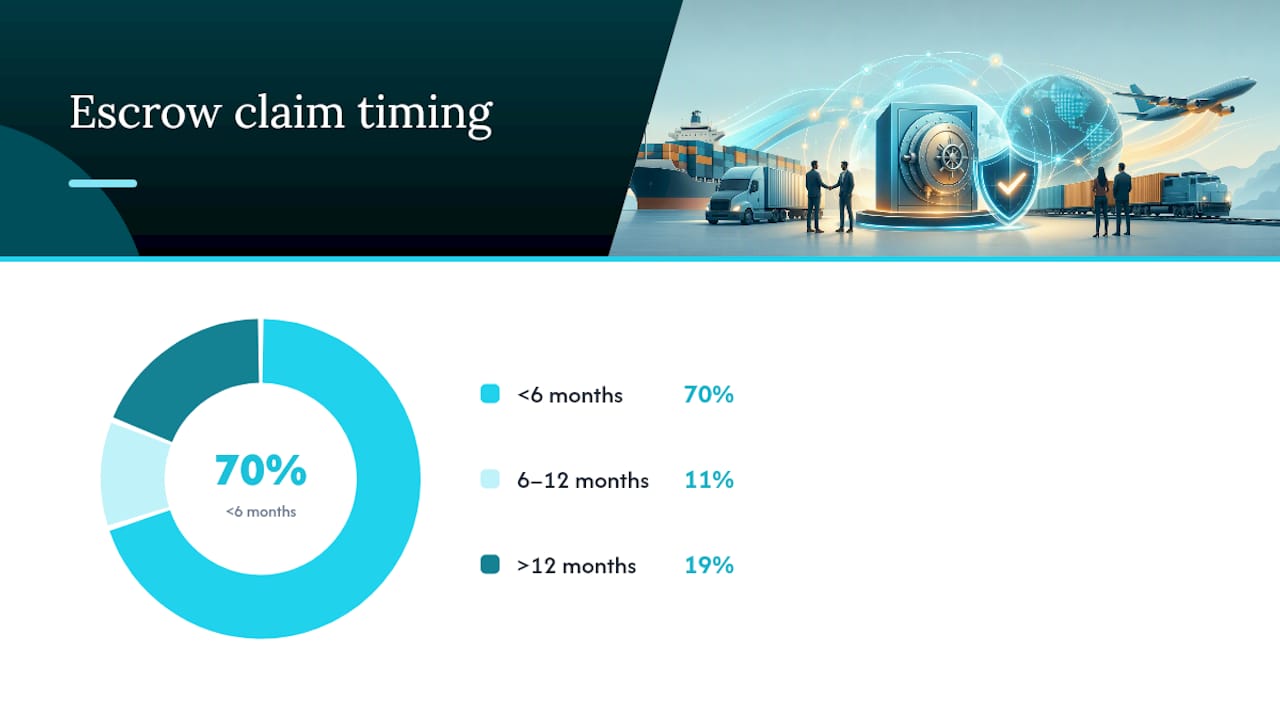
Statistic to build your calendar around: J.P. Morgan’s escrow study found that roughly 70% of escrow claims resolve in under six months, and 81% resolve within a year. Staged release schedules that mirror those windows aren’t arbitrary. They’re built around how claims actually behave.
Representations and warranties insurance changes this math. When a buyer carries RWI, the escrow often shrinks dramatically since the insurer absorbs most breach exposure, though a small escrow usually survives to cover policy exclusions and the retention layer.
Claim Procedure and Reserves: Keeping Funds From Freezing Indefinitely
Vague notice requirements are the single biggest cause of escrow funds sitting frozen for years. Delaware courts consistently enforce notice provisions strictly, so a claim that doesn’t match the agreement’s defined format can get thrown out, or worse, sit in limbo while both sides argue about whether notice was even valid.
A workable claim procedure needs three things drafted with precision:
- A defined notice-of-claim form specifying the required content: the alleged breach, the estimated damages, and the factual basis, submitted within a fixed window (commonly 30 to 60 days of discovery).
- Proportional reserve mechanics that let the escrow agent hold back only the disputed amount, with the rest released on schedule regardless of an open claim elsewhere in the account.
- A defined dispute path, usually arbitration or a named court, with a hard timeline for resolution rather than an open-ended negotiation clause.
Pro Tip: Build an automatic release clause into the escrow agreement that triggers if the buyer hasn’t submitted a compliant notice of claim by the scheduled release date. It shifts the burden onto the buyer to act, instead of leaving the seller to chase a release that never comes.
Escrow agents administer these mechanics but don’t adjudicate disputes. That’s the parties’ job, and Fasthoff Law Firm’s guidance stresses building the claim procedure into the agreement itself rather than leaving it to be negotiated after a dispute has already started.
Coordinating Escrow With RWI, Caps, and Baskets
Escrow doesn’t operate in isolation. It sits inside a recovery stack that usually includes an indemnity cap, a basket or deductible, and increasingly, RWI. The ABA’s 2025 deal points study flags order-of-recovery language as one of the most commonly missed drafting points, and its absence is what causes deadlocks when a claim exceeds escrow but falls under the cap.
A few things to nail down before signing:
- Whether escrow is the buyer’s exclusive remedy for covered claims, or just the first source of recovery before going after the seller directly.
- How RWI exclusions interact with the escrow, since insurers rarely cover everything the seller reps to.
- Basic tax treatment of escrowed funds, since interest earned inside the account is generally taxable to whoever is entitled to the principal, and accounting treatment differs depending on whether the funds are treated as contingent purchase price or a separate asset.
Get counsel involved on the tax and accounting mechanics early. This is not an area to improvise on a term sheet.
Applying This to Linehaul and Chemical-Sourcing Deals
Linehaul acquisitions carry a specific wrinkle: customer contract assignment inside the FedEx network isn’t automatic, and a gap in consent can create real post-closing exposure. RJR Worldwide Corp’s approach to linehaul acquisitions treats assignment consent and proof-of-delivery documentation as closing conditions, not post-closing cleanup, which shrinks the pool of claims an escrow ever needs to cover.
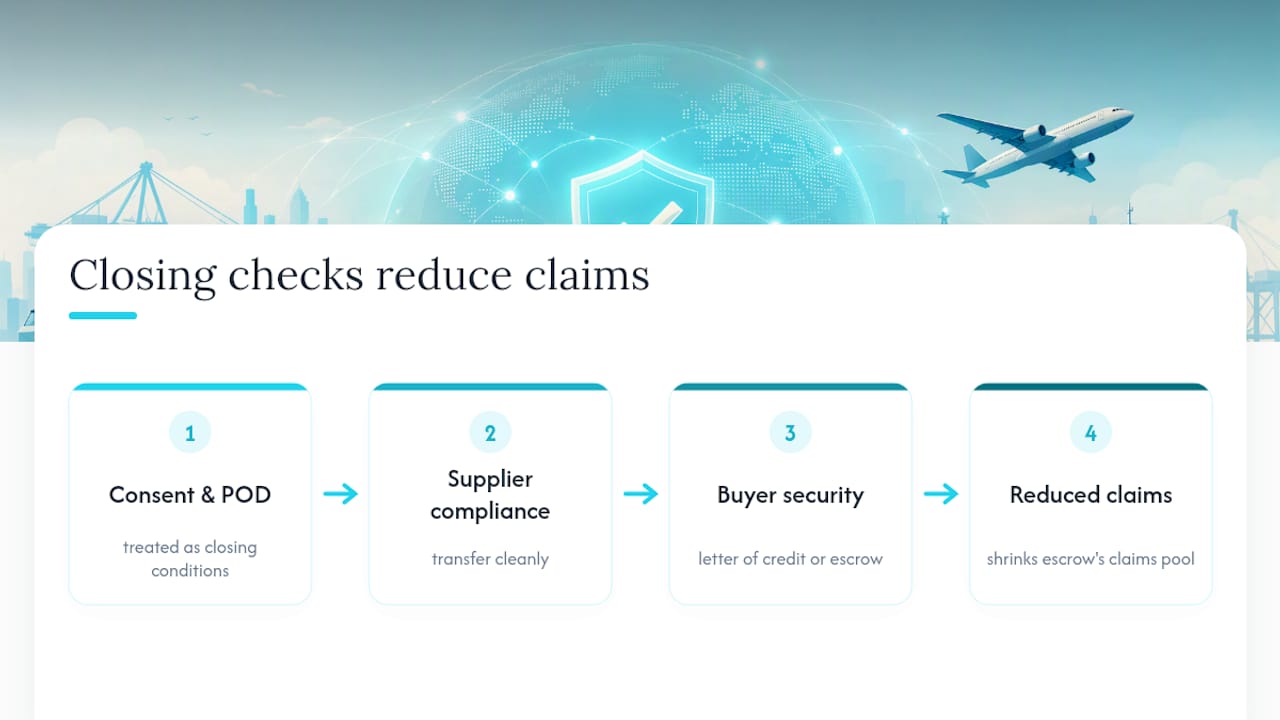
Chemical-sourcing transitions carry a parallel issue: supplier contract continuity and compliance documentation for food, technical, and pharmaceutical grades need to transfer cleanly, or the buyer inherits a compliance gap that shows up as an indemnity claim months later. Sellers working with a thinly capitalized buyer should ask for a letter of credit or bank-held escrow rather than accept a buyer-retained holdback.
Negotiation Priorities Every Party Should Walk in With
Buyers should preserve access to funds but narrow claim definitions and keep risk buckets separate, so one dispute doesn’t tie up money meant for something else entirely. Sellers should push for escrow over holdback, insist on objective claim triggers, and negotiate staged releases tied to real resolution timelines, not the buyer’s convenience.
Three things to lock down before signing: the exact notice-of-claim format, the release calendar with specific dates, and whether escrow is your exclusive remedy or just the first stop.
— RJR Worldwide
How RJR Worldwide Corp Supports Logistics M&A Transactions
Escrow and holdback terms only work if the operational handoff behind them is clean, and that’s where most logistics deals actually break down. Some buyers in logistics acquisitions acquire and integrate FedEx Linehaul businesses directly from terminals, aiming to ensure contract continuity, driver transition, and documentation handoffs as part of the deal itself rather than as a post-closing scramble that generates the very claims an escrow is meant to cover.

On the chemical-sourcing side, RJR’s multi-year, index-linked supply contracts with vetted China and India suppliers come with the compliance documentation buyers need to avoid post-closing disputes over grade or regulatory gaps. If you’re weighing a sale or an integration on either side of a logistics transaction, start by reviewing how RJR structures FedEx Linehaul acquisitions and reach out to discuss your specific deal.
Sources
- 2025 M&A holdback escrow study — J.P. Morgan
- Escrows and holdbacks in private M&A — Practical Law (Thomson Reuters)
- Escrows and holdbacks in M&A purchase agreements — Fasthoff Law Firm