30–90 Day FedEx Linehaul Transfer Approval for U.S. Buyers, TSA Steps

A FedEx linehaul transfer is a formal approval process that, once a buyer submits the required documentation, lets them assume an existing hub-to-hub FedEx linehaul contract from a seller. Most transfers close within a few months, with the biggest swing factor being how complete the buyer’s paperwork is when it lands on a terminal manager’s desk. If you’re serious about acquiring a route, start pulling together your business plan and incorporation documents now, and get the seller on a call before you make an offer.
TL;DR:
- Buyers should gather 12 months of settlement statements, complete corporate formation documents, and safety records to speed up FedEx approval.
- Lane stability and efficiency, including low deadhead miles and strong driver retention, are key determinants of route value.
- The ongoing Network 2.0 consolidation introduces regional risks, making short-term performance and contingency clauses crucial in negotiations.
- Approval timelines typically range from 30 to 90 days, with comprehensive documentation leading to faster FedEx review.
- Transition planning should focus on securing maintenance logs, cross-training dispatchers, and confirming equipment and driver staffing before close.
Table of Contents
- What Are FedEx Linehaul Routes, and Why Does Their Structure Matter?
- What Are the Real Benefits and Challenges of Owning a Route?
- What Determines a FedEx Linehaul Route’s Value?
- How Does the FedEx Linehaul Transfer Process Actually Work?
- What Documents Does FedEx Require, and How Long Does Approval Take?
- What Do Experienced Buyers Do Differently in the First 90 Days?
- Why Network 2.0 Changes How You Should Underwrite a Route
- How RJR Worldwide Supports Buyers Through the Transfer
- Where to Verify These Claims
- Sources
- FAQ
What Are FedEx Linehaul Routes, and Why Does Their Structure Matter?
Linehaul is the middle-mile backbone of the FedEx network: trailers moving freight between hubs and terminals on fixed lanes, rather than the last-mile delivery most people picture. Each route runs on a schedule with set departure and arrival windows, and that predictability is exactly what makes a route valuable or a liability, depending on how tightly it’s managed. Buyers should focus on lane stability, settlement statements, deadhead miles, and dispatch reliability before assigning a number to any route, since linehaul contracting centers on repeatable lanes and clean settlement data.
A few structural facts shape how these routes actually pay out:
- Contractors are typically paid for loaded miles, and sometimes for a portion of empty (“deadhead”) miles, depending on the lane agreement.
- Weekly settlement statements track mileage, fuel surcharges, and any accessorial pay, and they become the primary underwriting document for a buyer.
- Schedule adherence isn’t optional. Missed pickup or delivery windows at a hub can trigger penalties or jeopardize contract renewal, according to industry contracting guides.
What Are the Real Benefits and Challenges of Owning a Route?
The upside is real: linehaul contracts generate weekly settlements, and drop-and-hook operations mean drivers aren’t waiting around for freight to be loaded or unloaded by hand, which keeps utilization high. That efficiency is part of why buyers keep circling these routes as a cash-flow asset rather than a speculative bet.
The downside shows up in the details sellers don’t always volunteer.
- Deadhead miles on poorly matched lanes quietly eat into margin every single week.
- Uninsured downtime, a truck in the shop with no spare, turns a profitable week into a break-even one.
- Sudden maintenance costs on aging equipment can wipe out a quarter’s profit in one bad month.
Network changes add another layer of risk. FedEx’s ongoing Network 2.0 initiative is consolidating terminals and redrawing parts of the surface network, with full U.S. implementation expected by the end of 2027. A lane that looks stable today could get reassigned or restructured before that timeline closes out.
Pro Tip: Ask the seller for 12 months of settlement statements, not three. A single strong quarter can hide a lane that’s been sliding for the better part of a year.
What Determines a FedEx Linehaul Route’s Value?
Route valuation comes down to a handful of hard numbers, not a seller’s story about “steady work.” Revenue-per-mile matters more than gross revenue, because a route pulling in $8,000 a week with heavy deadhead can be worth less than one pulling in $6,500 with tight, efficient lanes.
Here’s what to verify before you put a number on any offer:
- Revenue stability: at least 12 months of settlement history, checked against deadhead percentage on each leg.
- Driver continuity: how long current drivers have been on the route, and whether payroll records match what the seller claims.
- Maintenance records: full service history on every tractor and trailer tied to the route, including any DOT violations.
- Lane type and contract terms: dedicated lanes generally carry more predictable revenue than supplemental or spot work, and shorter contract terms mean more renewal risk.
Treat the settlement statements as the actual product being sold. Clean, complete documentation on mileage, fuel surcharges, and accessorial pay is what lets you convert a seller’s claims into cash flow you can actually underwrite, rather than numbers you have to take on faith.
How Does the FedEx Linehaul Transfer Process Actually Work?
The transfer moves through five distinct stages, and skipping steps almost always costs you time later.
-
Find the route and make an initial offer. Request the seller’s last 12 months of settlement statements, current insurance certificates, and a basic equipment list before you put a number on paper. This isn’t the time to be polite about missing paperwork.
-
Run your own due diligence. Review the financials line by line, walk the terminal, and do a ride-along if the seller allows it. Check the tractors and trailers in person. Photos in a listing rarely tell you about a transmission that’s about to fail.
-
Assemble your FedEx approval packet. This is the RFI/business plan, corporate formation documents, your FEIN, state tax IDs, and a written safety and operational experience summary. Incomplete packets are the single biggest cause of delay at this stage.
-
Submit for FedEx review. Expect direct interaction with terminal or regional operations managers, who will vet your business plan, financial capacity, and operational readiness. This is where the FedEx business account portal becomes relevant for procedural questions and account setup.
-
Close and transition. Reconcile the final settlement statement with the seller, confirm equipment and staffing carry over as agreed, and set your operational priorities for the first 30 to 90 days: dispatch coverage, maintenance scheduling, and driver retention come first.
Buyers who preassemble their RFI elements and corporate filings before making an offer routinely move through FedEx review faster than those who scramble to gather documents after a deal is already in motion.
What Documents Does FedEx Require, and How Long Does Approval Take?
FedEx’s review focuses on whether your business can actually run the route, not just whether you can pay for it. That means corporate structure matters as much as cash.
Get these ready before you submit anything:
- Corporate formation: articles of incorporation for a C-Corp or S-Corp (purchaser advisories generally favor a formal corporate structure over a sole proprietorship), plus your Secretary of State filing.
- Tax and payroll IDs: your FEIN, state tax withholding ID, and unemployment insurance account number.
- RFI/business plan: financial statements, a staffing and driver retention plan, your safety record, and a written contingency plan for equipment failure or driver shortages.
- Insurance and equipment: current insurance certificates, background check clearances, and a full equipment list with maintenance logs.
Approval timelines commonly run 30 to 90 days, and terminal-level document review is usually the bottleneck, not FedEx corporate. Buyers who show up with a complete packet on day one tend to land at the shorter end of that range; buyers who submit partial documentation and fill in gaps over several weeks tend to land at the longer end.
What Do Experienced Buyers Do Differently in the First 90 Days?
The buyers who avoid costly surprises treat the transition itself as a project, not an afterthought. RJR Worldwide’s own transition work centers on Transition Services Agreements built around seven specific schedule fields, covering everything from dispatch handoff to maintenance record custody, which shortens the gap between closing and full operational control.
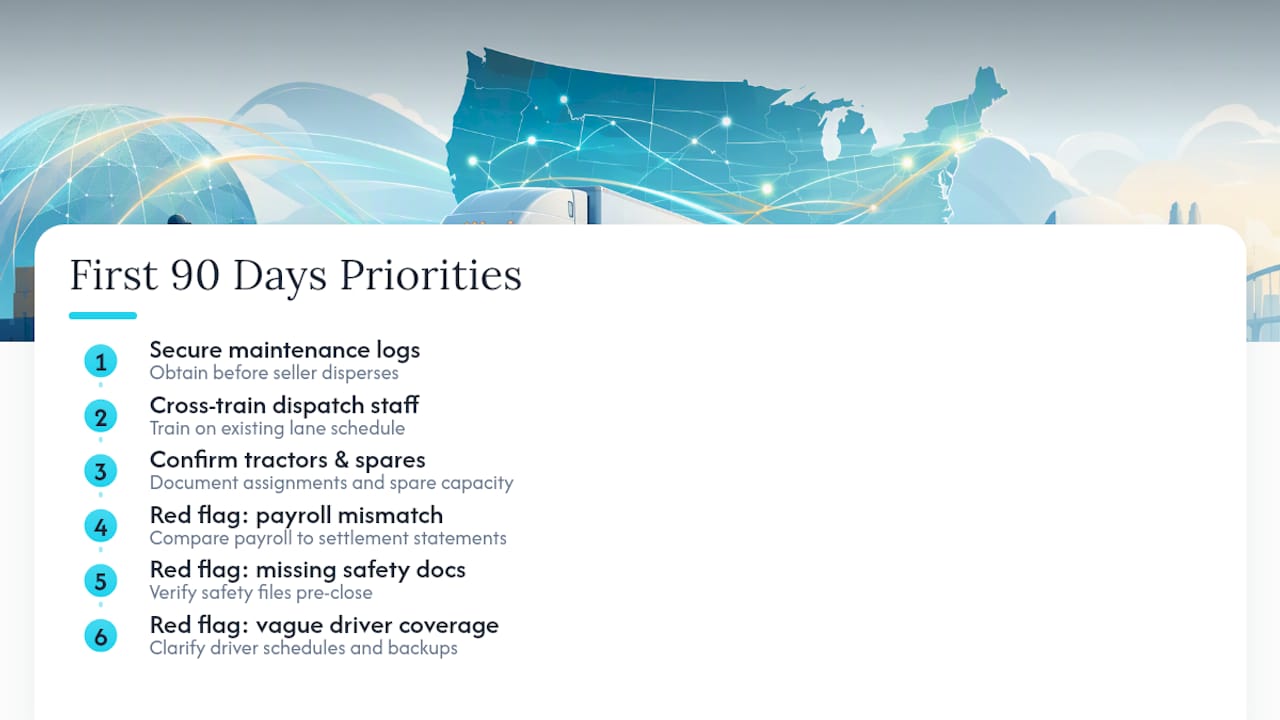
Three priorities matter most right after close: secure every maintenance log before the seller’s team disperses, cross-train your dispatch staff on the existing lane schedule, and confirm tractor assignments plus spare capacity in writing. Payroll records that don’t match settlement statements, missing safety documentation, and vague driver coverage plans are the red flags that show up most often, and each one is fixable if you catch it before closing rather than after.
Pro Tip: Get the outgoing dispatcher’s notes, not just the seller’s. Dispatchers know which customers call late, which docks run behind schedule, and which drivers actually show up on time. That knowledge doesn’t transfer on paper.
Why Network 2.0 Changes How You Should Underwrite a Route
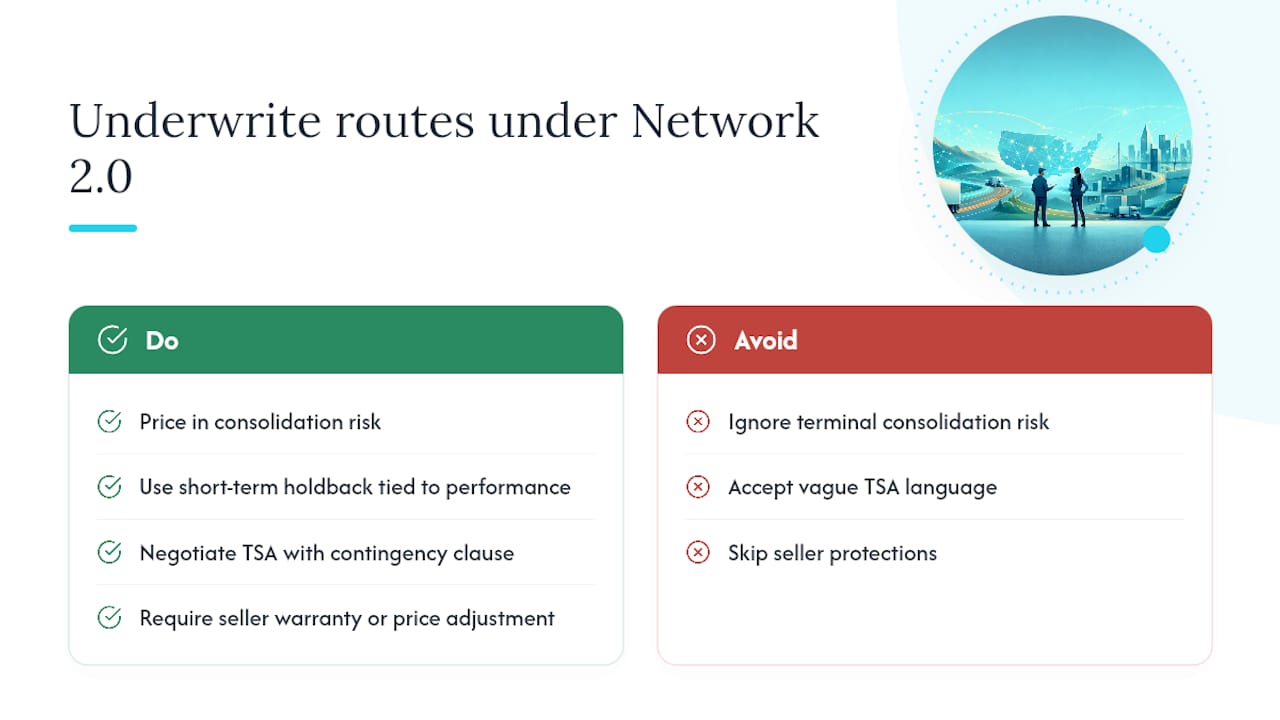
FedEx’s Network 2.0 consolidation is redrawing terminal assignments across the country, with completion targeted for the end of 2027. That means a lane’s five-year outlook carries more uncertainty than it did a decade ago, and buyers should price that uncertainty into the offer, not ignore it.
Build in a short-term holdback tied to lane performance, negotiate a stronger TSA with explicit contingency language, and don’t hesitate to ask for a seller warranty or price adjustment if the lane sits inside a terminal slated for consolidation.
— RJR Worldwide
How RJR Worldwide Supports Buyers Through the Transfer
The guidance behind this article draws on experience running dedicated and spot linehaul lanes rather than just brokering paperwork between strangers. This experience translates into faster approval packets, thorough TSA drafting covering operational details sellers might omit, and transition planning that supports continuous freight movement.
If you’re evaluating a linehaul acquisition and want a second set of eyes on due diligence, document prep, or transition structuring, RJR Worldwide’s chemical sourcing and linehaul division is the place to start that conversation. Reach out before you make an offer, not after, and you’ll have a stronger negotiating position and a cleaner path through FedEx’s approval review.
Where to Verify These Claims
FedEx’s own annual report filing covers Network 2.0’s terminal consolidation timeline. The FedEx business account portal hosts procedural resources for approvals, and BuildAGroundBiz explains linehaul contracting mechanics in detail. Logistics-routing background is also available through MGT DRS.
Sources
- Federal Express Corporation Annual Report (excerpt) — Network 2.0
- What Is Linehaul: Maximize FedEx Route Value | Bizbe
- Mybizaccount
- Contracting with FedEx Ground — Types of opportunities | BuildAGroundBiz
FAQ
How Does FedEx Linehaul Work?
FedEx linehaul moves freight between hubs and terminals on fixed, scheduled lanes, the middle-mile leg that connects local pickup and delivery operations to the broader network. Contractors run these lanes under agreements that pay largely by loaded mile, with settlement statements tracking mileage, fuel surcharges, and any accessorial pay each week.
How Much Money Does Linehaul Make for FedEx?
FedEx doesn’t publish route-level linehaul revenue figures, but the broader business runs on scheduled contract service agreements with independent contractors rather than direct route ownership. Individual route profitability depends heavily on lane efficiency, deadhead percentage, and equipment costs rather than any single published number.
What Is the 11 Hour Rule for FedEx?
The 11-hour rule refers to federal Hours of Service regulations that cap a commercial driver’s maximum driving time within a regulated on-duty window before requiring a mandated rest period. FedEx contractors and their drivers must comply with these federal limits regardless of lane schedule or delivery pressure.
What Are the Different Stages of FedEx Delivery?
Package movement generally runs through pickup, sortation at a local facility, linehaul transport between hubs, sortation at the destination terminal, and final local delivery. Linehaul is specifically the hub-to-hub middle stage, distinct from the last-mile delivery most customers see.
How Long Does FedEx Linehaul Transfer Approval Take?
Approval typically takes 30 to 90 days, depending largely on how complete the buyer’s documentation is when submitted. Buyers who preassemble their RFI, corporate filings, and financial statements before making an offer tend to move through review faster than those who submit partial packets.