2.35–3.75x SDE: FedEx Linehaul Valuation, U.S. Operator Playbook

Most U.S. Route stability and Network 2.0 exposure swing a deal well outside either range. Sellers who arrive with clean books and documented lanes capture the high end; those who don’t often watch buyers walk.
TL;DR:
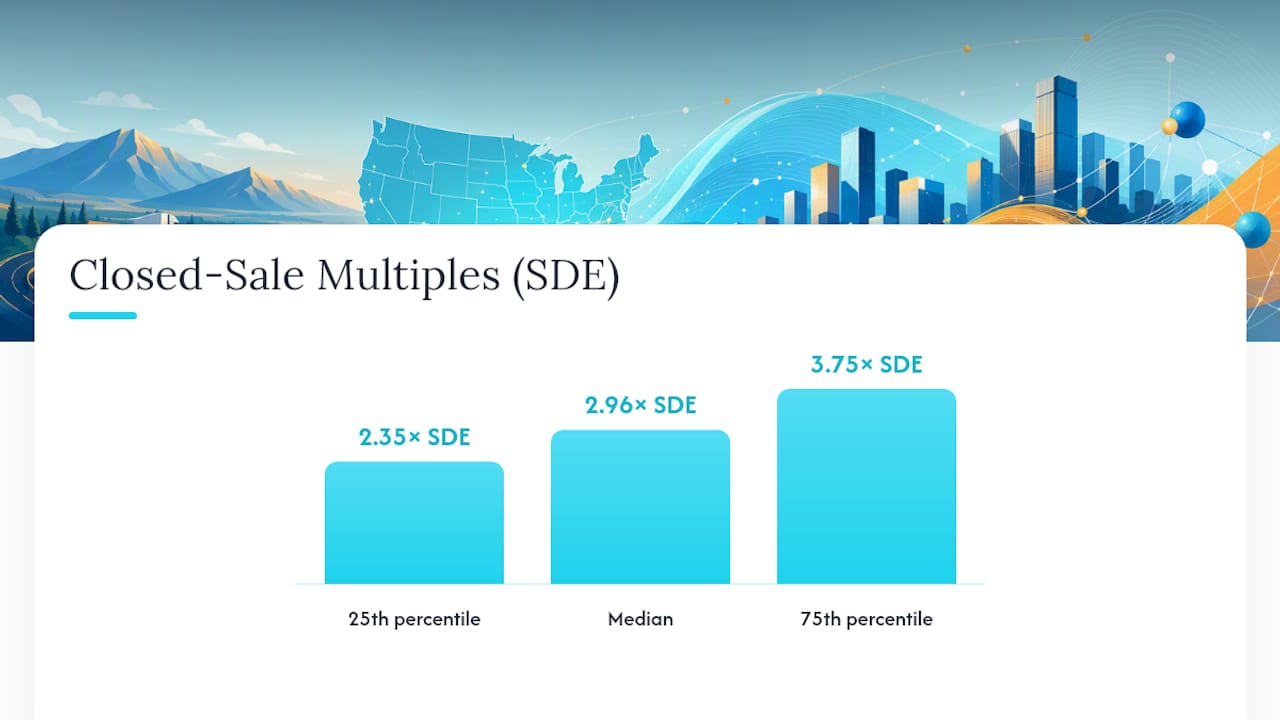
- Most small FedEx linehaul operations sell at a median of roughly 2.96x SDE, with a typical deal range between 2.35x and 3.75x.
- Buyers mainly focus on route stability, contract durability, driver retention, maintenance history, and safety scores during due diligence.
- The valuation must be supported by accurate earnings, a strong contract, and documentation, especially regarding lane revenue and maintenance records.
- Network 2.0 increases risk by potentially restructuring routes and hubs before the deal closes, influencing buyer discounts.
- Most acquisitions finalize within 60 to 120 days, emphasizing the importance of organized documentation and thorough pre-closing preparations.
Table of Contents
- FedEx Linehaul Valuation Benchmarks and What Deals Actually Close At
- What Buyers Underwrite Before They Sign an LOI
- How to Calculate a FedEx Linehaul Valuation Step by Step
- Why Network 2.0 Changes How You Price a Route
- The Due Diligence Checklist That Protects Your Multiple
- How FedEx Linehaul Deals Get Structured and Financed
- What Actually Moves the Needle on a Linehaul Sale
- How RJR Worldwide Supports FedEx Linehaul Buyers and Sellers
- Sources
- FAQ
FedEx Linehaul Valuation Benchmarks and What Deals Actually Close At
Most brokers quote multiples that never survive due diligence. Sold-transaction data tells a more disciplined story. Practitioner benchmarks drawn from closed sales show small trucking operators, including FedEx linehaul contractors, typically sell at a median near 2.96x SDE, with the middle 50% of deals landing between 2.35x and 3.75x. That’s the number sellers should anchor to, not the aspirational figure a listing site prints.
Larger fleets change the math entirely.
A few patterns show up across representative comps:
- Dedicated linehaul lanes with multi-year FedEx agreements typically price above spot or variable-assignment routes.
- Revenue multiples for linehaul often run higher than pickup-and-delivery (P&D) routes because linehaul contracts tend to carry more schedule certainty than P&D work.
- Individual buyers using SBA financing anchor to SDE multiples; institutional and search-fund buyers underwrite to EBITDA and demand cleaner financials.
- Deals with unverifiable owner add-backs get discounted hard, regardless of the headline multiple a seller wants.
The gap between broker chatter and closed deals is real.
What Buyers Underwrite Before They Sign an LOI
Every FedEx linehaul acquisition gets picked apart on the same handful of risk factors. Buyers aren’t pricing the truck. They’re pricing the durability of the contract sitting behind it.
- Route stability and schedule quality. Dedicated lanes with consistent daily or weekly assignments underwrite far better than routes cobbled together from spot work.
- Terminal dependency and geographic concentration. A route tied to a single terminal that could get folded into a hub redesign carries more Network 2.0 exposure than one serving a stable regional corridor.
- Driver bench strength and turnover. A seller with two spare qualified drivers and low turnover is worth more than one running on a single point of failure.
- Dispatch and backup coverage. Buyers want proof the operation survives a driver calling in sick without missing a FedEx dispatch window.
- Maintenance discipline and equipment age. A tractor fleet with deferred maintenance and high mileage means a capex bill lands on the new owner within the first year.
- DOT safety scores and insurance claims history. A clean CSA score and low claims history reduce insurance costs and signal operational competence.
- Revenue composition. Fixed, contracted revenue supports a higher multiple than variable or seasonal freight that could disappear next quarter.
Every one of these factors either tightens or widens the discount buyers apply to the base multiple. A route that checks every box justifies pricing at the top of its range. One with driver turnover problems and an aging fleet gets priced like a liability with wheels.
How to Calculate a FedEx Linehaul Valuation Step by Step
Get the earnings number right before worrying about the multiple. Most valuation disputes trace back to a seller inflating add-backs or a buyer refusing to recognize legitimate ones.
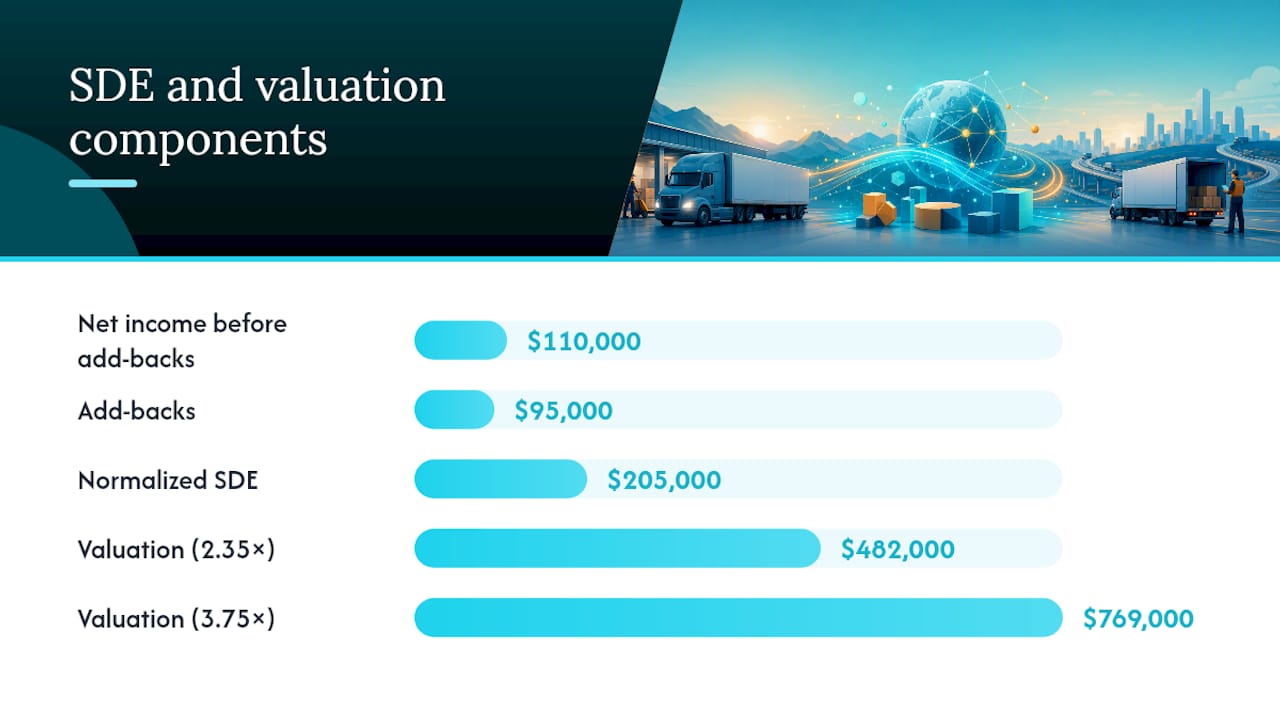
Start with seller’s discretionary earnings (SDE) for any single-route or small-fleet deal. Take net income, then add back owner salary, personal vehicle expenses run through the business, one-time legal or repair costs, and interest and depreciation. For larger fleets moving toward institutional buyers, convert to EBITDA by removing the owner-salary add-back and instead normalizing for a market-rate general manager, since institutional buyers won’t run the business themselves.
Here’s a simplified worked example for a single dedicated linehaul route:
- Annual revenue: $850,000
- Net income before add-backs: $110,000
- Add-backs (owner salary, personal auto, one-time repairs): $95,000
- Normalized SDE: $205,000
Pro Tip: Apply the 2.35x to 3.75x SDE range to that $205,000 and you get a valuation range of roughly $482,000 to $769,000. Then sanity-check against a revenue multiple (routes rarely price above 0.5x to 0.9x revenue) and against the liquidation value of trucks and trailers. If the SDE multiple implies a price the equipment and revenue floor can’t support, the earnings number is probably wrong, not the multiple.
Why Network 2.0 Changes How You Price a Route
FedEx’s own disclosures give buyers a rare, primary-source look at the risk they’re underwriting. The company’s 2026 annual report confirms that Network 2.0 is restructuring the U.S. surface network, with full U.S. implementation targeted for completion by calendar 2027. FedEx contracts with approximately 5,300 independent small businesses across linehaul and P&D operations, and any one of those relationships can shift when a hub gets consolidated or a lane gets redrawn.
Network 2.0 is transforming the U.S. surface network, and implementation in the U.S. is expected to complete by calendar year 2027. That timeline means any route bought today could operate under a materially different network map before the note on a seller-financed deal is paid off.
Rate volatility compounds the risk. DAT reported truckload freight rates and diesel surcharges hitting multiyear highs in 2026, squeezing per-mile margins across the industry. A buyer modeling a linehaul acquisition today needs to stress-test both hub consolidation risk and fuel-cost volatility over the next 12 to 24 months, not just trailing twelve-month earnings.
The Due Diligence Checklist That Protects Your Multiple
Sellers who show up organized keep more of their asking price. Buyers who skip any item on this list usually regret it within the first year of ownership.
- Settlement statements with lane-level detail. Buyers want to see revenue broken out by route, not a blended top-line number that hides a weak lane.
- Driver rosters and payroll records. This confirms staffing depth and shows whether wages are competitive enough to retain drivers post-close.
- Maintenance logs and repair history. A full service history on every truck and trailer flags deferred capex before it becomes the new owner’s problem.
- Insurance claims and DOT safety records. Clean records reduce future premium risk and confirm the operation isn’t one accident away from a rate hike.
- Contract files, amendments, and remaining term. Buyers need to see the actual FedEx agreement, not a verbal description of “how it usually works.”
- Seller financing documentation. If the seller is carrying a note, get the terms, security interest, and default provisions in writing before the LOI is signed.
Pro Tip: Request TSA schedule fields as part of diligence, not after close. A transition services agreement that defines dispatch handoffs and terminal access up front prevents the operational gap that kills value in the first 90 days of ownership.
How FedEx Linehaul Deals Get Structured and Financed
Most FedEx linehaul acquisitions close with a blend of cash, an SBA 7(a) loan, and seller financing covering the gap. Full seller financing is rare; a seller note covering 10% to 30% of the price is common and often what gets a deal across the finish line, since it signals the seller believes in the route’s durability.
- Cash plus SBA financing is the default structure for individual buyers acquiring a single route or small fleet.
- Earn-outs show up when a buyer wants to hedge against Network 2.0 uncertainty tied to a specific lane.
- Seller notes narrow the price gap between listing price and what a lender will actually underwrite.
Expect a timeline of 60 to 120 days from signed letter of intent to close, with diligence and TSA negotiation consuming most of that window. Net proceeds depend heavily on deal structure and how the sale is allocated between asset classes for tax purposes, so sellers should get a tax advisor involved before signing the LOI, not after.
What Actually Moves the Needle on a Linehaul Sale
Most sellers overestimate what a clean truck and a friendly relationship with a terminal manager is worth. Buyers price contracts, not goodwill. The fastest way to raise an achievable multiple isn’t cosmetic. It’s fixing driver turnover, documenting every lane’s revenue history for two full years, and resolving deferred maintenance before a buyer finds it during inspection.
Buyers, for their part, need to stress-test every lane against Network 2.0’s 2027 timeline and ask a direct question the seller may not want to answer: what happens to this specific route if the hub it feeds gets consolidated? RJR Worldwide’s acquisition experience running terminal operations and transition services has shown that the deals that hold their value are the ones where documentation survives that question, not the ones where the seller just insists the route is “always been steady.”
— RJR Worldwide
How RJR Worldwide Supports FedEx Linehaul Buyers and Sellers
Some buyers operate directly from California terminals, manage dedicated lanes, and acquire and integrate FedEx linehaul operations firsthand, which means the diligence standard above isn’t theoretical.
For sellers, that means a buyer who understands transition services agreements, driver retention, and terminal continuity well enough to close fast and keep the business running without disruption. For buyers exploring the market, it means access to an operator’s-eye view of what separates a durable lane from a Network 2.0 liability. RJR also supplies industrial and specialty chemical sourcing, including sodium metabisulfite, xanthan gum, and calcium hypochlorite, backed by index-linked pricing and full compliance documentation for manufacturers and industrial buyers who need supply certainty alongside operational reliability. If you’re evaluating a FedEx linehaul acquisition or considering a sale, start the conversation on RJR’s acquisition resource page to see how transition support and terminal-based continuity apply to your specific route.
Sources
- Federal Express 2026 annual report (SEC filing)
- What drives trucking company valuation multiples in 2026 · Iconic
- DAT: Truckload freight rates hit two-year highs as diesel costs surge
- FedEx Linehaul Carriers: A Complete Guide to Opportunities, Risks, and Valuation — JackimWoods
FAQ
How Much Money Does Linehaul Make for FedEx?
FedEx does not break out linehaul-specific profit in its public filings; linehaul is operated largely through independent contracted businesses rather than as a separate reported segment. What’s publicly documented is that FedEx works with approximately 5,300 independent small businesses running linehaul and P&D routes, and those operators’ individual profitability depends on lane assignment, contract terms, and cost control rather than a company-wide figure.
Is FedEx Bigger Than UPS or Amazon in Revenue?
Public comparisons of FedEx, UPS, and Amazon’s logistics revenue vary by which segment is being measured, and this article does not have sourced figures to state a definitive ranking. Investors evaluating a linehaul acquisition should focus on FedEx’s own disclosed contractor network and Network 2.0 timeline rather than cross-company revenue comparisons, since that’s the data that actually affects route valuation.
What Multiple Should I Expect When Selling a FedEx Linehaul Route?
Small, single-route FedEx linehaul operations typically sell near a median of 2.96x seller’s discretionary earnings, with most closed deals falling between 2.35x and 3.75x.
Does Network 2.0 Make My Route Worth Less?
Not automatically, but it does add underwriting risk that buyers now factor into price. Routes tied to terminals or hubs likely to be consolidated under Network 2.0’s 2027 completion timeline should expect more buyer scrutiny and possibly a discount versus a route with clearer long-term lane stability.
How Long Does It Take to Close a FedEx Linehaul Acquisition?
Most deals move from signed letter of intent to close within 60 to 120 days, with the bulk of that time spent on financial diligence and negotiating a transition services agreement. Sellers who arrive with organized settlement statements, driver rosters, and maintenance records consistently close faster than those who assemble documentation after the LOI is already signed.