Buying a FedEx Linehaul Route: Operations and Terminal Rules
Yes, buying and operating a FedEx linehaul route is a viable U.S. business when you get three things right before you sign anything. First, verify the lane’s contract stability, meaning how likely it survives FedEx’s ongoing network consolidation. Second, confirm regulatory compliance is airtight, since DOT and Hours of Service violations kill deals and revoke authorizations. Third, model your working capital honestly, because fuel, driver pay, and maintenance hit before FedEx settlements clear. Operators like RJR Worldwide Corp, which runs dedicated lanes directly out of Southern California terminals, show what disciplined terminal operations look like in practice.
Before you go further, weigh these three filters against any route you’re evaluating:
- Contract stability: Has the lane survived recent station consolidation, and what does the service agreement say about unilateral removal?
- Compliance history: Are there open Hours of Service violations, missing driver qualification files, or unresolved safety events?
- Cashflow runway: Do you have 60 to 90 days of operating capital before FedEx settlement payments normalize?
Key Takeaways
A viable FedEx linehaul acquisition depends on verified contract stability, documented compliance history, and enough working capital to survive the settlement payment cycle.
| Point | Details |
|---|---|
| Verify lane survivability | Check whether the route has weathered recent Network 2.0 station consolidation. |
| Demand VEDR history | Pull at least 90 days of driving event data before finalizing any purchase. |
| Model deadhead miles | Base valuation on revenue per mile after empty miles, not gross contracted mileage. |
| Separate insurance from ops budget | Carry cargo, auto liability, and physical damage coverage priced by a trucking specialist. |
| Use an integrated operator | RJR Worldwide Corp supports acquisition sourcing, diligence, and lane integration from its own California terminals. |
Table of Contents
- What Is FedEx Terminal Operations Linehaul?
- What Types of Linehaul Runs Does FedEx Assign?
- Is Owning a FedEx Linehaul Route a Good Investment?
- What Compliance Rules Govern FedEx Linehaul Operations?
- How Do You Value a FedEx Linehaul Route for Purchase?
- What Is the FedEx Linehaul Contracting and Approval Process?
- RJR Worldwide: Lessons From Terminal-Level Linehaul Operations
- How Do You Qualify and Onboard as a Linehaul Operator?
- What Insurance Do FedEx Linehaul Operators Need?
- How Do You Recruit and Retain Linehaul Drivers?
- What Equipment and Technology Standards Does FedEx Require?
- When Should You Walk Away From a Linehaul Deal?
- How RJR Worldwide Supports Linehaul Acquisitions and Operations
- Sources
What Is FedEx Terminal Operations Linehaul?
FedEx terminal operations linehaul refers to the scheduled freight runs that move trailers between FedEx Ground stations, hubs, and sort facilities, distinct from the last-mile pickup and delivery (P&D) that gets packages to your door. Linehaul is the connective tissue of the hub-and-spoke system: freight arrives at a station, gets consolidated, and rides a linehaul trailer to the next node in the network, whether that’s a regional hub or another terminal.
FedEx Express uses employee drivers for much of its air-integrated network, but Ground and linehaul work runs almost entirely through contracted Transportation Service Providers, or TSPs, which are a distinct role from the Independent Service Providers, or ISPs, who handle P&D routes. There are roughly 5,900 ISP contractors covering pickup and delivery nationally, with TSPs occupying the linehaul and spot side of that same contracted ecosystem.
Scale matters here. The average package currently spends about 1.9 days moving through the FedEx Ground system, and FedEx is actively working to shrink that window by cutting total facility count from roughly 1,200 to about 1,000 by 2027 under its Network 2.0 initiative. That consolidation directly reshapes which linehaul lanes exist, grow, or disappear.
What Types of Linehaul Runs Does FedEx Assign?
Not every linehaul contract looks the same, and the assignment model you buy into shapes your staffing, equipment, and cashflow from day one.
- Assigned runs give you a fixed schedule and dedicated lane, which makes driver scheduling predictable and simplifies maintenance planning around known mileage.
- Unassigned or team runs offer more route flexibility but often involve overnight layovers, which triggers more complex Hours of Service tracking and usually requires two-driver teams to keep freight moving continuously.
- Spots, or spotted trailers, are ad hoc trailer drops and pickups at a station used to balance capacity during peak volume. These improve equipment utilization but require tighter coordination with station management.
Buyers often underestimate how much the assignment type affects driver retention. Team runs with overnight layovers see higher turnover than predictable assigned lanes, simply because most drivers prefer to sleep in their own bed.
Is Owning a FedEx Linehaul Route a Good Investment?
The business case rests on contracted, recurring revenue tied to an established carrier network, and that stability is the entire appeal. You’re not chasing spot-market freight; you have a service agreement with defined lanes and expected volume. That predictability lets owners scale by adding trucks and drivers against known demand rather than gambling on load boards.
The downside is real capital exposure. A tractor-trailer fleet, insurance, and working capital to cover payroll before FedEx settlements land all require serious upfront cash. Fuel price swings and driver turnover under Hours of Service constraints eat into margin faster than most first-time buyers expect, and equipment breakdowns on a tight-margin lane can wipe out a month’s profit.
Contract terms make or break the return:
- Mileage reimbursement rates and fuel surcharge structures determine your actual per-mile profit, not the headline rate.
- Premium pay for weekend or holiday runs can meaningfully boost annual revenue on the right lane.
- Lane type matters: a high-density urban linehaul route generally sees steadier utilization than a rural spur that depends on seasonal volume.
- Contract length and renewal terms tell you how exposed you are to a station-level reassignment during consolidation.
Buyers who treat the purchase price as the only number, and skip modeling these contract mechanics, are the ones who regret the deal within a year.
What Compliance Rules Govern FedEx Linehaul Operations?
Compliance isn’t optional paperwork here. It’s the difference between a route that runs and one that gets suspended mid-contract.
- DOT Hours of Service: drivers are limited to an 11-hour driving window within a 14-hour on-duty period, and violations trigger FedEx station audits fast.
- CDL-A licensing: every linehaul driver needs a Class A Commercial Driver’s License, and lapses or endorsement gaps disqualify a driver immediately.
- VEDR monitoring: Video Enhanced Driver Response systems record in-cab footage and driving events, and FedEx expects operators to review flagged incidents, not just install the hardware.
- Pre and post-trip inspections: documented daily, since missing inspection logs are one of the fastest ways to fail an audit.
- Hazmat protocols: apply where lanes carry regulated materials, requiring specific driver certification and placarding compliance.
Pro Tip: Pull 90 days of VEDR event history before you buy any route. A clean recent record tells you more about a lane’s real risk profile than any sales pitch from the seller.
How Do You Value a FedEx Linehaul Route for Purchase?
Valuation starts with revenue per contracted mile, but the real number that matters is revenue per mile after deadhead, meaning the empty miles a driver runs without a paying load. A lane that looks profitable on paper can quietly bleed margin if deadhead percentage is high.
Track these cost buckets separately when building your model:
- Driver wages and benefits, typically the largest recurring cost.
- Fuel, which moves independently of your control and needs a surcharge clause to hedge against.
- Maintenance and tires, which climb sharply on older equipment.
- Insurance premiums, covered in more detail below.
- Capital expenditure for tractors and trailers, whether financed or paid outright.
Most buyers in this space anchor valuation to a multiple of trailing EBITDA, adjusted for one-time expenses the seller may have buried in the books. During diligence, expect to add back owner’s compensation while also stripping out any deferred maintenance the seller postponed to inflate short-term cashflow. A lookback of 12 to 24 months of actual settlement statements, not projections, is the only reliable basis for a valuation number you can defend later.
What Is the FedEx Linehaul Contracting and Approval Process?
Getting approved to operate a linehaul route follows a fairly consistent sequence, though timelines vary by station and region.
- Submit inquiry and application to the relevant FedEx Ground station or through an existing TSP relationship, including company formation and safety documentation.
- Station and area review, where FedEx evaluates lane need, your equipment plan, and operational capacity against local volume.
- Insurance and background checks, covering both the company and named drivers, plus a review of any prior safety violations.
- Schedule and service agreement execution, sometimes referred to as Schedule L addenda, which spell out lane specifics, rates, and performance expectations.
If you’re buying an existing route rather than starting fresh, request the seller’s driver qualification files, maintenance logs, fuel records, and VEDR data before closing. Delays most often trace back to incomplete insurance filings, open compliance violations, or a station simply not needing added capacity on that lane right now.
RJR Worldwide: Lessons From Terminal-Level Linehaul Operations
Running dedicated lanes directly from California terminals means RJR Worldwide Corp answers to the same operational pressures every buyer in this space will face. Indexed pricing tied to fuel and freight benchmarks protects margin when costs move, rather than absorbing volatility after the fact.
Acquisitions close cleaner when the handover includes real documentation, not verbal assurances:
- VEDR datasets covering recent driving history and flagged events.
- Written standard operating procedures for dispatch and maintenance.
- A driver retention plan, since losing your driver base on day one of ownership erases whatever value you paid for.
Pro Tip: Ask any seller for their spotting and backhaul planning practices specifically. A route that only runs loaded one direction is leaving money on the table every single trip.
How Do You Qualify and Onboard as a Linehaul Operator?
FedEx station managers vet prospective operators on a mix of financial and operational criteria before granting authorization. You’ll typically need to demonstrate business formation documents, a Federal EIN, and proof of adequate startup capital, since undercapitalized operators tend to fail fast and disrupt station schedules.
Safety history matters as much as balance sheet strength. Any principal or driver with a recent pattern of moving violations, DOT out-of-service orders, or prior contract terminations faces closer scrutiny, and some stations will decline outright. Expect a review of your proposed equipment, including tractor and trailer age, maintenance records, and whether the fleet meets the route’s weight and configuration requirements.
Onboarding itself moves through a few distinct phases. First comes documentation submission: business licensing, insurance certificates, and driver qualification files for anyone who’ll run the route. Next is a station-level orientation covering local dock procedures, load securement standards, and communication protocols with dispatch. Many stations also require a probationary period, often 30 to 90 days, where your performance on scheduled pickups, on-time delivery to the next node, and safety compliance gets tracked closely before the relationship becomes long-term.
New operators sometimes assume qualification is a one-time hurdle. It isn’t. FedEx reserves the right to reassess a contractor’s standing whenever safety scores slip or service failures pile up, so onboarding is really the start of an ongoing performance relationship, not a finish line.
What Insurance Do FedEx Linehaul Operators Need?
Insurance requirements for linehaul contractors run higher than a typical local trucking operation, reflecting the freight value and liability exposure of interstate hub-to-hub runs. At minimum, expect to carry commercial auto liability, cargo insurance covering the freight you’re hauling, and general liability for terminal and dock operations.
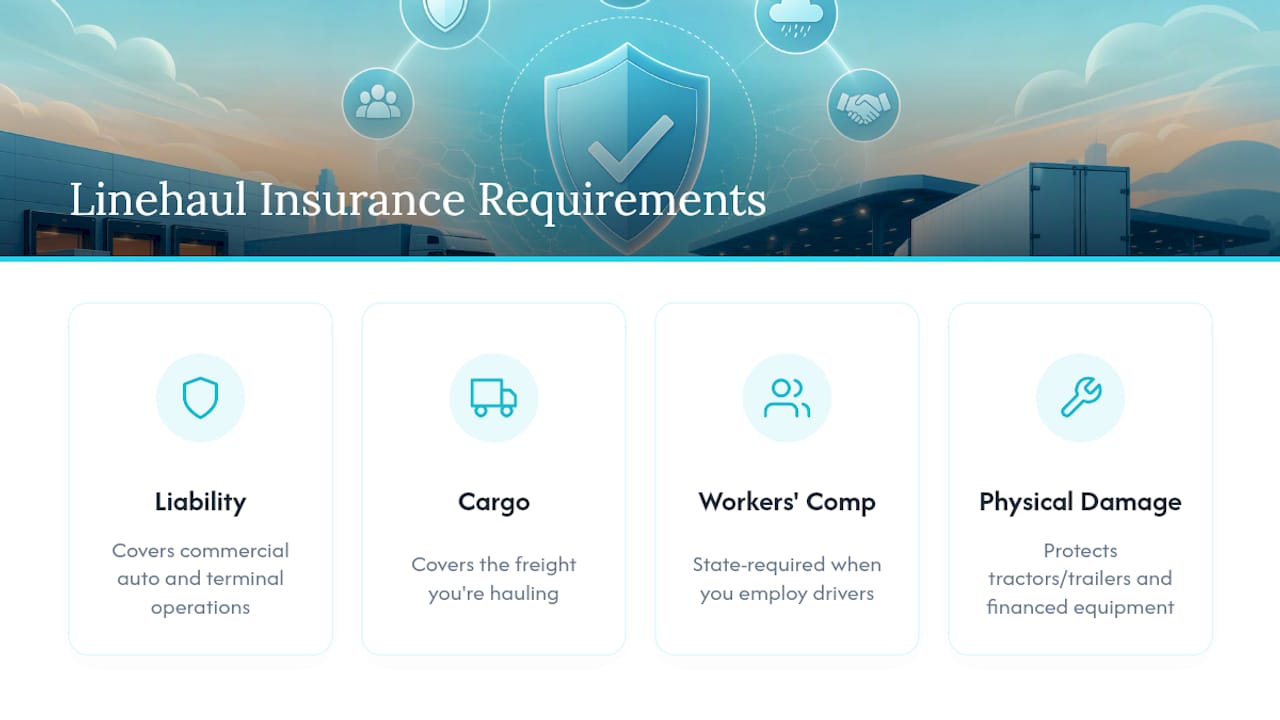
Workers’ compensation coverage is non-negotiable if you employ drivers directly rather than using owner-operators, and most states require it regardless of fleet size. Physical damage coverage on tractors and trailers protects your capital investment, which matters more than it might seem given how much equipment financing typically factors into the purchase.
Risk management goes beyond the policy paperwork. Operators who build in a maintenance reserve fund, separate from operating cashflow, avoid the trap of deferring repairs until a breakdown strands a load mid-lane. Route-specific risk also deserves attention: a lane running through mountain grades or severe winter weather carries different accident exposure than a flat urban corridor, and your insurance carrier will price that difference into your premium.
Work with a broker who specializes in trucking and TSP contracts specifically, not a generalist commercial agent. The claims history and coverage gaps unique to linehaul work require someone who’s actually priced these policies before.
How Do You Recruit and Retain Linehaul Drivers?
Driver turnover is the single biggest threat to a linehaul route’s profitability, and recruitment for this work looks different from hiring local delivery drivers. You’re competing for CDL-A holders who could just as easily take a job at a national carrier, so pay structure and schedule predictability need to be competitive from the start.
Assigned runs recruit more easily than unassigned or team runs, precisely because drivers can plan their lives around a fixed schedule. If your route requires overnight layovers, budget extra time and money for recruitment, since that schedule type sees measurably higher turnover than predictable day runs.
Training goes beyond a standard CDL orientation. New linehaul drivers need route-specific onboarding covering the exact stations and hubs they’ll service, dock procedures at each stop, and how to properly document VEDR incidents if a review is triggered. Operators who skip this step see more early-tenure safety events, simply because the driver hasn’t learned the quirks of a specific lane yet.
Retention comes down to a few concrete levers: consistent home time, transparent pay statements that match settlement data, and a real path for drivers to raise maintenance or safety concerns without feeling like they’ll be penalized for reporting them. A written retention incentive schedule, tying bonuses to tenure milestones, tends to outperform informal verbal promises that new owners often inherit and then quietly abandon.
What Equipment and Technology Standards Does FedEx Require?
FedEx sets specific equipment and technology standards for linehaul contractors, and meeting them is a condition of maintaining your authorization, not a suggestion. Tractors and trailers must meet age and maintenance thresholds set at the station level, with documented service histories available for review at any time.
VEDR systems are now standard across linehaul fleets, recording both forward-facing and in-cab footage to capture driving events and support post-incident review. Beyond the hardware requirement, FedEx expects operators to actively monitor flagged events rather than treat the system as a passive black box.
Electronic logging devices, or ELDs, are mandatory for Hours of Service tracking, feeding data that both you and FedEx use to verify compliance. Telematics platforms that track fuel efficiency, idle time, and route adherence have become common additions, partly because they help operators catch maintenance issues before a breakdown happens on the road.
Trailer specifications matter too: FedEx often dictates minimum cubic capacity and weight ratings tied to specific lanes, so a mismatched trailer can disqualify you from a route even if your tractor meets every other standard. Buyers acquiring an existing route should confirm the current equipment actually meets today’s specifications, since standards tighten over time and a route that passed inspection three years ago may not pass one now.
When Should You Walk Away From a Linehaul Deal?
Three signals should stop any acquisition cold: chronic Hours of Service or VEDR violations, deferred maintenance hidden behind a low asking price, and contract language that lets FedEx pull the lane without compensating you.
— RJR Worldwide
How RJR Worldwide Supports Linehaul Acquisitions and Operations
If you’re weighing whether to handle a FedEx linehaul acquisition solo or find equipment financing and diligence support piecemeal, there’s a faster path: RJR Worldwide Corp already does this work daily from its own California terminals, which means you’re buying into operational knowledge, not just a lane.
RJR sources acquisition opportunities, supports due diligence with real documentation review, and manages the transition using indexed pricing that protects margin against fuel and freight swings rather than leaving you exposed to them. At close, you get a full documentation handover, including VEDR history and maintenance records, plus driver retention assistance so you’re not starting from zero on staffing. Lane integration is handled directly, drawing on RJR’s own experience blending routes and managing backhaul across dedicated lanes. If you’re evaluating a FedEx linehaul acquisition, reach out to discuss the specific lane you’re considering and what a clean transition actually requires.