GMP vs ISO 9001: What Quality Managers Need to Know

GMP (cGMP in the U.S.) is a legally enforced set of manufacturing regulations for product safety, identity, strength, and purity. ISO 9001 is a voluntary Quality Management System standard focused on management processes and continual improvement. If you manufacture regulated products in the United States, cGMP is the non-negotiable floor. ISO 9001 complements it but cannot substitute for it.
- Who must follow GMP: pharmaceutical manufacturers, medical device makers, food processors, cosmetics producers, and dietary supplement companies operating under FDA jurisdiction.
- When ISO 9001 adds value: when you need a formal QMS for market access, customer contract requirements, or operational discipline across non-regulated processes.
- Priority rule: get your GMP controls in place first. ISO 9001 certification will not protect you from an FDA warning letter if your batch records are incomplete.
Key Takeaways
GMP (cGMP) is a legally mandatory regulatory framework for product safety in regulated industries; ISO 9001 is a voluntary QMS standard that strengthens management discipline but cannot substitute for GMP compliance.
| Point | Details |
|---|---|
| GMP is the regulatory floor | For FDA-regulated products, cGMP compliance is mandatory; ISO 9001 certification does not satisfy GMP requirements. |
| ISO 9001 accelerates GMP programs | Shared elements (document control, internal audits, CAPA) reduce duplication when both systems are integrated from the start. |
| Sequence by regulatory deadline | Build GMP controls first if an FDA inspection is imminent; add ISO 9001 certification once the GMP foundation is stable. |
| Supplier documentation is critical | Require COAs, audit reports, and change-control agreements from every regulated-material supplier before the first shipment. |
| RJR Worldwide for compliant sourcing | RJR Worldwide supplies pharmaceutical- and food-grade chemicals with full GMP-ready documentation under multi-year contracts. |
Table of Contents
- How GMP and ISO 9001 differ in scope and purpose
- Key operational differences that affect your compliance program
- Where GMP and ISO 9001 overlap and how to use that overlap
- U.S. regulatory context: what cGMP actually means for your facility
- Do you need GMP, ISO 9001, or both?
- How to implement GMP and ISO 9001: steps, timelines, and cost drivers
- ISO 9001 to GMP mapping: a practical checklist
- A practical perspective on common pitfalls
- Compliant chemical sourcing that supports your GMP and ISO 9001 programs
- Sources
How GMP and ISO 9001 differ in scope and purpose
Advisera explains that ISO 9001 is a voluntary QMS standard applicable across virtually every industry, while GMP is a product-specific, often mandatory regulatory framework enforced by national authorities. That distinction shapes everything from how you get audited to what happens if you fail.
ISO 9001 is published by the International Organization for Standardization. It gives organizations a framework for managing quality at the system level: leadership commitment, process approach, risk-based thinking, internal audits, and continual improvement. Certification is voluntary and granted by accredited third-party certification bodies. ISO reports over 1.2 million ISO 9001 certificates globally, spanning manufacturing, services, healthcare, and logistics.
GMP (Good Manufacturing Practices) is a set of regulations that govern how products are manufactured, tested, and released. In the U.S., the FDA enforces current Good Manufacturing Practices (cGMP) under Title 21 of the Code of Federal Regulations. The “current” in cGMP is deliberate: manufacturers are expected to use up-to-date technologies and systems, not just meet a static checklist. WHO describes GMP as measures that ensure medicinal products are consistently produced and controlled to quality standards appropriate to their intended use, with product-class annexes covering biologicals, sterile products, and more.
Industry applicability at a glance:
- GMP applies to: prescription and OTC drugs (21 CFR Parts 210/211), medical devices (21 CFR Part 820 / FDA QSR), food and dietary supplements (21 CFR Parts 110/111/117), cosmetics (proposed FDA rules under MoCRA), and biologics.
- ISO 9001 applies to: any organization in any sector that wants a certified QMS, from a software firm to a chemical distributor to a hospital.
| Dimension | GMP / cGMP | ISO 9001 |
|---|---|---|
| Purpose | Product safety, identity, purity, and potency | Management system performance and customer satisfaction |
| Who issues / enforces | FDA, WHO, EMA, national regulators | ISO (standard); accredited certification bodies (audit) |
| Mandatory or voluntary | Mandatory for regulated product categories | Voluntary |
| Compliance verification | Regulatory inspection (FDA, state agencies) | Third-party certification audit |
| Consequence of failure | Warning letters, recalls, injunctions, consent decrees | Loss of certificate, reputational harm |
Key operational differences that affect your compliance program
Chemrite Copac notes that FDA cGMP is a legally binding set of requirements enforced by inspection, and non-compliance can trigger enforcement actions ranging from warning letters to facility shutdowns. ISO 9001 certification is voluntary and enforced via third-party audits with no regulatory teeth. That gap in legal consequence is the single most important thing to internalize before you plan your quality program.

Legal status and consequences. A failed FDA inspection can result in a public warning letter, mandatory recall, import alert, or injunction. Losing an ISO 9001 certificate means losing a commercial credential, which matters to customers but carries no regulatory penalty.
Primary focus. GMP centers on the product: every control exists to prevent contamination, mix-ups, errors, and deviations that could harm patients or consumers. ISO 9001 centers on the system: it asks whether your processes are defined, measured, and improving over time.
Documentation requirements. GMP demands batch records, deviation reports, product release decisions, and traceability from raw material to finished good. ISO 9001 requires documented procedures and records that demonstrate process control, but it does not prescribe the specific content of a batch record or a certificate of analysis.
Roles and responsibilities. GMP regulations explicitly require a qualified quality unit with authority to approve or reject materials and finished products. ISO 9001 requires defined management responsibility and process ownership, but the standard does not mandate a separate quality unit with release authority.
Technical controls. GMP prescribes facility design, equipment qualification, cleaning validation, environmental monitoring, and personnel hygiene. ISO 9001 uses risk-based planning and asks you to identify and address risks, but it does not specify how a cleanroom must be designed or how often equipment must be requalified.
How compliance is verified. FDA inspectors arrive unannounced (or with limited notice) and examine physical facilities, equipment, records, and personnel practices. ISO 9001 auditors schedule visits, review documented procedures, and sample records for conformance to the standard’s clauses.
| Dimension | GMP / cGMP | ISO 9001 |
|---|---|---|
| Legal enforceability | Mandatory; regulatory penalties apply | Voluntary; commercial consequences only |
| Core focus | Product attributes and safety | System performance and customer satisfaction |
| Documentation specificity | Prescriptive (batch records, COAs, validation protocols) | Flexible (process records, procedures, objectives) |
| Quality unit authority | Explicit release authority required | Management responsibility defined; no release mandate |
| Technical controls | Prescriptive (validation, sanitation, facility segregation) | Risk-based planning; no prescriptive technical specs |
| Audit / inspection type | Regulatory inspection; unannounced possible | Scheduled third-party certification audit |
Pro Tip: Never walk into an FDA inspection assuming your ISO 9001 certificate signals GMP readiness. Inspectors are trained to look for GMP-specific controls — validated cleaning procedures, complete batch records, qualified personnel sign-offs — that ISO auditors do not evaluate. The two frameworks measure different things.
Where GMP and ISO 9001 overlap and how to use that overlap
GMP Publishing emphasizes that GMP and ISO 9001 share documented processes, management involvement, and supplier audits as common ground, while GMP adds prescriptive technical controls that ISO 9001 does not require. That shared ground is where integration pays off.
Both frameworks require:
- Document control: version-controlled procedures, change management, and record retention.
- Internal audits: systematic evaluation of whether the system is functioning as designed.
- Corrective and preventive action (CAPA): structured investigation and resolution of nonconformances and deviations.
- Supplier controls: evaluation and monitoring of external providers who affect product or service quality.
- Management review: periodic leadership assessment of system performance and resource adequacy.
9001simplified confirms that ISO 9001 gives a management system foundation — internal audits, document control, CAPA — that can speed GMP implementation, but it does not replace legally required GMP controls. Think of it as scaffolding: ISO builds the structure that GMP-specific requirements then fill with product-safety content.
Specific ISO 9001 clauses that directly support GMP activities:
- Clause 7.5 (Documented information): maps to GMP’s SOP and batch record requirements.
- Clause 9.2 (Internal audit): maps to GMP self-inspection programs.
- Clause 8.7 (Control of nonconforming outputs): maps to GMP deviation and rejection handling.
- Clause 10.2 (Corrective action): maps to GMP CAPA systems.
- Clause 8.4 (Control of external providers): maps to GMP supplier qualification and audit programs.
Where ISO 9001 adds the most operational value beyond GMP’s product-safety scope: HR and training management, administrative process improvement, customer complaint handling outside regulated channels, and cross-functional continual improvement projects. These are areas GMP touches lightly but ISO 9001 addresses systematically.
U.S. regulatory context: what cGMP actually means for your facility
The “c” in cGMP is not cosmetic. FDA’s enforcement of cGMP means manufacturers must use current technologies and systems, and regulators expect documented validation and evidence that processes remain suitable as technology evolves. A procedure written in 2005 that has never been reviewed against current equipment or methods is a liability, not a safeguard.
Primary U.S. regulatory sources:
- 21 CFR Parts 210 and 211: drug manufacturing (current good manufacturing practice for finished pharmaceuticals).
- 21 CFR Part 820: quality system regulation for medical devices (now aligned with ISO 13485 under the FDA’s Quality Management System Regulation, effective February 2026).
- 21 CFR Parts 110, 111, and 117: food manufacturing, dietary supplements, and preventive controls for human food.
- FDA Guidance Documents: non-binding but practically authoritative; inspectors reference them.
What FDA inspectors examine:
- Facility controls: environmental monitoring, pest control, segregation of materials.
- Equipment: qualification status, calibration records, cleaning validation.
- Batch records: completeness, accuracy, and traceability from raw material receipt to finished product release.
- Complaint handling and adverse event reporting.
- Personnel training records and qualification of key quality personnel.
Common enforcement outcomes when GMP controls fail:
- Form 483 observations (issued at the close of an inspection).
- Warning letters (publicly posted on FDA’s website).
- Mandatory recalls and market withdrawals.
- Consent decrees and injunctions for repeat or serious violations.
WHO GMP text and annexes are widely adopted or adapted into national laws, making WHO guidance a practical starting point for manufacturers supplying international markets alongside U.S. customers. If you source or export across borders, the WHO framework and EU GMP (enforced by EMA) are the two reference points most likely to appear in your customer contracts.
Inspection readiness basics:
- Maintain a living SOP index with version history and review dates.
- Keep batch records complete and contemporaneous — no retroactive entries.
- Document all deviations, even minor ones, with root cause and disposition.
- Qualify personnel formally; training records must show what was trained, when, and by whom.
Do you need GMP, ISO 9001, or both?
Work through this decision sequence before committing resources:
- Does your product fall under FDA jurisdiction? Pharmaceuticals, medical devices, food, dietary supplements, and cosmetics (under MoCRA) all carry GMP obligations. If yes, GMP compliance is mandatory. Start there.
- Are you manufacturing under contract for a regulated-product company? Contract manufacturers and co-packers are held to the same GMP standards as brand owners. Your customer’s FDA registration does not cover your facility.
- Do your customer contracts or RFPs require ISO 9001 certification? Many large manufacturers and distributors require suppliers to hold a current ISO 9001 certificate as a condition of doing business. If yes, add ISO 9001 to your roadmap.
- Are you a non-regulated component or raw material supplier? GMP regulations are typically mandatory for pharmaceuticals, medical devices, food, cosmetics, and dietary supplements, but suppliers of non-regulated industrial components may face only ISO 9001 or customer-specific quality requirements. Confirm your regulatory exposure before assuming GMP applies.
- What is your timeline to market or to first inspection? Regulatory deadlines dictate sequencing. If an FDA inspection is six months away, GMP gap remediation takes priority over ISO 9001 certification.
Scenario guidance:
- New pharmaceutical startup: GMP first, always. Build your quality unit, write your batch record templates, and validate your processes before you think about ISO certification.
- Established food manufacturer adding a supplement line: 21 CFR Part 111 GMP applies to the supplement line immediately. Your existing food safety program (FSMA/HACCP) gives you a head start on documentation discipline, but supplement-specific controls (identity testing, label claim verification) require additional work.
- Contract manufacturer / co-packer: you need GMP compliance for every regulated product you touch, plus ISO 9001 if your customers require it commercially. Many co-packers pursue both in parallel once the GMP foundation is solid.
- Non-regulated industrial chemical supplier: ISO 9001 is likely your primary quality credential. If you supply pharmaceutical-grade materials, your customers’ GMP programs will audit you against their supplier qualification standards, which often mirror GMP documentation requirements.
How to implement GMP and ISO 9001: steps, timelines, and cost drivers
Many regulated manufacturers start with an ISO 9001-style QMS for management discipline, then layer GMP-specific technical controls on top. Regulatory inspection deadlines should dictate which track you prioritize.
GMP implementation steps:
- Gap assessment: compare current practices against the applicable CFR parts. Document every gap with a remediation owner and target date.
- Documentation: write or update SOPs, batch record templates, deviation forms, and training records. GMP documentation must be specific, current, and controlled.
- Facility and equipment qualification: complete installation qualification (IQ), operational qualification (OQ), and performance qualification (PQ) for critical equipment. Validate cleaning procedures.
- Personnel training: train all affected staff on new or revised SOPs before implementation. Document training completion and competency verification.
- Internal audit and mock inspection: run a full self-inspection against the applicable CFR parts before any regulatory contact. Close all findings before the real inspection.
ISO 9001 implementation steps:
- Define QMS scope: identify the processes, sites, and product lines the QMS will cover.
- Document procedures: write procedures for the ISO clauses that require documented information (document control, internal audit, corrective action, management review).
- Internal audit program: conduct at least one full internal audit cycle before the certification audit.
- Management review: hold a formal management review meeting with documented outputs.
- Certification audit: engage an accredited certification body for a Stage 1 (document review) and Stage 2 (on-site) audit.
Timeline and cost drivers:
- Scope and complexity: a single-product, single-site operation moves faster than a multi-site, multi-product facility. Expect 6–18 months for a first GMP compliance program; ISO 9001 certification typically takes 3–12 months depending on existing QMS maturity.
- Validation intensity: pharmaceutical and sterile product facilities carry the heaviest validation burden. Food and supplement facilities are lighter but still require process validation for critical controls.
- Supplier control maturity: if your supplier qualification program is underdeveloped, building it out adds time and cost to both GMP and ISO 9001 programs.
- Consultant and certification costs: ISO 9001 certification audit fees vary by certifier and scope; GMP consulting costs depend on the gap size and the complexity of validation work required.
Pro Tip: Run GMP documentation and ISO 9001 document control in a single system from day one. Maintaining two separate document management systems for the same facility doubles the administrative burden and creates version-control risks that show up as findings in both regulatory inspections and certification audits.
ISO 9001 to GMP mapping: a practical checklist
Use this table to crosswalk ISO 9001 clauses against GMP controls and identify where your existing QMS already supports regulatory requirements.
Immediate actions from this mapping:
- Audit your SOP index against the applicable CFR parts. Every GMP-required procedure must exist, be current, and be controlled under your document management system.
- Pull your last three batch records and verify completeness: raw material lot numbers, in-process test results, yield calculations, and release signatures must all be present.
- Confirm every active supplier has a current qualification on file: Certificate of Analysis, audit report or questionnaire, and change-control notification agreement.
- Run a mock self-inspection using the FDA’s Compliance Program Guidance Manuals as your checklist before your next scheduled audit.
Items marked “Regulatory” are non-negotiable: they must be in place before an FDA inspection. Items marked “Best Practice” are ISO additions that improve system efficiency and audit performance but carry no direct regulatory penalty if absent.
A practical perspective on common pitfalls
The most expensive mistake quality managers make is treating ISO 9001 certification as a proxy for GMP readiness. It is not. An ISO certificate tells an auditor that your management system is documented and functioning. It tells an FDA inspector almost nothing about whether your batch records are complete, your equipment is validated, or your quality unit has genuine release authority. Those are GMP questions, and they get answered during an inspection, not a certification audit.
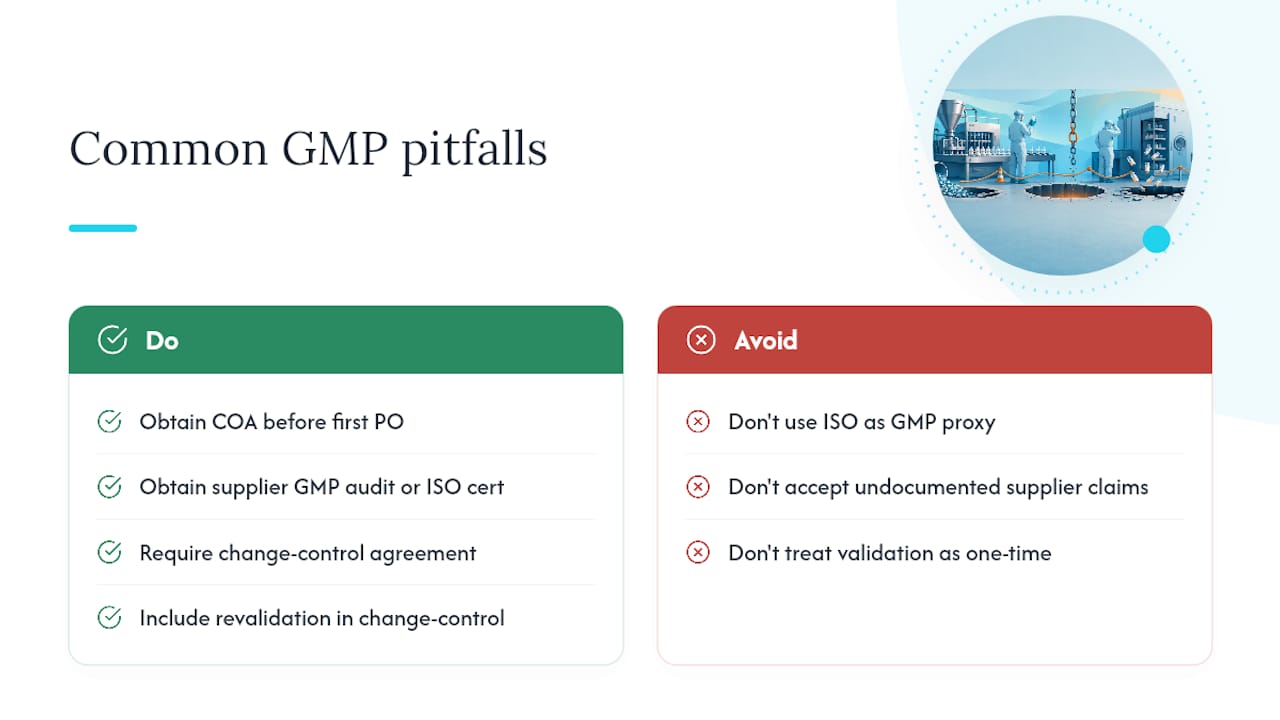
A second pitfall: poor supplier documentation. In regulated chemical supply chains, the gap between what a supplier claims and what they can document is where most audit findings originate. Requiring Certificates of Analysis, change-control notifications, and validated COA traceability from every supplier before the first purchase order is not excessive caution. It is the minimum standard for a GMP-compliant supply chain. ISO 9001’s Clause 8.4 gives you the framework for supplier evaluation; GMP fills in the specific documents you must collect and retain.
Third: underestimating validation. Quality managers who come from ISO-only backgrounds often treat validation as a one-time event. GMP regulators treat it as an ongoing obligation. Process changes, equipment replacements, and facility modifications all trigger revalidation requirements. Build that into your change-control procedure from the start, not after your first Form 483 observation.
Pro Tip: When onboarding a new chemical supplier for a regulated product line, request three documents before the first shipment: a current Certificate of Analysis for the specific lot, a copy of the supplier’s most recent GMP audit report or ISO 9001 certificate, and a written change-control notification agreement. These three documents cover the minimum documentation trail an FDA inspector will expect to see in your supplier qualification file.
Compliant chemical sourcing that supports your GMP and ISO 9001 programs
Sourcing pharmaceutical-grade, food-grade, or technical-grade chemicals from suppliers who cannot provide complete documentation is one of the fastest ways to generate a supplier-related finding in an FDA inspection or ISO 9001 audit.

RJR Worldwide’s chemical sourcing division supplies food, technical, and pharmaceutical-grade materials from vetted suppliers in China and India, with full compliance documentation: Certificates of Analysis, batch traceability records, and change-control notification agreements built into every multi-year supply contract. Index-linked pricing removes the cost unpredictability that disrupts procurement planning, and dedicated documentation support means your supplier qualification files stay audit-ready without chasing paperwork across time zones. If your GMP or ISO 9001 program needs a sourcing partner whose documentation holds up under inspection, contact RJR Worldwide to discuss your material requirements and compliance documentation needs.
Sources
These primary and secondary sources cover the regulatory and standards frameworks discussed throughout this article. Consult them directly for current regulatory text and guidance.
- WHO – Good manufacturing practices (GMP)
- ISO 9001 and GMP - What Are The Differences? - Advisera
- ISO 9001 vs GMP: Key Differences & Practical Advice - 9001simplified
- Comparing FDA cGMP vs. ISO 9001 - Chemrite Copac
- GMP is not ISO 9001 — Where are the similarities and differences? - GMP Publishing