Chemical Buyers: Stop Audit Holds With Compliance First Sourcing

The single biggest risk in industrial chemical sourcing isn’t price. It’s a supplier that can’t produce a clean certificate of analysis when your auditor asks for one, or one whose freight falls apart the week you need a rail car. Prioritize documented compliance, logistics continuity, and contract protections over the lowest quote. Suppliers built around long-term agreements and dedicated freight, such as RJR Worldwide Corp., show what that combination should look like in practice.
TL;DR:
- Suppliers with long-term agreements and dedicated freight lanes are less likely to experience delivery delays or compliance issues during disruptions.
- Qualification for critical or specialty chemicals can take six to eighteen months, so pre-qualifying backup suppliers is essential for supply security.
- Proper documentation such as lot-specific COAs, SDS, and certificates of origin are crucial to avoid shipment holds and audit failures.
- Index-linked pricing and clear contract terms, including force majeure and delivery guarantees, improve predictability and control over costs.
- Dual sourcing from suppliers with verified compliance and capacity control helps mitigate risks from trade policy shifts and freight disruptions.
Table of Contents
- What Are the Main Types of Chemical Suppliers?
- How Do Logistics Choices Reduce Supply Risk?
- What Documents Should Procurement Always Collect?
- What Pricing and Contract Structures Should You Expect?
- How Do You Qualify and Monitor Chemical Suppliers?
- What Belongs in Every Chemical RFQ?
- How Does RJR Worldwide Corp. Meet These Standards?
- Where Is Chemical Demand Heading?
- Which Digital Tools Actually Help With Sourcing?
- How Does Sustainability Factor Into Chemical Sourcing?
- What Quality Control Should You Require Before Shipment?
- How Do Trade Policy Shifts Affect Chemical Sourcing?
- What Inventory Strategy Fits Industrial Chemicals?
- A Publisher’s Take on Common Procurement Mistakes
- Ready to Source With Documentation and Freight Built In?
- Sources
- FAQ
What Are the Main Types of Chemical Suppliers?
Sourcing industrial chemicals starts with picking the right kind of counterparty, and the three options behave differently under pressure.
Manufacturers sell directly from the plant. You get the tightest pricing and the most technical access, but minimum order quantities are often high and lead times track their production schedule, not your delivery date. Distributors buy in bulk from manufacturers and resell in smaller lots with faster turnaround and local warehousing, which suits mid-size buyers who can’t commit to rail-car volumes. Brokers arrange deals between parties without holding inventory. They can be useful for one-off spot buys but add a layer between you and the actual production site, which matters when something goes wrong with a batch.
Product grade adds a second axis to the decision:
- Commodity chemicals (industrial-grade solvents, basic acids) are widely available with multiple qualified sources, so price competition is real and switching costs are low.
- Specialty and supply-constrained grades (pharmaceutical, food, or USP-certified materials) come from a smaller pool of qualified producers, which means longer qualification cycles and less room to switch suppliers on short notice.
- Each category carries different documentation. Commodity buys typically need a spec sheet and safety data sheet (SDS). Specialty and regulated grades require a certificate of analysis (COA), grade attestation, and often a certificate of origin.
How Do Logistics Choices Reduce Supply Risk?
Freight mode should match the chemical, not just the budget. Bulk liquids move by tanker truck or rail tank car; drummed or bagged solids typically move by standard freight or intermodal container; and anything with hazard classifications needs carriers certified for that placarding.
The real differentiator is whether a supplier controls its own freight lanes or depends on the spot market. A supplier running dedicated freight lanes and its own linehaul operations can commit to delivery windows that a broker reselling capacity cannot guarantee. The Global Miebach Chemical Logistics Study found that rising warehousing and transportation costs are the top concern for chemical companies right now, and only a minority of surveyed firms felt ready to handle that pressure. That gap is exactly why locked-in freight capacity is worth asking about before you ask about price.
Before signing, verify:
- Hazmat certification for the specific UN number your material carries
- Bonded warehousing if the shipment crosses borders before final delivery
- Temperature-controlled storage for anything with a defined stability range
- Cargo insurance coverage limits, not just confirmation that coverage exists
Pro Tip: Ask for the carrier’s DOT number and check its safety rating directly on the FMCSA site. A supplier that hesitates to share it is telling you something.
What Documents Should Procurement Always Collect?
Missing paperwork is the most common reason a shipment gets held at a dock or fails an internal audit. Before any purchase order goes out, collect and check:
- Safety data sheet (SDS) matching the exact grade and packaging you’re ordering, not a generic version pulled from the manufacturer’s website.
- Certificate of analysis (COA) tied to the specific lot number shipping to you, showing actual test results against spec.
- Spec sheet confirming purity, particle size, or other parameters your process requires.
- Certificate of origin, especially important for materials subject to Section 301 tariffs or country-specific import restrictions.
- Grade attestation for USP, food-grade, or pharmaceutical-grade claims, since these carry legal weight under FDA and USP monographs.
Watch for regulatory touchpoints tied to each shipment: TSCA reporting obligations for new or modified substances, DOT hazmat placarding requirements for transport, and EPA registration where applicable. A red flag worth remembering: documentation that’s generic, undated, or missing a lot-specific COA usually means the supplier is reselling material they didn’t test themselves. RJR Worldwide Corp.'s own USP grade compliance checklist walks through what audit-ready paperwork should actually contain.
What Pricing and Contract Structures Should You Expect?
Four pricing shapes dominate industrial chemical procurement, and each trades predictability for flexibility differently.
- Index-linked pricing ties your cost to a published benchmark, protecting both sides from sudden swings and giving you a transparent basis for renegotiation.
- Fixed-price contracts lock a rate for a defined term, useful for budgeting but risky if raw material costs move sharply against the supplier.
- Spot purchases offer no long-term commitment but expose you to full market volatility on every order.
- Minimum order quantities (MOQs) vary by grade and often determine which pricing structure is even available to you.
When negotiating, push for a defined price review cadence, service-level agreements on delivery windows, acceptance testing rights before payment releases, and clear force majeure language covering port delays and raw material shortages.
How Do You Qualify and Monitor Chemical Suppliers?
Qualification isn’t a one-time checkbox. It’s an ongoing process, and skipping steps here is where most supply failures start.
- Document review. Collect SDS, COA templates, facility certifications (ISO, GMP where applicable), and financial references before any sample ships.
- Sample testing. Run incoming samples against your own spec, not just the supplier’s stated results.
- Facility verification. Confirm production location, capacity, and whether the supplier subcontracts any step of manufacturing.
- Reference checks. Talk to existing customers about delivery consistency and how the supplier handled a past disruption.
Once qualified, monitoring doesn’t stop. Watch financial health indicators, regulatory notices or warning letters, and how concentrated production is at a single site. CAS’s supply-chain intelligence guidance points out that supplier-level checks alone miss molecular-level risk. For specialty chemicals, tracing the actual synthesis pathway and precursor sourcing reveals upstream dependencies a standard audit never catches.
Qualification cycles for critical inputs typically run six to eighteen months, so pre-qualifying a backup supplier before you need one is not optional for anything single-sourced.
Pro Tip: Set a recurring calendar reminder to re-check a key supplier’s financial filings and regulatory status every quarter, not once a year. Annual reviews miss problems that build over months.
What Belongs in Every Chemical RFQ?
A tight RFQ gets you comparable answers instead of five suppliers quoting five different things. Request:
- SDS, COA, and a physical sample tied to a specific lot
- Stated lead times for both initial and repeat orders
- Packaging options and minimum order quantities
- Incoterms defining who owns risk and cost at each shipping stage
- Insurance coverage and named freight options, including whether the supplier controls its own lanes
Ask directly about contingency plans: what happens to your order if their primary production line goes down. Compare offers on total landed cost, meaning freight, duties, insurance, and storage stacked on top of the unit price, not the unit price alone. The Purdue Libraries guide to chemical suppliers and pricing is a solid starting point for benchmarking quotes against catalog pricing before you negotiate.
How Does RJR Worldwide Corp. Meet These Standards?
Some suppliers are built around the combination this guide recommends: sourcing tied to freight continuity and full documentation, rather than a broker relationship that ends at the purchase order.
- Multi-year supply agreements with vetted manufacturers in multiple countries, structured around index-linked pricing rather than one-off spot quotes.
- Direct operation of dedicated linehaul lanes out of regional terminals, keeping delivery inside the supplier’s control rather than the general freight market.
- Full documentation packages, including SDS, COA, and grade attestations, for various specialty materials.
- Product-specific technical resources, like the calcium hypochlorite reference page, showing the depth of documentation buyers should expect on every material.
Where Is Chemical Demand Heading?
Demand for industrial chemicals is shifting in a direction that punishes buyers who source reactively. Cost pressure on warehousing and transportation now ranks as chemical companies’ top operational concern, and the Miebach 2024 study found roughly a third of respondents felt genuinely prepared for it. That readiness gap is showing up in longer lead times for specialty and pharmaceutical-grade materials, where a small number of qualified producers can’t absorb sudden demand spikes.
Reshoring pressure in North America is adding another wrinkle. Manufacturers are increasingly asking suppliers to hold dual-source capacity, meaning both a China-origin and an India-origin option for the same specification, so a single country’s export policy or freight disruption doesn’t stall a production line. That dual-country structure is becoming less of a nice-to-have and more of a baseline expectation among procurement teams that got burned during past shortages.
Forecasting demand accurately now depends less on historical order volume and more on tracking upstream signals: raw material availability at the precursor level, regional regulatory changes, and freight capacity trends. Procurement teams that used to reorder on a fixed schedule are shifting toward rolling forecasts reviewed monthly, adjusting order timing against freight cost trends rather than just inventory position. The chemicals that see the sharpest swings tend to be the ones with concentrated production in one or two countries, which is exactly where dual-sourcing pays off first.
Which Digital Tools Actually Help With Sourcing?
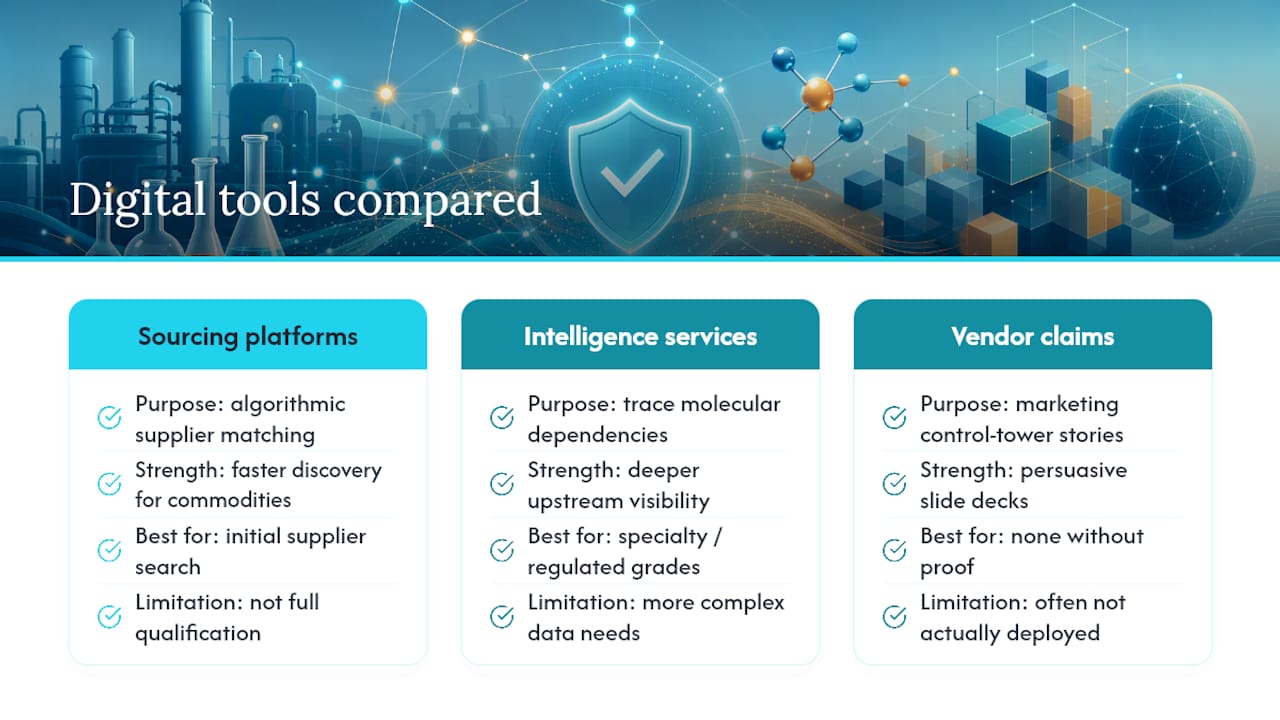
Adoption of advanced digital tools in chemical logistics is still catching up to the hype. The Miebach study found that while a majority of chemical companies are planning to use AI for inventory optimization, actual implementation of digital twins or warehousing control towers remains low. That gap matters for procurement: a supplier’s slide deck about “AI-driven sourcing” doesn’t tell you whether they’ve actually deployed it.
The tools worth paying attention to fall into a few categories. Digital sourcing platforms, such as Valdera, use algorithmic matching to connect buyers with vetted suppliers faster than manual catalog searches, and they’re genuinely useful for initial supplier discovery on commodity materials. Supply-chain intelligence services go deeper, tracing molecular-level dependencies rather than just supplier relationships, which matters most for specialty and regulated grades where a single precursor shortage can halt production three tiers upstream.
GEP’s guidance on chemical supply chain management recommends pairing digital optimization with diversified sourcing and formal supplier risk models rather than treating software as a substitute for either. That’s the practical read here: use digital platforms to widen your supplier search and flag risk signals faster, but don’t assume a tool replaces the document review, sample testing, and facility verification that qualification actually requires. The suppliers with real digital maturity tend to be upfront about what’s automated and what isn’t. The ones overselling “control tower” capabilities they haven’t built yet usually can’t answer specific questions about how the system actually flags a late shipment.
How Does Sustainability Factor Into Chemical Sourcing?
Green chemistry pressure is reshaping specification sheets faster than most procurement teams have adjusted their RFQs. Buyers in food production, water treatment, and pharmaceutical manufacturing are increasingly required to document the environmental footprint of every input, not just its performance characteristics.
Three practical shifts matter here. First, suppliers are being asked to disclose production-site energy sourcing and waste handling, which used to be treated as proprietary but is now showing up as a standard RFQ line item for buyers with their own sustainability reporting obligations. Second, REACH-style restrictions on certain substances in the EU are pushing global suppliers toward reformulated alternatives even for buyers who only sell domestically, since a supplier serving both markets often standardizes on the stricter formulation. Third, packaging and freight emissions are getting more scrutiny, which is where dedicated freight lanes have an underappreciated advantage: consolidated, planned routes generally produce a smaller carbon footprint per shipment than fragmented spot-market freight bouncing between multiple carriers.
None of this means sustainability claims should be taken at face value. Ask suppliers for the same level of documentation on environmental claims that you’d require for a purity spec: a stated methodology, not a marketing paragraph. A supplier that can produce a real waste-handling disclosure alongside its COA is operating at a different level of transparency than one offering a vague “committed to sustainability” statement with nothing behind it.
What Quality Control Should You Require Before Shipment?
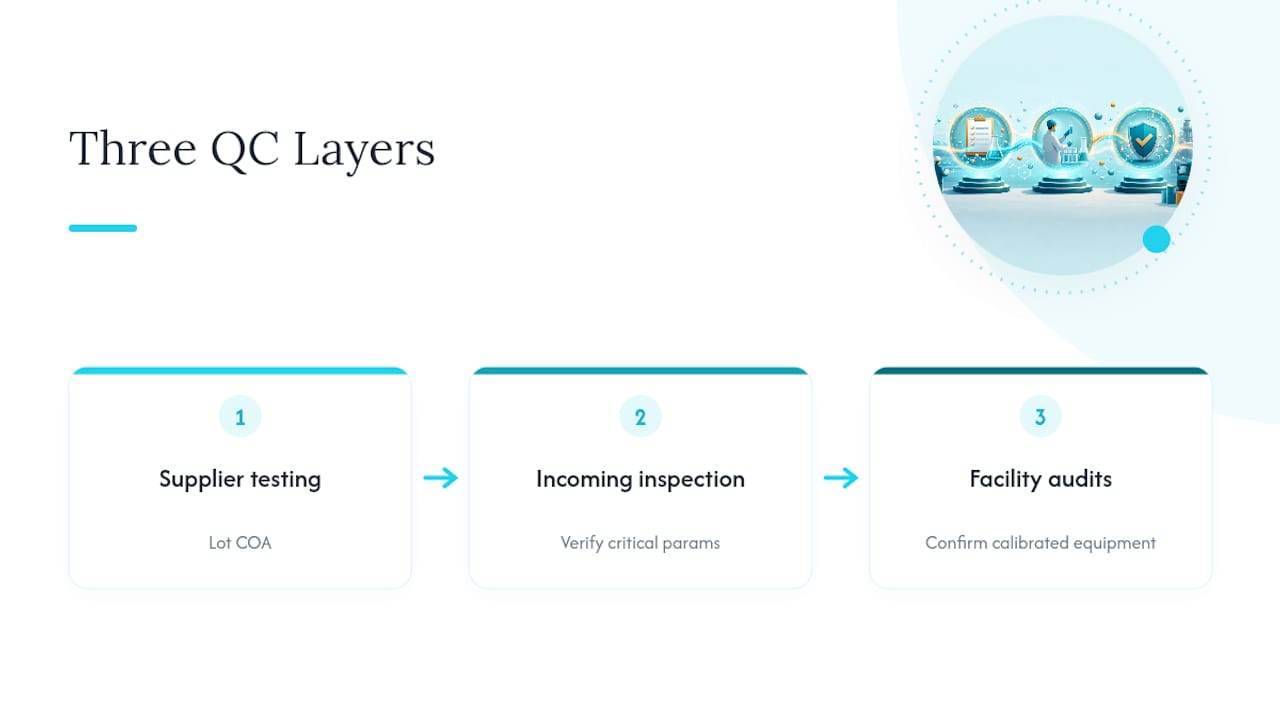
Quality control in chemical sourcing happens in layers, and skipping any one of them is how contaminated or off-spec lots reach a production floor.
The first layer is supplier-side testing, documented in the COA for each specific lot. The second layer is your own incoming inspection, which should never simply accept the supplier’s numbers without independent verification, at minimum on critical parameters like purity or moisture content. The third layer, often skipped by smaller buyers, is periodic facility audits confirming the supplier’s testing equipment is calibrated and their process hasn’t drifted since your last qualification review.
For regulated grades, testing protocols need to map to the actual standard being claimed. A USP-grade attestation should reference the specific USP monograph, and food-grade claims should tie back to FDA food contact substance regulations rather than a generic “food safe” label. Pharmaceutical-grade materials carry the highest bar, often requiring GMP facility certification in addition to lot-specific testing.
The practical failure mode here isn’t usually outright fraud. It’s a supplier that tested lot 1 rigorously to win the contract, then got less careful by lot 40 once the relationship felt settled. That’s exactly why continuous monitoring, not just initial qualification, belongs in your quality control plan. Re-testing a percentage of incoming lots on an ongoing basis, even after a supplier is fully qualified, catches drift before it becomes a production problem.
How Do Trade Policy Shifts Affect Chemical Sourcing?
Geopolitics touches industrial chemical sourcing more directly than most procurement teams plan for, because so much specialty and commodity material still traces back to a handful of producing countries.
Tariff changes are the most immediate lever. A Section 301 tariff adjustment on a specific chemical category can shift landed cost by a meaningful margin overnight, which is why certificate of origin documentation matters beyond simple compliance. It’s the paper trail that determines which tariff schedule actually applies to your shipment. Export restrictions work the other way: a producing country tightening export licensing on a precursor chemical, often for its own domestic supply reasons, can strand orders that were fully paid and scheduled.
Dual-country sourcing exists specifically to blunt this risk. A supplier maintaining qualified production in both China and India, structured into long-term agreements rather than spot deals, gives you a working alternative when one country’s policy shifts against you. That structural redundancy is worth more during a trade dispute than any amount of price negotiation, because a supplier with only one country of origin has no lever to pull when that country’s export rules change.
Freight policy adds a second layer. Port congestion, bilateral shipping agreements, and carrier capacity allocations during a trade dispute can delay chemicals as badly as an outright export ban, which is another reason dedicated freight lanes carry more weight than they used to. A supplier controlling its own linehaul capacity, rather than competing for space on the spot freight market, has more room to reroute around a disrupted lane.
What Inventory Strategy Fits Industrial Chemicals?
Standard just-in-time inventory rules don’t translate cleanly to industrial chemicals, because shelf life, hazard classification, and qualification lead times all complicate holding decisions in ways a generic component doesn’t face.
Safety stock calculations need to account for the actual qualification timeline of a replacement supplier, not just typical reorder lead time. If requalifying an alternate source for a specialty grade takes six to eighteen months, your safety stock for that material should reflect that worst case, not the supplier’s normal 30-day lead time. For commodity chemicals with multiple qualified sources, you can run leaner, since switching suppliers is faster and cheaper.
Storage constraints add a second layer most inventory models ignore. Temperature-sensitive or hazard-classified materials often can’t simply be stockpiled in a general warehouse, which means your inventory strategy is capped by your bonded or hazmat-rated storage capacity, not just budget. Buyers frequently discover this constraint only after ordering more safety stock than their facility can legally hold.
The most resilient approach splits inventory strategy by risk tier: lean, frequent ordering for commodity chemicals with multiple sources, and deliberately higher safety stock, backed by a pre-qualified alternate supplier, for anything single-sourced or slow to requalify. Reviewing that split annually against actual supplier concentration, rather than setting it once and forgetting it, is what keeps the strategy matched to real risk instead of outdated assumptions.
A Publisher’s Take on Common Procurement Mistakes
Most supply failures we see trace back to two habits: treating supplier monitoring as a once-a-year task and bringing freight into the conversation only after a contract is signed. Build both into the contract itself, from day one.
— RJR Worldwide
Ready to Source With Documentation and Freight Built In?
Everything covered above, compliance paperwork, dedicated freight, index-linked pricing, and contract protections is exactly what certain suppliers build into their sourcing agreements from the start. Some operate their own terminals and linehaul lanes, so the freight commitment doesn’t depend on spot-market capacity the week your order ships.
That combination solves the two problems procurement teams raise most: unpredictable pricing and incomplete compliance documentation. Multi-year agreements with vetted manufacturers come with full SDS, COA, and grade attestation paperwork for specialty-grade materials, backed by index-linked pricing that supports forecasting.
If you’re evaluating a new supplier for sodium metabisulfite, xanthan gum, bio glass, or calcium hypochlorite, request current pricing and sample documentation directly from RJR Worldwide Corp.'s chemical sourcing team to see how a confidential sourcing discussion compares against what you’re getting now.
Sources
- Global Miebach Chemical Logistics Study 2024
- CAS — Chemical supply chain intelligence services
- Chemical suppliers, catalogs, and pricing — Purdue Guides
FAQ
What Is the Difference Between a Chemical Distributor and a Broker?
A distributor buys inventory in bulk and holds it in warehouses before reselling, giving you faster delivery and local support. A broker arranges deals without holding stock, which can work for spot purchases but adds a layer between you and the actual manufacturer.
What Documents Should I Require Before Ordering a New Chemical?
Always collect a safety data sheet (SDS), a certificate of analysis (COA) tied to the specific lot, and a spec sheet matching your required purity or grade. Regulated grades like USP or pharmaceutical-grade materials also need a formal grade attestation.
How Long Does Supplier Qualification Typically Take?
Initial qualification for commodity chemicals can move in weeks, but critical or specialty inputs often take six to eighteen months to fully requalify with a new source. That timeline is why pre-qualifying a backup supplier before you need one matters for anything single-sourced.
What Does RJR Worldwide Corp. Source and How Is It Priced?
RJR Worldwide Corp. sources food, technical, and pharmaceutical-grade chemicals, including sodium metabisulfite, xanthan gum, bio glass, and calcium hypochlorite, through long-term supplier agreements. Pricing is index-linked and available on request through the chemical sourcing division.
Why Does Dedicated Freight Matter More Than Lowest Price?
A supplier depending on spot-market freight capacity can’t guarantee delivery windows during a disruption, while dedicated freight lanes keep shipments inside a controlled schedule. Given that transportation cost pressure is currently the top concern for chemical companies, locked-in freight capacity often protects continuity better than a lower unit price.