Chemical Buyers: Losing 30–60% to Hidden Landed Costs in Chemicals
Landed cost for chemicals is the total price of a shipment once it clears customs and reaches your dock, not just the invoice total. The formula is: product cost + international freight + insurance + import duties/taxes + MPF/HMF + customs broker fees + handling/drayage + last-mile delivery + FX loss. Chemicals add a layer most commodities skip, since hazmat classification, packaging rules, and regulatory documentation can shift that total by double digits before a drum ever leaves the port.
TL;DR:
- Duty stacking for chemicals can increase total landed cost by 25 to 55 percentage points, depending on HTS classification and applicable tariffs.
- Ocean freight costs vary significantly based on mode, with LCL and air freight potentially erasing negotiated price advantages due to higher per-kilogram rates.
- Regulatory costs, including hazardous materials surcharges, compliance documentation, and environmental fees, can add substantial hidden expenses to chemical shipments.
- Proper tariff classification review and verification of origin are essential to avoid overpayment, penalties, or retroactive assessments.
- Regularly updating and stress-testing the landed-cost model ensures accurate budgeting amid fluctuating tariffs, freight rates, and currency exchange rates.
Table of Contents
- What Is Landed Cost for Chemicals?
- How Do You Calculate Each Landed-Cost Component?
- What Does a Real Landed-Cost Calculation Look Like?
- How Does Duty Stacking Change Chemical Import Costs?
- What Hidden Compliance Costs Affect Chemical Shipments?
- How Can Procurement Teams Reduce Landed Cost?
- RJR Worldwide’s Approach to Reducing Landed-Cost Risk
- What Storage and Warehousing Fees Should You Expect?
- Do Environmental Regulations Add to Chemical Import Costs?
- How Often Should You Re-Run Your Landed-Cost Model?
- Get an All-In Landed-Cost Review
- Sources
- FAQ
What Is Landed Cost for Chemicals?
Landed cost tells you what a kilogram of resin, solvent, or active ingredient actually costs once it’s sitting in your warehouse, ready to use. Most procurement teams still price deals off the FOB or CIF invoice number, then get blind sided when the real bill arrives three weeks later with broker fees, drayage, and a currency loss tacked on. The invoice price is the starting point, not the answer.
For industrial chemicals specifically, the gap between invoice and landed cost tends to run wider than it does for general cargo. A pallet of stainless bolts doesn’t need a hazmat surcharge, a certificate of analysis, or IATA dangerous goods paperwork. A drum of technical-grade acid does. That’s the core reason chemical buyers need a sharper landed-cost model than the generic import-cost calculators built for consumer goods.
Why chemicals need a different model
Three things separate chemical imports from ordinary freight math:
- Hazmat classification triggers packaging premiums, placarding requirements, and carrier surcharges that don’t exist for non-regulated cargo.
- Regulatory documentation (SDS, certificates of analysis, TSCA filings where applicable) adds real administrative cost and can delay clearance, which itself carries a price tag in demurrage.
- Tariff duty stacking on many chemical HTS lines runs layered, meaning a Section 301 tariff and a standard MFN duty can both apply to the same shipment, and getting the order of operations wrong understates your true cost.
How Do You Calculate Each Landed-Cost Component?
Every line item in a chemical shipment behaves a little differently than it would for a generic import, and the fastest way to blow your budget is treating them as interchangeable percentages.
Start with unit normalization. Suppliers quote in wildly inconsistent formats: per drum, per metric ton, per gallon, sometimes per pallet with an unstated fill weight — practical per unit math for procurement helps unify these variations for accurate cost comparisons. Convert everything to a single basis, usually dollars per kilogram, before comparing any two quotes. A supplier offering a lower price per drum can still be more expensive per kilogram once you account for a smaller drum size or heavier packaging.
Freight is where mode matters most. Ocean freight for a full container (FCL) typically runs a small percentage of total cargo value for bulk chemicals, while less-than-container-load (LCL) shipments carry a materially higher per-kilogram freight cost because you’re paying for space you don’t fully use. Air freight, reserved for urgent or high-value specialty chemicals, can multiply per-kilogram freight cost several times over, often erasing whatever unit-price advantage drove the purchase decision in the first place.
Insurance pricing depends on cargo value, route risk, and hazard classification. Hazardous cargo frequently needs a supplemental policy layered on top of standard marine cargo insurance, since base policies often exclude or cap coverage for regulated hazardous materials.
Import duties depend on your HTS classification and country of origin. The MFN rate schedule is public, but chemical HTS lines frequently carry additional layered tariffs that a basic rate lookup won’t surface.
MPF and HMF are federal fees every ocean and most air shipments pay. The Merchandise Processing Fee runs 0.3464% of the entered value, capped at $634.62 per entry for 2026, and the Harbor Maintenance Fee adds 0.125% on ocean cargo. Neither is negotiable, and both apply before duty.
- Customs broker fees typically run as flat per-entry charges plus a percentage for complex classifications.
- Terminal handling, drayage, and last-mile delivery are usually separate line items, each invoiced by a different party.
- Hazmat handling fees and dangerous-goods surcharges can add a fixed premium per shipment on top of standard handling.
- FX spread on international wire payments, plus any hedging premium if you’ve locked in a forward rate, both belong in the total.
What Does a Real Landed-Cost Calculation Look Like?
Numbers make this concrete faster than percentages do. Take a hypothetical 20,000-kilogram shipment of a technical-grade specialty chemical from a China-based supplier, invoiced FOB at $2.10 per kilogram.
That’s a $42,000 invoice. Nobody’s actual cost stops there.
The markup over invoice value here lands at about the same magnitude seen in duty stacking cases, driven almost entirely by the Section 301 tariff layer, which alone adds nearly a quarter of the original invoice value on top of the standard MFN duty. GoFreight’s own illustrative example on a $50,000 electronics shipment shows a 53.1% markup once every duty and fee line is added, which tracks with how aggressively duty stacking inflates the number once a Section 301 or anti-dumping order applies.
Swap the FCL ocean freight for an LCL booking on a smaller order, and per-kilogram freight cost climbs enough to erase a chunk of any negotiated price advantage. Origin country alone can swing your landed cost by 25 percentage points or more.
How Does Duty Stacking Change Chemical Import Costs?
Duty stacking means more than one tariff layer applying to the same HTS line, and getting the stacking order wrong is the single most common landed-cost math error we see.
The correct sequence starts with the base MFN rate, applied to the customs value. Then any Section 301 tariff (China-specific, tied to specific HTS subheadings) applies on top of that same customs value, not compounded onto the post-MFN total. IEEPA-related tariffs, where applicable, stack the same way. Anti-dumping and countervailing duties (AD/CVD), when a specific chemical falls under an active order, apply separately and can be the largest single line item on the entire shipment. GoFreight’s research shows combined duty stacking on China-origin goods adding 25 to 55 percentage points to total landed cost depending on the HTS classification and applicable orders.
Getting the HTS code right matters more for chemicals than almost any other commodity category, because adjacent HTS subheadings for closely related compounds can carry entirely different duty treatment. A misclassified specialty chemical can either overpay duty for years or, worse, trigger a retroactive assessment plus penalties once customs catches the error.
Practical mitigation steps worth running before you sign a supply agreement:
- Get a formal tariff classification review from a licensed customs broker, not just a supplier’s self-declared HTS code.
- Verify country of origin independently. Transshipment through a third country doesn’t change true origin for tariff purposes.
- Ask whether tariff engineering (a legal reformulation or repackaging that shifts classification) is viable for your specific compound.
- Check for any active preferencing or exclusion request that might apply to your specific HTS line.
What Hidden Compliance Costs Affect Chemical Shipments?
Regulatory compliance is where chemical landed cost diverges hardest from ordinary freight, and it’s the category suppliers most often leave out of their quotes entirely.
Dangerous goods classification under DOT, IATA, or IMDG rules triggers surcharges most buyers don’t see until the freight invoice arrives. Ocean carriers routinely charge a flat DG fee per container, and air carriers charge substantially more per kilogram for anything classified as a hazardous material, on top of standard freight.
Import compliance documentation carries its own cost. A chemical subject to TSCA import certification requires specific paperwork filed at entry, and getting it wrong doesn’t just cost money, it can hold your shipment at port while customs sorts out the discrepancy. Every day in demurrage is money burning with no product to show for it.
Quality assurance costs belong in the model too. Re-testing a batch on arrival, generating a fresh certificate of analysis, and maintaining lot-trace records for regulated industries (pharmaceutical intermediates especially) all add real per-shipment cost that never appears on a supplier’s FOB quote.
- DG surcharges typically apply per container or per kilogram, depending on carrier and mode.
- TSCA and import-compliance paperwork adds administrative cost and clearance-delay risk.
- Certificates of analysis and re-testing protect against off-spec lots but cost money every time you run them.
- Packaging choice (drums vs. totes vs. ISO tank containers) changes your amortized per-unit cost meaningfully at volume.
Pro Tip: Ask every chemical supplier for their DG classification and packaging spec before you request a freight quote. A carrier can’t price a shipment accurately without that information, and a vague answer from your supplier is usually a sign they haven’t checked either.
How Can Procurement Teams Reduce Landed Cost?
A full total cost of ownership model for chemicals should run through at least a dozen categories: material cost, duty, freight, insurance, broker fees, drayage, last-mile, FX exposure, QA and testing, inventory carrying cost, compliance documentation, and the opportunity cost of capital tied up in transit. Pricing off invoice value alone routinely misses 30 to 60% of the true cost in specialty chemical categories, which is exactly why so many “great deal” suppliers turn out to be average once the full bill lands.
Here’s how procurement teams actually move the needle:
- Lock index-linked pricing into multi-year agreements so raw material swings pass through predictably instead of triggering renegotiation every quarter.
- Negotiate FX and pass-through clauses upfront rather than absorbing currency risk after the fact.
- Consolidate orders to hit FCL thresholds and avoid the LCL freight penalty on smaller shipments.
- Optimize packaging format for the actual order volume. Oversized drums for a small order waste freight capacity and money.
- Dual-source critical inputs so a tariff change or supplier disruption on one lane doesn’t stall production.
- Explore foreign trade zones or bonded warehousing to defer duty payment until goods actually leave the zone for consumption.
- Layer insurance appropriately for hazard class rather than defaulting to a standard policy that may exclude your cargo type.
Domestic sourcing, once every one of those categories gets modeled honestly, sometimes beats the lower-looking international unit price entirely. A quote that looks 15% cheaper on paper can end up costing more once duty, QA, and administrative overhead get added in full.
Pro Tip: Insist on an itemized, all-in quote from every supplier before comparing prices. A single blended number hides which line item is driving your cost, and you can’t negotiate what you can’t see.
RJR Worldwide’s Approach to Reducing Landed-Cost Risk
Some chemical sourcing companies operate from terminals with direct management of dedicated freight lanes, rather than brokering through third parties who add their own margin and uncertainty. That structure matters for landed cost specifically because every additional intermediary in a chemical supply chain is another place fees can hide.
Long-term, index-linked supply contracts for food, technical, and pharmaceutical-grade chemicals from vetted suppliers may come with full documentation built in from the start, which can cut down on clearance delays and re-testing costs that erode landed-cost predictability elsewhere. Before signing with any supplier, ask for an audit-ready compliance checklist: an all-in quote breakdown, verified HTS and country-of-origin evidence, and a documented QA and testing plan. Suppliers who can’t produce all three on request are usually the ones whose invoice looks good and whose landed cost doesn’t.
— RJR Worldwide
What Storage and Warehousing Fees Should You Expect?
Storage fees start accruing the moment a container clears the vessel, and most import contracts include only a short free period, often just a few days, before per-diem charges kick in at the terminal. For chemical cargo, that clock runs faster in practice because hazmat-classified containers frequently require designated storage areas at the port, and there are fewer of those slots available than general cargo space.
Bonded warehousing offers one way to control this cost. Storing chemicals in a bonded facility defers duty payment until the goods actually move into commerce, which helps cash flow on large orders you’re drawing down gradually rather than using all at once. The tradeoff is a monthly storage fee plus handling charges every time inventory moves in or out.
Specialty chemicals with temperature or humidity requirements add another layer. Climate-controlled storage costs more per pallet or per drum than ambient warehousing, and that premium needs to sit in your landed-cost model if your product specification requires it. Buyers who skip this step often discover the gap only when a warehouse invoice arrives showing a surcharge for controlled conditions they assumed were included in the base rate.
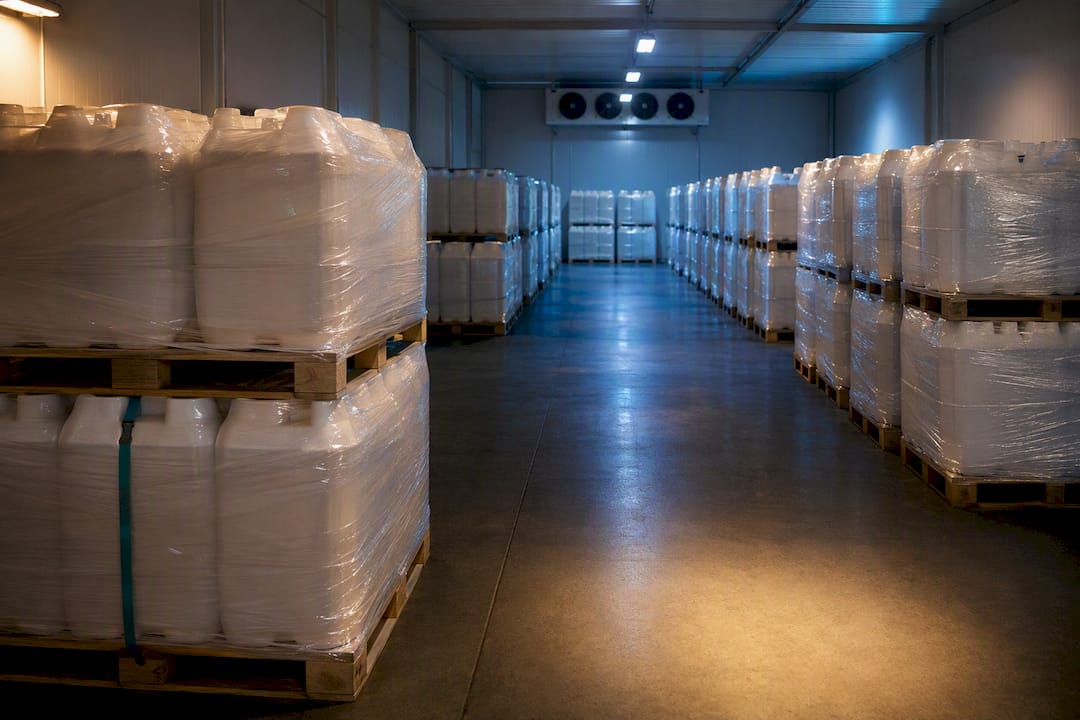
Long-term storage for slow-moving inventory carries its own hidden cost too: the capital tied up sitting on a shelf is money that isn’t earning a return anywhere else. That’s the inventory-carrying-cost line a full TCO model accounts for and a simple per-unit price comparison never does.
Do Environmental Regulations Add to Chemical Import Costs?
Environmental compliance costs are real and often underestimated in early-stage sourcing decisions. Many jurisdictions charge disposal fees or environmental handling surcharges on specific chemical categories, particularly those with end-of-life disposal requirements or packaging that falls under extended producer responsibility rules.
Eco-taxes on packaging materials, common in several international markets, apply to the drums, totes, or containers your chemical arrives in, not just the chemical itself. If your supplier’s packaging format triggers one of these fees, it shows up as a separate line on your customs entry or a downstream invoice from your logistics provider, and it’s easy to miss if you’re only tracking the product-level duty rate.
Domestic environmental permitting requirements matter here too. Some regulated chemicals require specific handling certifications on the receiving end, and the administrative cost of maintaining those certifications belongs in your total cost of ownership even though it has nothing to do with the shipment itself. Energy-intensive chemical categories also carry indirect environmental cost exposure: rising energy prices increase processing costs across the supply chain, and some of that gets passed through as an environmental compliance surcharge rather than a straightforward price increase.
None of these costs are large individually. Stacked together across a full shipment, they can add a meaningful percentage, which a basic landed-cost calculator built for generic imports simply does not include as a line item.
How Often Should You Re-Run Your Landed-Cost Model?
Run three scenario bands: best case, expected case, and stressed case, each pulling different levers. Stress freight rates and tariff exposure in the stressed scenario; hold duty and compliance costs steady in the expected case; and flex FX in all three.
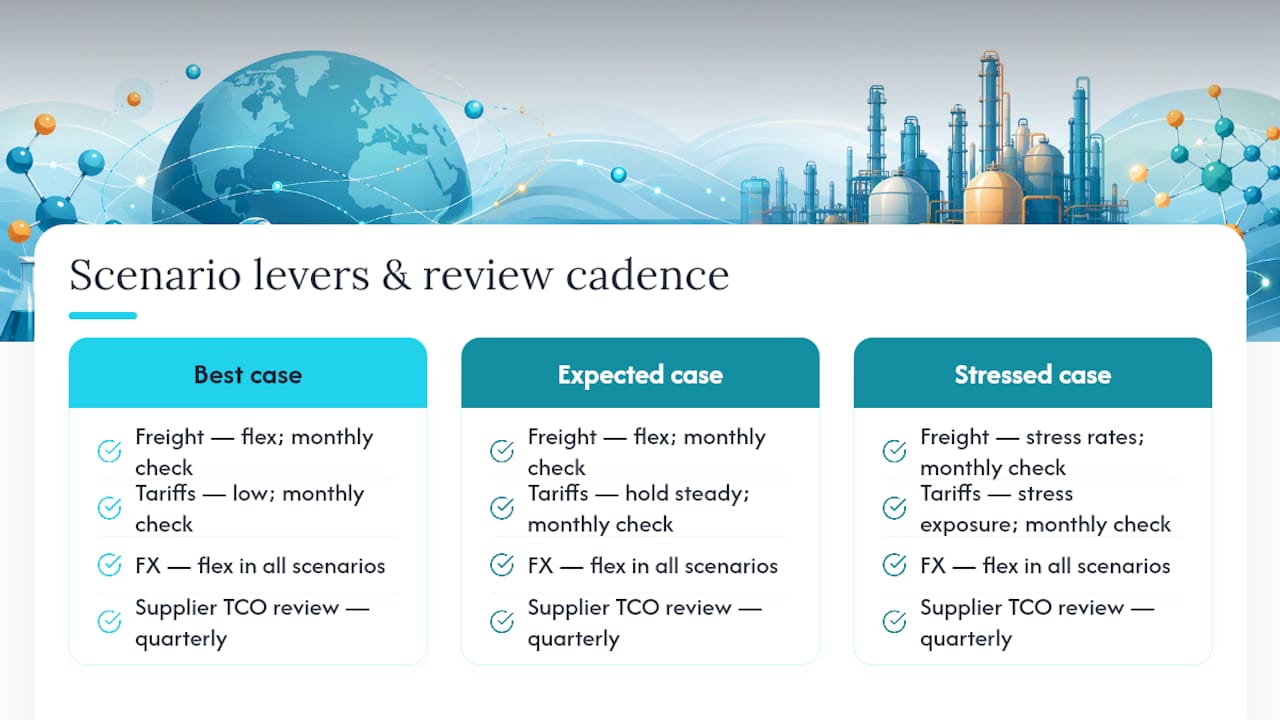
Freight and tariff conditions deserve a monthly check given how fast 2026 cost drivers are shifting. A full supplier TCO review makes sense quarterly. Landed-cost accuracy shouldn’t sit with one department. It’s a joint call between procurement, who knows the supply terms, and finance, who tracks the FX and carrying-cost exposure.
Get an All-In Landed-Cost Review
Most chemical suppliers quote a number and let you discover the rest at customs. Some chemical sourcing divisions provide an all-in quote up front, with duty, freight, and documentation accounted for, supported by index-linked multi-year contracts and direct control over dedicated lanes rather than a patchwork of subcontracted freight.
If you’re comparing suppliers right now, the fastest way to see the real difference is to hand over your HTS code, country of origin, and a sample invoice and request a landed-cost breakdown against what you’re currently paying. RJR Worldwide Corp’s team will show you exactly where the hidden cost sits, whether that’s duty stacking, packaging premiums, or a freight mode mismatch. Start that comparison through the Chemical Sourcing Division and see what a fully itemized quote actually looks like before your next contract renewal.
Sources
Duty stacking and MPF/HMF figures come from GoFreight’s landed-cost methodology. Macro chemical pricing context comes from BLS chemical industry data and the HG Iron 2026 chemical cost forecast. Verify current rates for your specific HTS code and country of origin before finalizing any contract.
- Landed Cost Calculation for Freight Forwarders 2026: Formula, Automation, and Client Reporting | GoFreight
- Global Chemical Forecast: Which cost drivers are shaping 2026 prices | HG Iron
FAQ
How Do You Calculate Landed Cost?
Add product cost, international freight, insurance, import duties, MPF/HMF, customs broker fees, handling and drayage, last-mile delivery, and FX loss, then divide the total by the number of units received to get a per-unit landed cost.
What Is an Example of Landed Cost?
A 20,000-kilogram chemical shipment invoiced at $42,000 FOB can land at roughly $59,000 once freight, a Section 301 tariff, MPF, HMF, broker fees, drayage, and FX spread are added, a markup of about 40.6% over the original invoice value.
What Is FOB vs. Landed Cost?
FOB (free on board) is the price of the goods loaded at the origin port, before any freight, insurance, duty, or destination fees apply. Landed cost is the full amount once the shipment clears customs and reaches your facility.
Does Landed Cost Include Compliance Costs?
Yes, for chemicals it should. Hazmat surcharges, dangerous-goods fees, testing, certificates of analysis, and documentation costs all belong in a complete landed-cost model, even though many supplier quotes leave them out.
What Is a Landed Cost Price?
A landed cost price is the true per-unit cost of an imported item once every fee between the factory and your warehouse door is included, giving you the number that actually determines your margin.