24–72 Hour Linehaul Business Continuity Playbook for Terminals
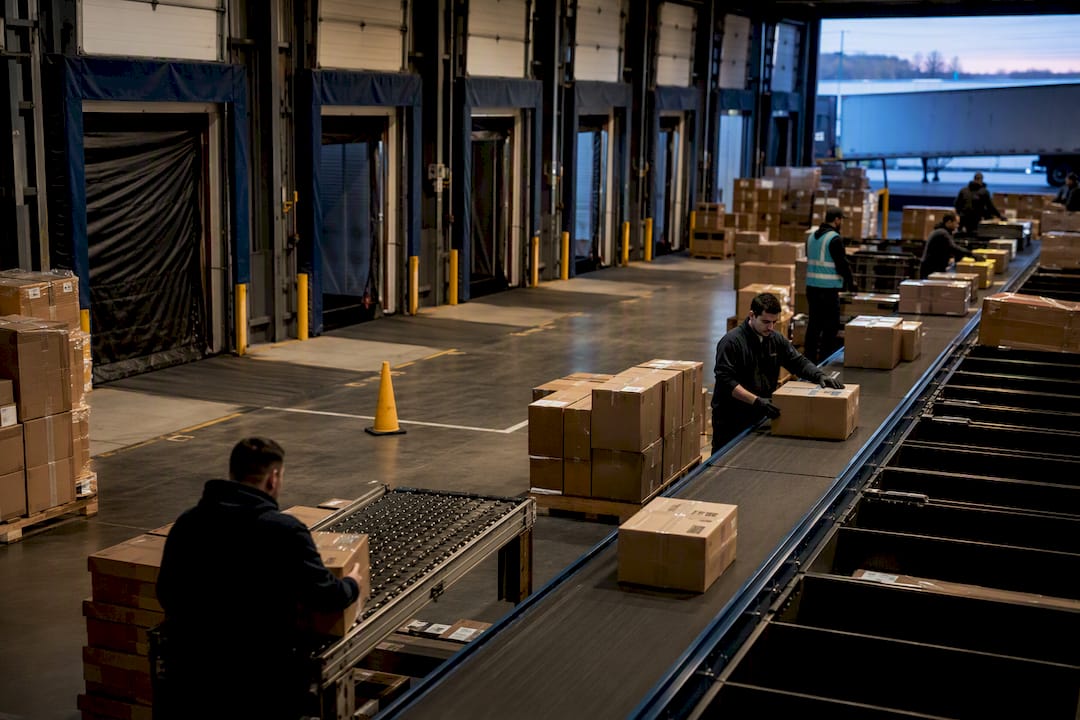
Linehaul business continuity comes down to five things: a business impact analysis that ranks lanes and terminals by revenue exposure, recovery time and recovery point objectives set for dispatch and hours of service data, pre-qualified “warm” backup carriers under contract, documented manual workarounds for TMS and ELD outages, and a scenario playbook that’s actually been tested. In the first 24 hours after any disruption, the priorities are fixed: confirm driver and yard safety, lock in backup capacity, notify affected customers, and capture whatever operational data you can before systems go dark.
TL;DR:
- Conduct a lane-specific business impact analysis to identify high-volume terminals and routes vulnerable to single-point failures.
- Set recovery time and recovery point objectives based on system criticality, with near-zero RPO for compliance data like HOS logs.
- Build redundancy through verified backup carriers, alternate terminals, and visibility systems independent of a single vendor.
- Create and regularly test manual fallback procedures, including failover drills with systems turned off, to ensure readiness during outages.
- Prioritize human capital and partner relationships over software fixes, emphasizing training, contract verification, and manual decision-making protocols.
Table of Contents
- What Threatens Linehaul Business Continuity Most
- Building the Core Linehaul Business Continuity Plan
- Scenario Playbooks for the Failures That Actually Happen
- Testing, Governance, and the Metrics That Prove Readiness
- Why People, Not Just Software, Determine Linehaul Resilience
- Continuity Is a Revenue Decision, Not Just an Ops One
- How RJR Worldwide Supports Linehaul Continuity Planning
- Sources
- FAQ
What Threatens Linehaul Business Continuity Most
Not every disruption hits the same way, and treating them all as equally likely wastes planning time. A terminal closure from fire, flood, or a labor action wipes out cross-dock capacity instantly and forces freight to reroute through facilities that weren’t sized for the overflow. A TMS or ELD outage doesn’t stop trucks, but it blinds dispatch to load status and puts hours-of-service compliance at risk the moment drivers can’t log electronically. Carrier bankruptcy is slower to unfold but just as damaging. Contracted lanes go unstaffed with little warning, and shippers find out when a load doesn’t show.
Severe weather corridor closures, especially across mountain passes or hurricane-exposed Gulf and Atlantic routes, force hub-skip decisions under time pressure. Regulatory stoppages, from a compliance audit to an emergency FMCSA order, can ground a whole terminal’s fleet overnight.
Each scenario stresses a different priority:
- Terminal closure breaks capacity and visibility simultaneously.
- TMS/ELD outage breaks visibility and compliance tracking.
- Carrier bankruptcy breaks capacity and SLA commitments.
- Weather corridor closure breaks routing and customer communication timing.
- Regulatory stoppage breaks compliance and, often, driver availability.
Mapping each risk to the priority it threatens tells you where to spend your planning budget first.
Building the Core Linehaul Business Continuity Plan
A generic corporate BCP template doesn’t work for linehaul. The plan has to be built around lanes, terminals, and freight volume concentration, not departments.
-
Run a linehaul-specific business impact analysis. Identify which lanes and terminals carry the highest volume concentration, then flag the ones where a single-point failure would cascade across multiple customer commitments. A terminal handling a large share of daily linehaul volume deserves a different continuity budget than one handling a smaller share.
-
Set recovery time and recovery point objectives by system. Dispatch and manifesting systems typically need an RTO measured in hours, not days. ELD and HOS data need a near-zero recovery point objective because gaps in driver logs create compliance exposure under federal hours-of-service rules. Terminal operations like fueling and yard management can usually tolerate longer recovery windows.
-
Design redundancy into capacity and visibility. That means contractually verified warm backup carriers by lane, an alternate terminal or overflow warehousing arrangement, and a visibility system that doesn’t depend on a single vendor’s uptime.
-
Document manual fallback procedures. Dispatch teams need a paper or spreadsheet based workflow they can run cold, plus a contact and SLA inventory listing every customer commitment, backup carrier phone tree, and escalation path.
Skipping any one of these four leaves a gap that surfaces exactly when you can least afford it.
Scenario Playbooks for the Failures That Actually Happen
A plan sitting in a binder isn’t a playbook. A playbook has activation triggers, named owners, and a timeline.
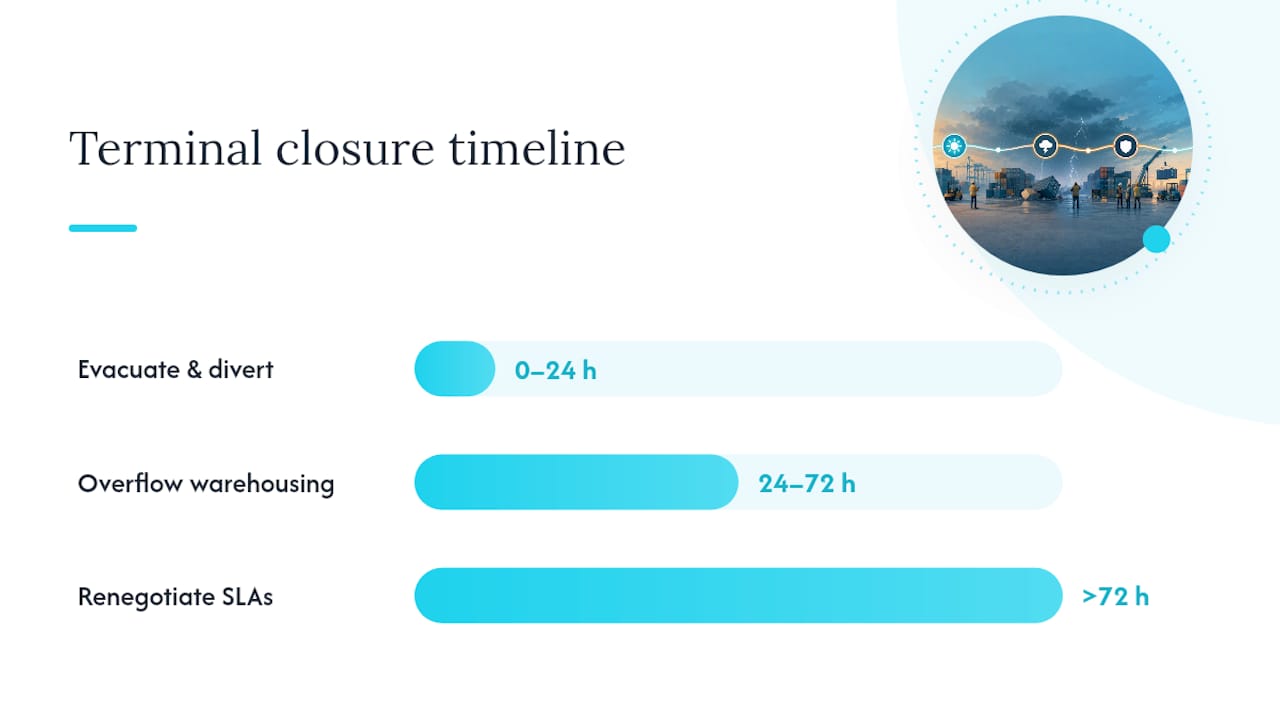
Terminal closure. The trigger is usually a fire alarm, flood warning, or local emergency declaration. In the first 0 to 24 hours, get people out safely and divert inbound loads to the nearest functioning cross-dock. From 24 to 72 hours, activate overflow warehousing and reallocate volume across remaining terminals. Past 72 hours, you’re renegotiating customer SLAs and possibly redrawing routes permanently.
TMS or ELD outage. Switch dispatch to a manual, phone and spreadsheet based workflow immediately. Drivers keep paper logs as backup per FMCSA driver qualification guidance, and every manual entry should be captured for reconciliation once systems are restored.

Carrier bankruptcy. Activate your pre-qualified backup list by lane, triage which routes are most SLA-critical, and target full capacity replacement within 72 hours. Waiting longer usually means losing the customer relationship, not just the load.
Severe weather corridor closures. Set weather thresholds in advance that trigger hub-skip routing automatically, then push customer notifications before the closure hits, not after.
- Assign one owner per scenario, not a committee.
- Write activation triggers as measurable thresholds, not judgment calls.
- Keep contact trees current; a backup carrier’s dispatcher from eight months ago may not work there anymore.
- Write activation triggers as measurable thresholds, not judgment calls.
- Keep contact trees current; a backup carrier’s dispatcher from eight months ago may not work there anymore.
Pro Tip: Run your TMS failover drill with the system deliberately turned off, not simulated. Teams that only “walk through” an outage on paper miss the friction of actually filling out a manual bill of lading under time pressure.
Testing, Governance, and the Metrics That Prove Readiness
Plans that never get tested tend to fail exactly when they’re needed, since paper procedures rarely survive contact with a real outage. Tabletop exercises are discussion based, gathering dispatch, operations, and customer service leads to walk through a scenario and find gaps in decision rights and communication. Functional tests go further: you actually fail over the TMS, actually call the backup carrier, and see what breaks in practice.
- Run tabletop sessions regularly, each focused on one scenario, and perform full functional exercises at least annually, covering system failover.
- Trigger an immediate plan review after any material change (new terminal, new backup carrier, new TMS vendor) or after any real incident, whether or not the plan performed well.
Useful KPIs to track: time to source backup capacity after activation, percentage of RTOs actually achieved during drills, share of lanes with a contracted (not informal) backup carrier, and how often that backup capacity gets re-verified. Industry guidance on continuity planning in trucking recommends treating these numbers as living metrics, reviewed after every drill and updated in the plan itself, not filed away until next year.
Why People, Not Just Software, Determine Linehaul Resilience
Research on freight resilience finds something that surprises a lot of operations directors: network integration and human capital investment often outperform pure technical fixes when it comes to perceived resilience during disruption. A study on socio-technical dynamic capabilities in freight transport found that capabilities built around partner relationships and trained people edged out operations-planning technology alone.
That tracks with what shows up in scenario drills. A dispatcher who’s practiced the manual workaround twice performs better under real outage pressure than one relying on a system that’s never actually failed before.
A practical checklist for closing the gap between tools and people:
- Choose systems that integrate cleanly with backup carriers’ own platforms, not just your primary fleet.
- Train dispatch and customer service teams on manual fallback procedures at least twice a year.
- Tie technology KPIs to actual decisions made, not just uptime percentages.
- Verify warm backup carrier capacity contractually and re-confirm regularly, since informal arrangements tend to evaporate when most needed.
Decision-intelligence tools applied to route optimization can meaningfully cut recovery time, but only when paired with local teams who know how to act on the recommendation, not just read it.
Terminal operations running dedicated lanes and managing warm backup relationships at the terminal level follow this same logic, rather than adding them only after a crisis.
Resilience in freight networks depends less on which software a carrier runs and more on whether its people and partner relationships were built to absorb a shock before one hit.
Continuity Is a Revenue Decision, Not Just an Ops One
The plans that hold up under real disruption share one trait: they’ve been rehearsed, not just written. Fewer SLA breaches during a bad week protect revenue more directly than most continuity spending gets credit for. That’s the calculation we make constantly running terminal operations and dedicated FedEx linehaul lanes out of Southern California, where a single missed pickup window has real financial consequences the next morning.
— RJR Worldwide
How RJR Worldwide Supports Linehaul Continuity Planning
Running terminals and dedicated lanes directly rather than brokering freight brings practical continuity management. Warm backup capacity, documentation, and terminal-level redundancy are incorporated into daily linehaul operations, not just theoretical plans.
If you’re evaluating your own continuity gaps, a few next steps are worth taking now:
- Contact us for an operational assessment of your lane and terminal exposure.
- Run a TMS failover drill using the manual dispatch workaround before you need it for real.
- Verify your warm backup carriers are still under contract, not just on a list from last year.
Readers weighing a FedEx linehaul acquisition should also look at how operational due diligence catches continuity gaps before closing, and manufacturers sourcing food, technical, or pharmaceutical-grade chemicals can review index-linked contract terms on our chemical sourcing page.
Sources
For deeper reference material, Ready offers free templates and checklists. The OECD’s report on transport system resilience covers macro-level disruption drivers worth folding into any risk inventory. FMCSA’s driver qualification checklist remains essential for HOS and compliance planning during outages.
- The role of human capital and Industry 4.0 in socio-technical dynamic capabilities for freight transport resilience
- Plan for the worst, deliver your best: business continuity and disaster recovery in trucking | FleetOwner
- FMCSA Driver Qualification Checklist
FAQ
What are the five components of a business continuity plan?
Most linehaul continuity plans cover risk assessment and business impact analysis, recovery objectives (RTO/RPO), backup capacity and redundancy arrangements, communication protocols, and testing and maintenance procedures.
How often should a disaster recovery plan be updated?
Review your plan at least annually, and immediately after any material operational change or real incident, since industry guidance treats untested or outdated plans as high-risk.
What is the difference between a BCP and a DRP?
A business continuity plan (BCP) covers how the whole operation keeps running during a disruption, while a disaster recovery plan (DRP) focuses specifically on restoring IT systems and data, like TMS or ELD platforms.
What are the three main areas of business continuity?
The three areas most planners focus on are people (safety and roles), processes (manual fallback procedures and communication), and technology (systems, backups, and data recovery).
How does RJR Worldwide help with linehaul continuity?
Operating terminals and dedicated lanes provides direct, practical experience in building warm backup capacity and documentation support that linehaul operators can consider when planning continuity.