90 Day Forensic Review: Linehaul Settlement Deductions for U.S. TSPs

Linehaul settlement deductions are the charges FedEx subtracts from a Transportation Service Provider’s gross settlement before issuing the net deposit, covering everything from accident damages to equipment charges and service-failure penalties. Every dollar deducted lowers cash flow visibility if it is not tracked line by line. The first move for any TSP owner or finance team: export the weekly charge statement and start a formal reconciliation through a dedicated Settlement Clearing Account before assuming the net deposit tells the whole story.
TL;DR:
- Proper reconciliation of settlement deductions using a dedicated clearing account reveals true margins and prevents errors from accumulating unnoticed over time.
- Disputing deductions requires detailed supporting evidence tied to specific settlement line references to ensure quick resolution before charges become permanent.
- Tracking effective revenue after deductions at the route level exposes underperforming lanes and highlights operational issues like frequent damage or service penalties.
- Automating settlement review with rule-based software and linking data to accounting systems helps maintain accuracy and catch variances early.
- Contractual and legal protections depend on the operating agreement, so understanding deduction clauses and dispute procedures is critical before an acquisition or dispute escalation.
Table of Contents
- What Are Linehaul Settlement Deductions on a FedEx Statement?
- How Do You Reconcile Settlements With a Clearing Account?
- How Do You Dispute a Questionable Deduction?
- What Can Settlement Data Tell You About Route Performance?
- Which Tools Make Settlement Reviews Repeatable?
- What Legal Protections Apply to Settlement Deductions?
- How Do You Reduce Deductions Before They Happen?
- RJR Worldwide’s Practitioner View on Settlement Deductions and Acquisition Diligence
- If You Want Help: RJR Services for Settlement Review and Acquisition Support
- Sources
What Are Linehaul Settlement Deductions on a FedEx Statement?
A FedEx settlement statement works like an invoice running in reverse. Gross revenue minus deductions, plus or minus prior-period adjustments, equals the net deposit that lands in your account. The deductions are non-payroll charges FedEx withholds directly from that settlement, and they show up under specific line codes rather than as one lump subtraction.
Most operators run into five recurring categories:
- Accident and damage chargebacks. These require photo evidence, incident reports, and often a corresponding insurance claim number before FedEx will reverse or reduce them.
- Scanner and equipment charges. Recurring rental fees for handheld scanners or telematics devices. Verify the device count against what’s actually deployed on your trucks. Phantom units billed after equipment returns are common.
- Vehicle lease payments and escrow withholdings. Lease payments are ongoing and expected. Escrow withholdings differ. They’re held as a reserve against future claims and should eventually return to you, not disappear as a permanent expense.
- Insurance program charges. Premiums for FedEx-administered coverage, typically recurring and predictable week to week.
- Service-failure penalties and liquidated damages. These are episodic, tied to a missed delivery window or uncovered route, and directly reduce net deposits the week they occur.
Knowing which of these are one-time versus structural recurring costs is the difference between a surprise and a forecast.
How Do You Reconcile Settlements With a Clearing Account?
Most contractors never separate gross settlement dollars from the deductions eating into them. They just book the net deposit as revenue and call it done. That habit obscures true margins and makes it nearly impossible to catch a recurring billing error before it costs you thousands over a year.
The fix, according to standard FedEx linehaul accounting practice, is a dedicated FedEx Settlement Clearing Account sitting between your settlement data and your operating bank account. Here’s the sequence:
- Import the weekly settlement CSV and post gross revenue, fuel surcharges, and bonuses to the clearing account as revenue.
- Record each deduction. Chargebacks and penalties post as operating expenses; escrow withholdings post as a current asset until FedEx confirms forfeiture or release.
- Clear the account by matching every posted deduction against its settlement line reference.
- Transfer only the reconciled net deposit to your operating account, leaving a clean audit trail behind.
Pro Tip: Tag every clearing account entry with a class or location code tied to the specific route or terminal. It takes an extra ten seconds per entry and turns your weekly reconciliation into a route-level profitability report by month’s end.
Run this weekly, not monthly. A one-week lag between the charge statement and your books is manageable. A four-week lag means you’re reconciling four settlement cycles’ worth of scanner fees and escrow entries at once, and errors start hiding in the pile.
How Do You Dispute a Questionable Deduction?
Catching an incorrect deduction fast matters more than catching it eventually. FedEx accounting windows close, and a charge you don’t flag inside the dispute period tends to become permanent. Before filing anything, cross-check the disputed line against your own operational records:
- Driver activity logs and dispatch records for the date in question
- Proof-of-delivery scans or signature captures
- GPS or telematics logs showing route completion
- Payroll records confirming the driver was assigned and working
- Fuel card exports showing the vehicle was active on that lane
A defensible dispute needs specifics, not a general complaint. Include the exact settlement reference number, the CSV line ID, the dollar amount in question, and the supporting document that contradicts FedEx’s charge. Vague disputes get vague answers. Precise ones get resolved.
Log every open dispute in a tracker with a filing date and a deadline for follow-up. Sophisticated reconciliation practice treats small, recurring errors as the real threat. A small scanner overcharge feels trivial in isolation. Left unchallenged across multiple trucks for a year, it can compound into a significant financial leak unnoticed until the books close.
What Can Settlement Data Tell You About Route Performance?
Once deductions are broken out instead of buried in a net number, the settlement statement turns into a management report. The most useful number you can compute is effective per-stop revenue after deductions, not before. A route that looks profitable on gross revenue can turn negative once you subtract its share of escrow withholdings, scanner fees, and the occasional service-failure penalty.
Comparing that effective revenue against payroll and fuel costs at the route level exposes underperforming lanes fast, which is exactly why operators who track settlement revenue against internal cost data at that granularity can make faster staffing and pricing decisions than those working off net deposits alone.
Class and location tracking inside your accounting system, the same tags mentioned in the reconciliation workflow, makes this comparison automatic instead of a quarterly spreadsheet project. Once you have truck-level or route-level P&Ls running continuously, three things become visible that weren’t before:
- Which lanes carry a disproportionate share of accident or damage chargebacks, often a signal of a specific vehicle or driver issue
- Which routes trigger service-failure penalties repeatedly, pointing to a scheduling or capacity problem rather than bad luck
- Which lanes are quietly break-even or negative after deductions, even though gross revenue looks fine on paper
This same data becomes the backbone of contract renegotiation conversations and, for sellers, the first thing a serious buyer’s diligence team will ask to see during a FedEx linehaul acquisition.
Which Tools Make Settlement Reviews Repeatable?
Manual line-by-line review works, but it doesn’t scale past a handful of trucks without eating an entire day every week. The practical fix is deterministic, rule-based checking rather than a black-box tool that flags things without explaining why.
Start with the MyGroundBiz CSV or XML export as your canonical source of truth. It’s the same data FedEx itself uses to calculate your settlement, so every dispute you file traces back to an exact line in that file. From there, a few categories of automation are worth layering in:
- Deterministic settlement-check rules that compare each line against your contracted rates and flag variances automatically
- Reconciliation software that ingests CSV or XML exports directly instead of requiring manual re-entry
- Accounting integrations, QuickBooks Online among them, that post clearing-account entries without duplicate manual work
- Payroll and fuel card importers that let you cross-check driver activity against settlement lines in minutes instead of hours
Whatever you use, insist on flags that cite the exact source line and dollar amount, keeping dispute drafts pre-populated with the evidence you’ll actually need to file.
What Legal Protections Apply to Settlement Deductions?
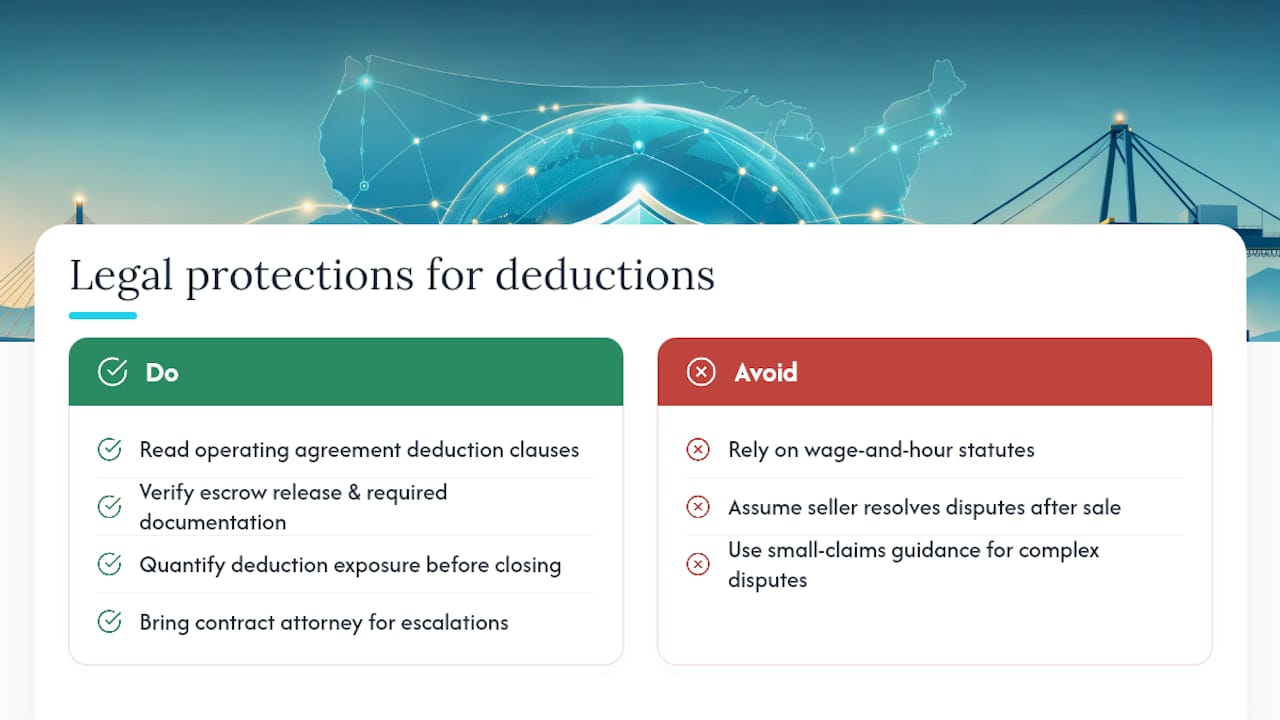
FedEx Ground and FedEx Home Delivery contract with TSPs under an independent contractor operating agreement, not an employment relationship, which shapes how disputes over deductions get resolved. That agreement typically spells out FedEx’s right to deduct for specific categories, damages, uncovered routes, equipment charges, and the process a TSP must follow to contest a charge within a defined window.
Because the relationship is contractual rather than governed by wage-and-hour law, your primary protection is the operating agreement itself, not a labor statute. That makes it worth reading closely, particularly the sections defining what counts as a chargeable event, how escrow funds get released, and what documentation FedEx requires before reversing a deduction.
State-level contractor classification rules can also affect how disputes are treated, especially in states with stricter independent contractor tests, though these generally govern the TSP’s relationship with its own drivers rather than the TSP’s relationship with FedEx. For buyers and sellers negotiating a linehaul acquisition, the operating agreement’s deduction and dispute clauses deserve the same scrutiny as the purchase price. Unresolved deduction disputes at the time of sale can become the buyer’s problem the moment the agreement transfers, and a careful diligence process should quantify that exposure before closing rather than after.
When a dispute escalates beyond the standard settlement dispute channel, that’s the point to bring in a contract attorney familiar with FedEx Ground operating agreements rather than relying on general small-claims guidance.
How Do You Reduce Deductions Before They Happen?
The cheapest deduction is the one that never gets charged. Most recurring deductions trace back to a handful of fixable operational habits rather than bad luck.
Vehicle maintenance is the biggest lever most operators underuse. A structured fleet maintenance program catches the mechanical issues that turn into accident chargebacks and missed-route penalties before they happen, rather than after a truck breaks down mid route. Scanner and equipment counts deserve a monthly physical audit against the billing statement. Devices assigned to a driver who left three months ago are a common, entirely avoidable charge.
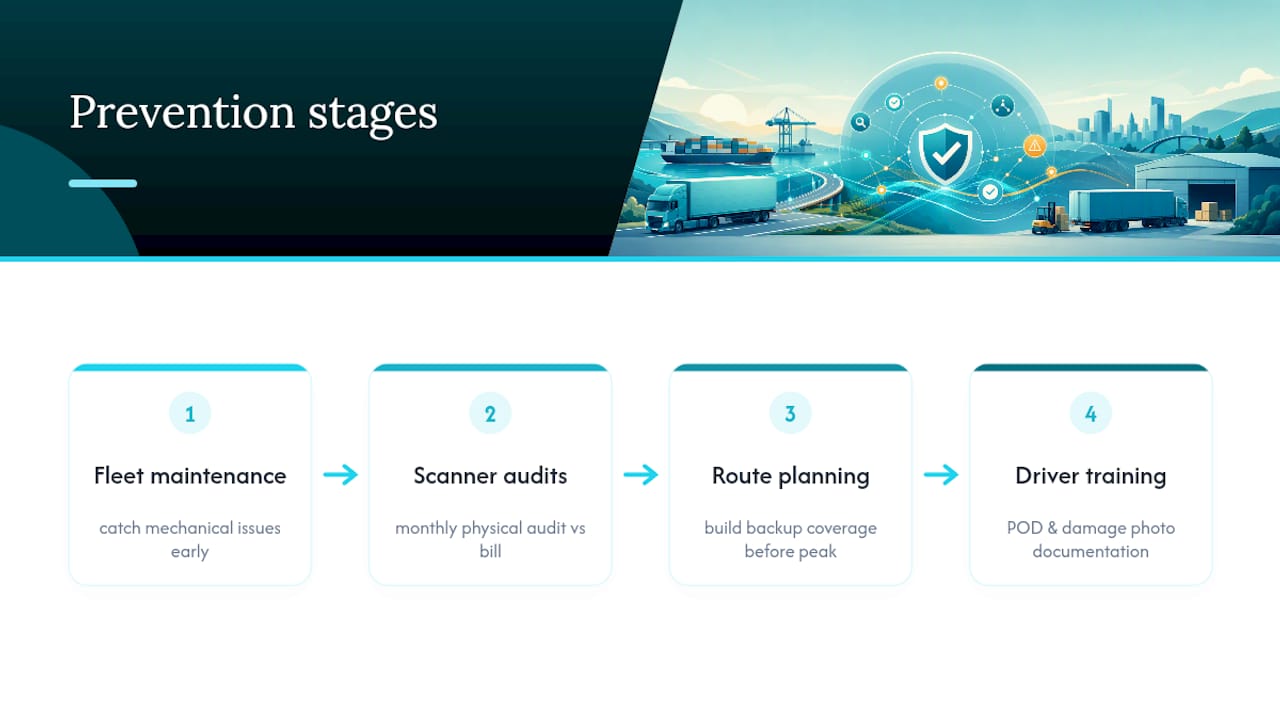
Route coverage planning matters just as much, especially heading into peak season linehaul planning when volume spikes and driver availability tightens at the same time. Building backup coverage into your schedule before November, rather than scrambling for it, is what separates operators who avoid service-failure penalties from those who eat them every peak season.
Driver training on proof-of-delivery procedures and damage documentation closes the loop. A driver who photographs package condition at pickup and delivery gives you the evidence to fight a damage chargeback instead of just absorbing it. None of this eliminates deductions. It shrinks them to the ones that are genuinely earned, which is the realistic goal.
RJR Worldwide’s Practitioner View on Settlement Deductions and Acquisition Diligence
We treat every settlement statement as forensic evidence during the first 90 days after acquiring a linehaul operation, not just a bookkeeping input. Recurring escrow withholdings or scanner overcharges tell you more about a route’s real condition than the seller’s own P&L usually does.
Dedicated lane management, paired with documentation discipline similar to those used in index-linked chemical supply contracts, helps reduce chargebacks that come from inconsistent equipment tracking or gaps in route coverage.
If you’re buying or running a TSP, adopt this short checklist now: separate gross from deductions weekly, tag every entry by route, and file disputes within days, not weeks.
— RJR Worldwide
If You Want Help: RJR Services for Settlement Review and Acquisition Support
Some companies buy and operate FedEx linehaul businesses out of Southern California terminals, which means settlement review isn’t an outside consulting exercise for them. It’s how we run our own dedicated lanes every week.

If you’re a TSP owner weighing a sale, or a buyer trying to figure out whether a target’s settlement history hides recurring deduction problems, that operational experience shapes how we evaluate a FedEx linehaul acquisition from day one. An engagement with us means a full look at gross revenue, deduction categories, escrow positions, and route-level performance before any number gets attached to a deal, backed by the same transparent, documented approach we use across our chemical sourcing contracts. If you’re considering buying, selling, or simply want a second set of eyes on your settlement data before your next contract renewal, reach out through RJR Worldwide and start with a conversation about what your settlement history actually shows.
Sources
- Routecontractor
- FedEx linehaul carriers: a complete guide to opportunities, risks and valuation — Jack Im Woods
- Understanding FedEx Ground settlement reports | FleetWage
- FedEx linehaul accounting: how to properly structure your books — Tullis Consulting & Financial Services, LLC