Protect Lanes: Draft Enforceable 3–5 Year Non-Competes for Logistics Sales

In most logistics business sales, a narrowly drafted non-compete tied to the seller’s sale proceeds will hold up in court, while a broad, vague one gets struck down or rewritten. Sale non-competes are lawful and routinely enforced when scope, geography, and duration are reasonable. Buyers and sellers should get counsel involved before signing anything, and both sides should push to define the restricted “business” and the territory in concrete, lane-level terms rather than sweeping language.
TL;DR:
- Courts will enforce narrowly drafted non-competes tied to specific lanes, customer lists, or proprietary data within a defined, realistic geographic area.
- Broad, vague restrictions or those lacking concrete evidence of protectable assets are likely to be invalidated or rewritten by judges.
- Effective non-competes specify service type, geographic scope based on actual business footprint, and limit duration to three to five years.
- Remedies for breach include injunctive relief, liquidated damages, and escrow or transition agreements to enforce compliance without litigation.
- Both buyers and sellers should tailor restrictions with precise definitions, documented customer and lane data, and carve-outs for passive investments and pre-existing relationships.
Table of Contents
- What a Non-Compete in a Logistics Sale Actually Restricts
- How Courts Actually Treat These Clauses
- Drafting a Covenant That Actually Holds Up
- Remedies When a Non-Compete Gets Breached
- Negotiation Checklist for Buyers and Sellers
- What Logistics Deals Need That Other Sales Don’t
- What We See Buyers and Sellers Get Wrong
- Get Help Structuring Your Logistics Sale
- Where to Dig Deeper
- Sources
What a Non-Compete in a Logistics Sale Actually Restricts
A sale non-compete stops the seller of a logistics business from starting, joining, or investing in a competing operation for a set period after closing. It’s a different animal from an employment non-compete, and courts know it.
The distinction matters because of consideration. An employee signs a non-compete for a paycheck and maybe a small bonus. A seller signs one as part of a multi-million dollar transaction where the non-compete is priced into the purchase. Because the restriction is part of a bargained-for exchange, courts give sale-based covenants more deference than they give employer-employee restrictions, even in states that are otherwise hostile to non-competes generally.
Three related but distinct covenants usually travel together in a logistics purchase agreement:
- Non-compete: bars the seller from operating or owning a competing carrier, brokerage, or linehaul business within a defined market.
- Non-solicit: bars the seller from poaching the specific customers, drivers, or carrier partners tied to the sold business.
- Confidentiality: protects rate sheets, lane profitability data, and carrier relationships from disclosure.
Typical duration in a business sale runs 3 to 5 years, with geographic scope matched to the actual operating footprint rather than a state or national boundary picked out of habit.
How Courts Actually Treat These Clauses
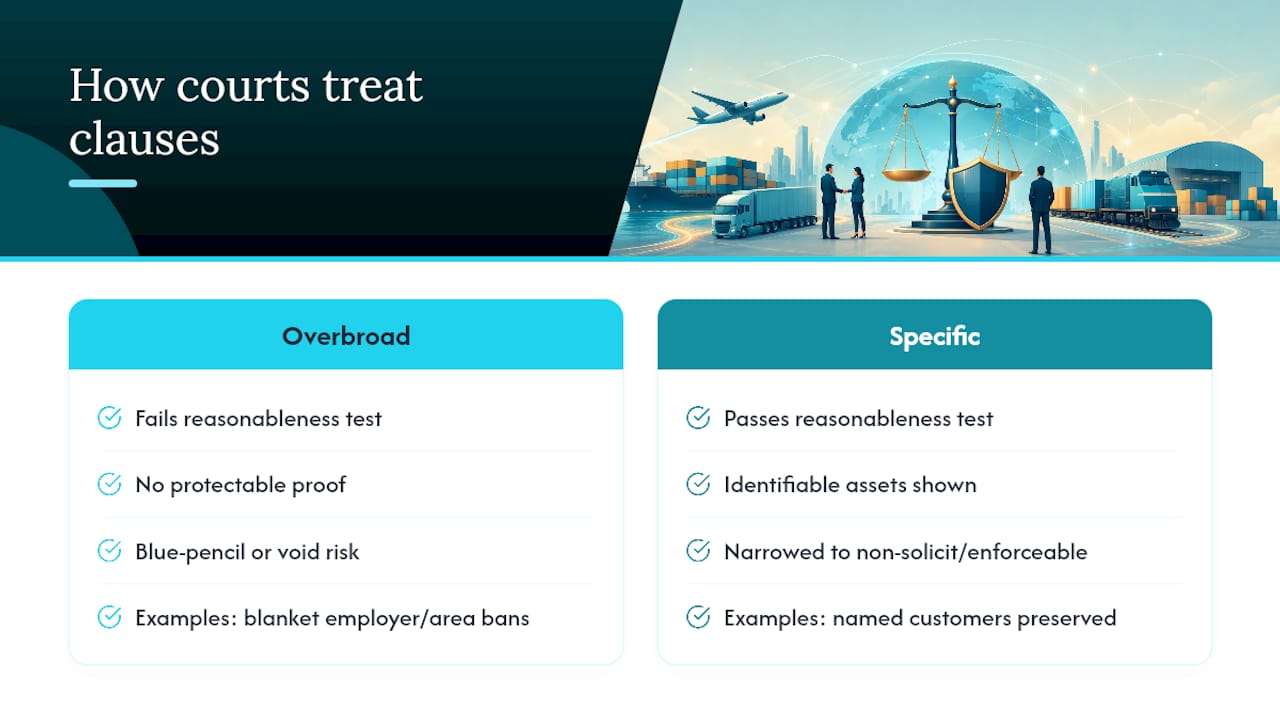
Courts run every non-compete through the same basic filter: is the scope reasonable, is the geography reasonable, and is the duration reasonable given the legitimate business interest being protected? Fail any leg of that test and a judge won’t necessarily throw out the whole clause. Many states will “blue-pencil” it instead, meaning they’ll rewrite the restriction down to something enforceable rather than void it outright. That’s good news for a buyer who overreached in the drafting stage, but it’s a gamble nobody should plan around.
Logistics litigation gives a clear picture of where courts draw the line. In a widely discussed case, a court limited enforcement of a broad activity ban because the buyer couldn’t show proprietary training or a genuinely compiled customer database. Absent that proof, enforcement narrowed to non-solicitation of known accounts. A separate Ohio matter followed the same pattern: without concrete evidence of protectable assets, the court refused to enforce a sweeping ban and instead limited the seller to leaving specific named customers alone.
The pattern courts keep confirming: breadth invites scrutiny, and specificity survives it.
A more recent example bears this out outside the sale context. Reporting on litigation involving XPO showed that a blanket list of prohibited employers and expansive territorial language drew exactly the kind of challenge that gets a clause thrown out or rewritten. Choice-of-law and venue clauses can shift which state’s reasonableness standard applies, but they’re not a substitute for reasonable drafting in the first place. Picking a favorable jurisdiction doesn’t fix an overbroad clause; it just relocates the fight.
Drafting a Covenant That Actually Holds Up
Enforceability lives in the definitions. A one-sentence ban on “competing in the transportation industry” is the kind of clause that gets gutted the first time it’s tested. Precision is what makes a covenant defensible, not the length of the restriction.
- Define “competitive business” narrowly. Specify service type (linehaul, brokerage, dedicated lanes), not the entire freight industry, and state clearly which roles count as a violation: owner, W2 employee, 1099 contractors, or equity investor above a stated threshold.
- Tie geography to the actual customer footprint. Base the restricted territory on historical lanes and account locations, not a state map. A nationwide ban is hard to defend unless the business genuinely operated nationwide.
- Cap duration at the minimum protective period. Three to five years covers most transitions. Longer terms need a specific justification, such as multi-year customer contracts that take that long to fully transition.
- Build out non-solicitation and confidentiality as the real workhorses. A detailed definition of protected customers, tied to account, lane, and historical spend, does more enforcement work than a broad activity ban ever will, since courts look for compilations, not just individual contact facts, before treating a list as protectable.
- Add carve-outs the seller will actually need. Passive investments under a stated percentage, pre-existing consulting arrangements, and family business exceptions should be named, not implied.
- Structure payment to match risk. Escrow holdbacks, installment non-compete payments, or liquidated-damages caps give both sides a financial mechanism that doesn’t require a lawsuit to enforce.
Pro Tip: Draft the non-compete as if you’ll have to defend it in front of a skeptical judge who assumes it’s overbroad until proven otherwise. If you can’t point to a specific customer list, training program, or lane relationship the clause protects, rewrite it before signing.
Legal commentary on drafting restrictive covenants makes the same point directly: a precise, activity-based restriction beats a sweeping one every time enforcement gets tested in court.
Remedies When a Non-Compete Gets Breached
Buyers have two real tools when a seller violates a non-compete: injunctive relief and money damages. Courts favor injunctions, especially early, because lost customer relationships and lane goodwill are hard to price after the fact. A judge asked to issue a temporary restraining order wants documented evidence: customer lists, dates, communications showing solicitation, and proof of the specific business interest at stake.
- Fee-shifting clauses shift legal costs to the breaching party, which changes the math on whether a seller risks a violation.
- Liquidated-damages provisions set a pre-agreed dollar figure for breach, avoiding a costly valuation fight later, though courts will strike a number that looks like a disguised penalty rather than a genuine damages estimate.
- Tolling clauses pause the non-compete clock during active litigation, so a seller can’t run out the restriction period by dragging out a court fight.
- Escrow holdbacks and transition service agreements give buyers leverage without needing to go to court at all, since withheld funds or continued cooperation requirements create their own enforcement pressure.
Negotiation Checklist for Buyers and Sellers
Every logistics deal negotiation over a non-compete comes down to a handful of recurring pressure points. Working through them in order, before the term sheet is final, saves both sides a legal bill later.
- Buyers should insist on narrow, activity-based definitions, documented customer and lane lists, identified trade secrets, and an escrow or installment structure tied to compliance.
- Sellers should insist on explicit carve-outs for passive investment, consulting work, and family-related business activity, plus a duration and geography matched to the actual business sold, not the buyer’s growth ambitions.
- Both sides should consider a compromise structure: a shorter non-compete (say, 3 years) paired with a longer non-solicit (5 years), since courts are generally more comfortable extending non-solicitation obligations than outright competitive bans.
- Cap liquidated damages at a defensible figure tied to actual lost revenue estimates, not an arbitrary round number that looks punitive.
- Document the legitimate business interest in the purchase agreement itself, referencing the specific customer relationships, lane data, or carrier network the covenant protects.
What Logistics Deals Need That Other Sales Don’t
Logistics goodwill lives in lanes and carrier relationships, not just a customer roster. A retail business sale might get away with a generic customer list. A linehaul or brokerage sale won’t, because the value sits in specific contracted lanes, carrier agreements, and pricing history that a generic list doesn’t capture.
- Document customer handoffs by account, lane, and historical volume, not just a name and phone number.
- Keep training and transition logs that show exactly what institutional knowledge changed hands and when.
- Assign carrier agreements explicitly in the purchase documents rather than assuming they transfer automatically.
- Use index-linked pricing and transparent documentation to preserve customer goodwill through the transition, since price volatility right after a sale is a common trigger for customer defection and disputes.
What We See Buyers and Sellers Get Wrong
The most common mistake is treating the non-compete as boilerplate, copying language from a template without tying it to the actual lanes, contracts, and customer relationships in the deal. The second is skipping carve-outs the seller will need within the first year, which turns a minor request into a breach dispute.
We structure transitional deals around documented handoffs and limited, clearly defined seller roles, because a covenant nobody can point to specific evidence for is a covenant that won’t survive a challenge. Get counsel and an operational transition plan in place before the letter of intent, not after.
— RJR Worldwide
Get Help Structuring Your Logistics Sale
FedEx Linehaul operations are bought and integrated directly from California terminals, which means the restrictive covenants in purchase agreements get drafted around actual lane data and carrier relationships, not generic templates borrowed from an unrelated industry. Buyers who work with a broker often get boilerplate non-compete language that a court has never actually tested against logistics-specific facts.

We handle transaction advisory, operational transition support, and drafting of covenants built around your specific lanes, contracts, and carrier network, backed by the same documentation discipline we use for our industrial chemical sourcing contracts. If insurance and operational risk allocation are part of your negotiation, it’s worth reviewing common coverage exclusions trucking owners run into before you finalize deal terms. If you’re planning to sell or acquire a FedEx Linehaul operation, start with a due diligence review of your current restrictive covenants and lane documentation before you go to market.
Where to Dig Deeper
For sample restrictive covenant language, review the SEC-filed asset purchase agreement example showing how sellers disclose existing restraints.
Sources
- M&A Non-Compete Agreement | A Complete Guide - Morgan & Westfield
- Non-Compete and Non-Solicitation Agreements in a Business Sale: What Sellers Need to Know - Icon Business Advisors
- Representative court opinion summarizing limits on broad non-competes in logistics litigation
- XPO lawsuit gives look into noncompete agreements - FreightWaves