REACH Chemical Compliance: A Practical Guide for U.S. Exporters

If you manufacture or import chemical substances into the EU at 1 tonne or more per year, per legal entity, REACH applies to you — and your first move this week is to verify that tonnage threshold and determine whether any substance you supply appears on the SVHC Candidate List. As a non-EU manufacturer, you cannot hold a REACH registration yourself. You either need an EU-based importer who registers, or you appoint an Only Representative (OR) to act as your EU-registered entity.
Week 1 checklist:
- Identify every chemical substance in your products and articles
- Tally manufactured or imported tonnage per legal entity (not per product line)
- Screen each substance against the Candidate List, Annex XIV, and Annex XVII
- Register access to ECHA’s IUCLID and REACH-IT portals, or contact an OR
- Flag any article where an SVHC may exceed 0.1% w/w
Pro Tip: Treat REACH registration as continuous supply-chain monitoring, not a one-time filing. A substance can move onto the Candidate List after your initial registration, triggering new obligations immediately.
Table of Contents
- What is REACH and why does it control EU market access?
- Who is legally responsible under REACH?
- How does the registration process work, and what goes in a dossier?
- What happens when a substance becomes an SVHC?
- Step-by-step REACH compliance checklist for U.S. exporters
- What does REACH compliance actually cost, and how long does it take?
- How is REACH enforced, and what are the real risks of non-compliance?
- Common REACH misconceptions U.S. businesses get wrong
- Immediate next steps: what to do this week, this month, this quarter
- Key Takeaways
- Why the compliance burden falls harder on U.S. exporters than most guides admit
- RJR Worldwide supports U.S. companies navigating EU chemical regulations
- Authoritative sources and next reads
What is REACH and why does it control EU market access?
REACH stands for Registration, Evaluation, Authorisation and Restriction of Chemicals. It is EU Regulation EC 1907/2006, which entered into force in 2007 and replaced the previous EU chemicals framework. Its three stated aims are protecting human health and the environment, promoting alternative hazard-assessment methods, and ensuring free circulation of chemicals in the EU internal market.
The regulation’s core legal logic is the “no data, no market” principle. Under REACH, the burden of proof sits with industry, not regulators. Manufacturers and importers must gather safety data, build a registration dossier, and submit it to the European Chemicals Agency (ECHA) before placing a substance on the EU market. No registration means no legal sale.
Two institutions govern the system:
- European Commission sets REACH policy, proposes amendments, and manages Annex XIV and Annex XVII updates
- ECHA (European Chemicals Agency, Helsinki) manages the registration database, the Candidate List, the REACH-IT submission portal, and IUCLID software; it also conducts dossier evaluations and coordinates enforcement
REACH covers substances on their own, in mixtures, and under certain conditions in articles. That last category surprises many U.S. exporters who assume the regulation only touches bulk chemicals.
Who is legally responsible under REACH?
REACH assigns obligations by role, and the role your organization plays determines what you must do.
- EU manufacturer: produces a substance in the EU; must register directly with ECHA if tonnage meets the threshold
- EU importer: places a substance on the EU market from outside the EU; holds the registration and bears the same obligations as an EU manufacturer
- Downstream user: uses a substance in an industrial or professional process; must operate within the uses covered by the supplier’s registration and communicate safe-use information up and down the supply chain
- Only Representative (OR): an EU-based legal entity appointed by a non-EU manufacturer to fulfill registration obligations on the manufacturer’s behalf
For U.S. companies, the OR route is often the cleanest path. An OR centralizes registration for all EU importers of your substance, eliminating the need for each EU customer to register separately. That matters when you sell to multiple EU buyers — without an OR, each importer must register independently, which fragments data and multiplies cost.
Pro Tip: If you export to five EU customers, appointing a single OR means one dossier, one set of testing costs, and one point of contact with ECHA. Without an OR, each importer may register separately, and you lose control of how your substance is represented in the EU system.
Consider three common U.S. scenarios:
- A U.S. chemical manufacturer ships drums to multiple EU distributors. Each distributor is technically an importer and must register unless an OR is appointed.
- A U.S. company exports finished articles (electronics, coatings, textiles) that contain substances. If an SVHC exceeds 0.1% w/w, article obligations apply even though no bulk chemical is sold.
- A U.S. company uses an EU-based contract manufacturer (toller). The toller is the EU manufacturer for REACH purposes and holds the registration.
How does the registration process work, and what goes in a dossier?
Registration is required for any substance manufactured or imported into the EU at 1 tonne or more per year, per legal entity. The data requirements scale with tonnage.

| Tonnage Band | Typical Dossier Elements |
|---|---|
| 1–10 tonnes/year | Substance identity, physicochemical data, basic hazard data, use information |
| 10 tonnes/year | Above, plus Chemical Safety Assessment (CSA) and Chemical Safety Report (CSR), expanded ecotoxicology |
| — | Above, plus extended toxicology, reproductive toxicity studies, exposure scenarios |
| — | Full data package, comprehensive CSA/CSR, all endpoint studies, detailed exposure scenarios |
A complete dossier typically includes:
- Substance identity: CAS number, molecular structure, purity, impurities
- Physicochemical properties: boiling point, vapor pressure, water solubility, etc.
- Hazard data: toxicological and ecotoxicological endpoints
- Chemical Safety Assessment (CSA) and Chemical Safety Report (CSR): required at ≥10 tonnes/year; documents safe-use conditions and exposure scenarios
- Safety Data Sheet (SDS) and Exposure Scenarios (ES): communicated to downstream users; ES are appended to the SDS for substances requiring a CSR
- Use and risk management measures: conditions of use, operational conditions, risk management measures
The two required tools are IUCLID (data capture and dossier authoring software, available free from ECHA) and REACH-IT (the online submission portal). ECHA charges registration fees that vary by tonnage band and company size; SME reductions apply.
Data-sharing is not optional. REACH requires co-registrants to share vertebrate testing data and avoid unnecessary animal studies. Most registrants join a Substance Information Exchange Forum (SIEF) or consortium to pool existing data and share the cost of new studies.
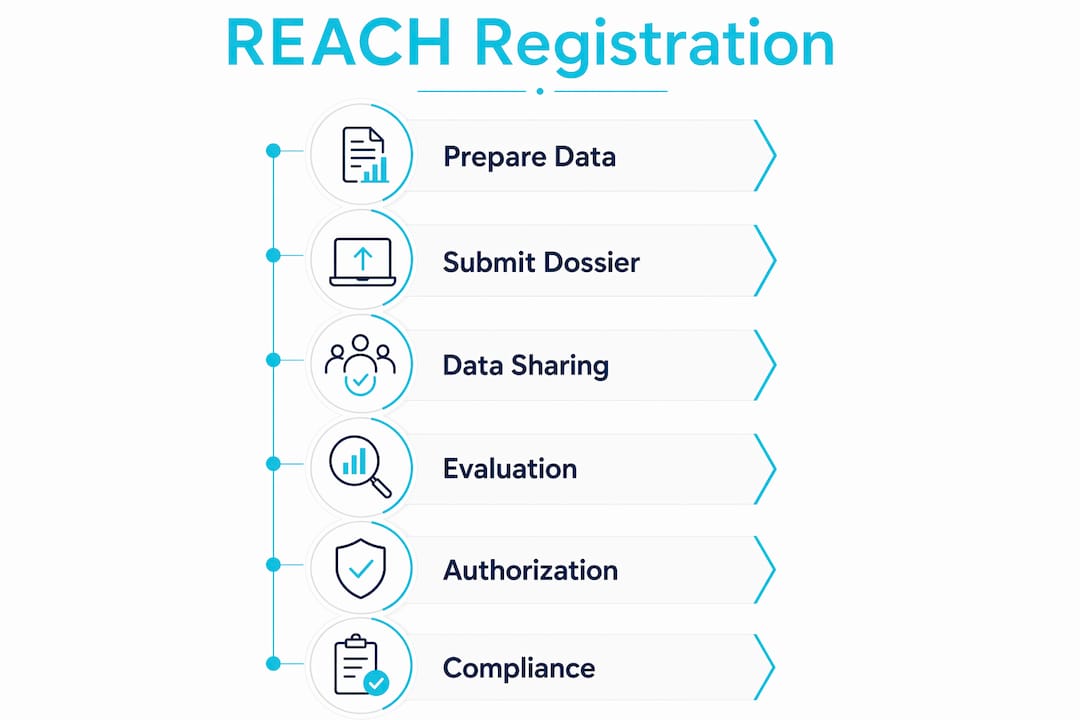
Pro Tip: Start IUCLID data collection before you need it. For high-volume substances with complex hazard profiles, dossier preparation can take six months or more. Engaging a professional dossier consultant early reduces the risk of compliance-check failures and costly re-submissions.
What happens when a substance becomes an SVHC?
Substances of Very High Concern (SVHCs) follow a defined regulatory lifecycle that can move from a communication obligation to a market ban within a few years.
- Candidate List: ECHA adds SVHCs here when they meet criteria such as carcinogenicity (CMR), persistence/bioaccumulation/toxicity (PBT), very persistent/very bioaccumulative (vPvB), or endocrine disruption. Inclusion triggers immediate duties: suppliers must communicate SVHC presence to customers, and article importers must respond to Article 33 consumer inquiries within 45 days.
- Annex XIV (Authorization List): SVHCs can be added to Annex XIV, which sets a “sunset date” after which the substance cannot be used or placed on the EU market without a specific authorization from the European Commission. Authorization applications are multi-year processes and are not guaranteed.
- Annex XVII (Restrictions): Restrictions can limit or ban specific uses of a substance across the entire EU, regardless of whether it is registered. Annex XVII applies to both registered and unregistered substances.
The practical consequence of a Candidate List addition is immediate, not eventual. The day ECHA adds a substance to the Candidate List, every supplier in the chain must be able to confirm whether their product contains that SVHC above 0.1% w/w and communicate that information to customers. Companies that have not screened their articles or mixtures in advance face sudden compliance gaps, potential customs holds, and Article 33 response failures — all before any Annex XIV sunset date arrives.
Check the Candidate List and both Annexes at least quarterly. A substance your supplier has been using for years can move onto the list without warning, and your downstream communication obligations begin the same day.
Step-by-step REACH compliance checklist for U.S. exporters
This checklist is structured by time horizon. Assign an owner to each item and set a calendar reminder for the quarterly review.
This week:
- List every chemical substance in your products and articles by CAS number
- Aggregate annual tonnage per legal entity (not per product or customer)
- Screen each substance against the current ECHA Candidate List, Annex XIV, and Annex XVII
- Confirm whether any article you export may contain an SVHC above 0.1% w/w
- Subscribe to ECHA Candidate List update alerts
This month:
- Collect existing Safety Data Sheets and analytical certificates for priority substances
- Evaluate whether to appoint an Only Representative or rely on an EU-based importer to register
- Begin IUCLID data compilation for substances at or near the 1 tonne/year threshold
- Identify whether any substance requires a CSA/CSR (≥10 tonnes/year)
This quarter:
- Decide on consortium or SIEF participation for shared testing costs
- Commission any required endpoint studies not covered by existing data
- Prepare registration dossiers or, for SVHCs on Annex XIV, begin authorization strategy planning
- Establish a documented process for Article 33 inquiries and SDS/ES updates
Pro Tip: Centralize your master substance data in one system — a spreadsheet or a dedicated compliance platform. Supply-chain changes (new supplier, new grade, new EU customer) can create new REACH obligations overnight. A single source of truth makes those changes visible before they become violations.
What does REACH compliance actually cost, and how long does it take?
Timelines and costs vary significantly by substance complexity and tonnage, but here are the realistic ranges to plan around.
Typical timelines:
- Dossier preparation: weeks for simple low-tonnage substances; four to twelve months for high-volume or complex hazard profiles
- ECHA dossier evaluation and compliance checks: months to over a year, depending on substance priority
- Authorization application (Annex XIV): planning and preparation alone can span two to three years before a decision
Major cost drivers:
- Vertebrate and non-vertebrate testing: often the largest single cost; consortium data-sharing can reduce this substantially
- Dossier preparation: consultant and legal fees for complex CSA/CSR work
- Consortia and SIEF fees: vary widely by substance and number of co-registrants
- ECHA registration fees: tiered by tonnage band and company size
- Substitution or reformulation: for SVHCs approaching sunset dates, reformulation costs can dwarf registration costs
Costs scale non-linearly with tonnage and hazard complexity. A 1–10 tonne/year registration for a well-characterized substance with existing data might cost a few thousand dollars in consultant time. A high-volume substance with PBT or vPvB endpoints requiring new vertebrate studies can run into six figures before ECHA fees are added. Build contingency into your budget for ECHA follow-up requests, which are common after compliance checks.
How is REACH enforced, and what are the real risks of non-compliance?
National competent authorities in each EU member state enforce REACH. ECHA coordinates enforcement activities through the Enforcement Forum, which runs periodic joint enforcement projects across member states. Penalties vary by jurisdiction — some member states impose criminal liability for serious violations; others rely on administrative fines and corrective orders.
The practical risks for U.S. exporters are more immediate than fines:
- Customs detention: EU border authorities can hold shipments of unregistered substances or articles containing undisclosed SVHCs
- Forced market withdrawal: products found non-compliant can be removed from sale across the entire EU
- Article 33 failures: failing to identify SVHCs in articles is a documented cause of customs seizures; downstream customers can also reject shipments if Article 33 responses are not provided within 45 days
- Reputational damage: EU customers increasingly require documented REACH compliance as a procurement condition; a compliance failure can cost you the customer relationship, not just the shipment
Mitigation comes down to documentation. Maintain traceable records of substance identity, tonnage, SDS versions, and Article 33 responses. If a customs authority or enforcement body asks for evidence of compliance, the answer needs to be a document, not a conversation.
Common REACH misconceptions U.S. businesses get wrong

Myth: OSHA compliance covers your EU obligations. It does not. OSHA’s Hazard Communication Standard governs workplace hazard communication inside the United States. REACH is an EU market-access regulation with entirely separate legal requirements. An SDS that meets OSHA HCS format does not substitute for a REACH-compliant SDS with EU-format Exposure Scenarios. The two systems share GHS alignment at a high level, but the registration, authorization, and restriction obligations under REACH have no OSHA equivalent.
Myth: REACH only applies to bulk chemicals. REACH obligations extend to substances in articles when an SVHC is present above 0.1% w/w and can be released under normal or reasonably foreseeable conditions. A U.S. company exporting coated metal parts, treated textiles, or electronic assemblies may have article obligations even if it never sells a drum of chemical.
Myth: A high-quality dossier is enough to avoid scrutiny. ECHA is statutorily required to perform compliance checks on at least 5% of all registration dossiers, with higher scrutiny typically applied to high-volume substances and complex supply-chain data. A dossier that passes initial submission can still be selected for a compliance check months or years later. Dossiers must be defensible and kept current.
Myth: U.S. regulatory compliance translates to EU compliance. It does not. U.S. EPA and FDA frameworks address different risk endpoints and use different data requirements than REACH. Plan for OR appointment or EU-based importer registration as a separate workstream from your domestic compliance program.
Immediate next steps: what to do this week, this month, this quarter
This week:
- Pull your full substance inventory and assign CAS numbers to every chemical in your products and articles
- Check each substance against the ECHA Candidate List and confirm whether any article may contain an SVHC above 0.1% w/w
- Tally annual tonnage per legal entity for each substance
- Subscribe to ECHA Candidate List update notifications
This month:
- Collect all existing SDS documents and analytical data for priority substances
- Decide whether to appoint an Only Representative or structure EU sales through a registering importer
- Begin IUCLID data compilation for substances at or approaching the 1 tonne/year threshold
- Identify which substances require a full CSA/CSR based on the ≥10 tonne/year threshold
This quarter:
- Evaluate consortium or SIEF participation for high-cost testing requirements
- Commission any endpoint studies not covered by existing data
- Finalize registration dossiers for priority substances or begin authorization strategy for any Annex XIV substances
- Assign a named owner for Article 33 response management and set a 45-day response protocol
Key Takeaways
REACH chemical compliance for U.S. exporters requires registration with ECHA (or appointment of an Only Representative) for every substance at or above 1 tonne per year per legal entity, continuous Candidate List monitoring, and traceable documentation at every point in the supply chain.
| Point | Details |
|---|---|
| Registration threshold | Any substance at ≥1 tonne/year per legal entity must be registered with ECHA or cannot be placed on the EU market. |
| Only Representative route | Non-EU manufacturers can appoint an EU-based OR to hold registration, centralizing obligations across all EU importers. |
| SVHC article obligations | Articles containing a Candidate List substance above threshold levels trigger immediate communication duties and potential customs risk. |
| ECHA compliance checks | ECHA is required to check at least 5% of dossiers; high-volume and complex substances face higher scrutiny, making dossier quality critical. |
| RJR Worldwide’s role | RJR Worldwide integrates chemical sourcing with compliance documentation and logistics, reducing friction at EU customs and during Article 33 inquiries. |
Why the compliance burden falls harder on U.S. exporters than most guides admit
Most REACH guides walk through the regulation’s structure and stop there. What they understate is the operational gap between knowing the rules and actually executing them from a U.S. base.
The 45-day Article 33 response window is a good example. When an EU customer asks whether an article contains an SVHC above 0.1% w/w, the clock starts immediately. If your substance data is scattered across supplier certificates, old SDS versions, and a contract manufacturer’s files in a different time zone, you will not hit that deadline consistently. The regulation does not care that your compliance team is in California and your EU customer is in Germany.
The same logic applies to Candidate List monitoring. ECHA adds substances to the list on a rolling basis. A substance that was clean when you last checked may carry new communication obligations today. U.S. companies that treat REACH as a one-time registration project, rather than a continuous supply-chain function, tend to discover this the hard way — at customs, or when a major EU customer puts their contract on hold pending compliance documentation.
The underrated advantage of working with a sourcing and logistics partner that already maintains EU-standard documentation is that the compliance infrastructure is built into the supply chain from the start. You are not retrofitting traceability onto a supply chain that was never designed for it.
RJR Worldwide supports U.S. companies navigating EU chemical regulations
U.S. exporters dealing with REACH obligations face a specific problem: the documentation, registration, and communication requirements are EU-centric, but your operations are not. RJR Worldwide’s chemical sourcing division is built around exactly this gap. Multi-year supply agreements with vetted manufacturers in China and India come with full compliance documentation — SDS packages, analytical certificates, and substance identity data structured for IUCLID-ready dossier preparation. That means when your EU importer or OR needs data, it exists and it is organized.
Beyond sourcing, RJR Worldwide’s California-based logistics operations handle customs documentation and freight continuity for EU-bound shipments, reducing the points of failure that typically surface during customs checks or Article 33 inquiries. If you are evaluating whether to appoint an Only Representative or restructure your EU sales channel, RJR Worldwide can help you map the documentation requirements before you commit to a structure. Contact RJR Worldwide through rjrworldwide.com to start a compliance intake conversation.
Authoritative sources and next reads
These are the primary resources to bookmark for ongoing REACH chemical compliance work:
- REACH Regulation — European Commission Environment: The official European Commission overview of REACH obligations, scope, and legal text; the authoritative starting point for understanding registration and article obligations
- REACH Explained — Internal Market, Industry, Entrepreneurship and SMEs: Plain-language explanation of the “no data, no market” principle, Candidate List, Annex XIV, and Annex XVII; useful for non-specialists building a compliance program
- ECHA Guidance on Information Requirements and Chemical Safety Assessment: ECHA’s detailed guidance on dossier structure, CSA/CSR requirements, IUCLID usage, and data-sharing obligations; essential for dossier preparers
- EU REACH — International Trade Administration (Trade.gov): U.S. government guidance on REACH for American exporters, covering OR appointment, article obligations, and enforcement context; written specifically for the U.S. business audience
- REACH Legislation — ECHA: Consolidated legal text of Regulation EC 1907/2006 and all implementing regulations; use this when you need to cite the specific article or annex that applies to your situation
- ECHA REACH-IT portal: The submission system for registration dossiers; register an account early, as account setup and dossier upload can take time
- ECHA Candidate List alerts: Subscribe at echa.europa.eu to receive notifications when new SVHCs are added; this is the single most important monitoring step for article manufacturers
For enforcement questions specific to your target EU member state, contact that country’s national competent authority directly. ECHA maintains a directory of national helpdesks that can clarify local enforcement priorities and penalty structures.