Excipient Risk Assessment: A Framework for GMP Compliance

Excipient risk assessment is a documented, trinomial evaluation of the excipient itself, its supplier, and its intended use, scored and mapped to the appropriate good manufacturing practice (GMP) level under ICH Q9 quality risk management principles. If you have not yet run one for a given excipient, your first move is to open a documented trinomial assessment (excipient + supplier + intended use) and assign it a preliminary risk rating before you touch a purchase order or a batch record.
A completed assessment produces four things every auditor will ask for:
- A GMP-level assignment for that specific excipient and use
- A residual risk rating (Low, Medium, or High)
- A mitigation or control plan tied to that rating
- A dated communication record with the supplier
Pro Tip: Start the trinomial file the day you shortlist a supplier, not after the first shipment lands. Retrofitting documentation after material is already in inventory is where most audit findings originate.
Key Takeaways
A defensible excipient risk assessment combines a documented trinomial evaluation, evidence-based scoring mapped to GMP levels, and a supplier relationship stable enough to support ongoing reassessment.
| Point | Details |
|---|---|
| Start with the trinomial | Document excipient, supplier, and intended use together before assigning any risk score. |
| Match evidence to function | Reserve nonclinical data and analytical testing like SSNMR for high-function excipients, not routine fillers. |
| Score to a fixed matrix | Use a consistent Low/Medium/High threshold so reassessments stay comparable over time. |
| Verify, don’t just file, COAs | Spot-check certificates of analysis against incoming material rather than accepting them on trust. |
| Reassess on triggers, not just a calendar | Supplier changes, COA drift, and deviations should force an off-cycle review immediately. |
Where to Go for the Primary Guidance
- EU formalised risk assessment guideline for GMP-level mapping
- IPEC Risk Assessment Guide (2025) for scoring methodology
- FDA nonclinical safety guidance for toxicology thresholds
- PDA commentary for practical implementation
- SSNMR characterization study for analytical method detail
Table of Contents
- Building an Auditable Risk Assessment Procedure
- Which Tools and Analytical Methods Reduce Uncertainty?
- How Do You Manage Risk by Tier and Supplier?
- Getting Long-Term Supply Support for Your Assessment Program
- The Real Gap in Most Excipient Risk Programs
- Frequently Asked Questions
- Sources
Building an Auditable Risk Assessment Procedure
Inspectors do not just want a risk rating. They want to see the reasoning that produced it, step by step, with names and dates attached. Here is the sequence that holds up under scrutiny.
- Assemble a cross-functional team and define scope. Pull in quality, regulatory affairs, and someone who understands the formulation itself. Define the exact excipient, the exact supplier or manufacturing site, and the exact intended use, since a change in any one of those three variables restarts the assessment.
- Identify risks across three domains. Intrinsic excipient hazards (chemical stability, source variability, known impurity profiles), supplier risks (manufacturing history, regulatory standing, geographic and logistics exposure), and user or formulation risks (route of administration, dosage form, whether the excipient performs a critical function like controlled release).
- Score each risk. Most teams use a simple qualitative or semi-quantitative matrix, severity multiplied by probability multiplied by detectability, similar to a classic FMEA structure. A Low score might sit at 1 to 3, Medium at 4 to 8, and High at 9 and above, though your thresholds should reflect your product portfolio rather than a borrowed template.
- Decide the control strategy. A Low score usually supports acceptance with standard testing. Medium often triggers reduced testing plus periodic verification. High demands enhanced controls, additional audits, or in some cases a supplier change.
- Document the output. Record the residual risk, the specific mitigation plan, who reviewed it, when the supplier was notified, and the date the assessment is due for renewal.
Pro Tip: Write the scope statement first and get it signed off before scoring begins. Teams that skip this step often argue about severity ratings for an hour, only to realize half the room was scoring a different route of administration than the other half.
Which Tools and Analytical Methods Reduce Uncertainty?
Scoring frameworks only work if the inputs feeding them are reliable, and that is where formal QRM tools and lab evidence come in.
- FMEA suits excipients with multiple failure modes across a supply chain, since it forces you to separate severity from likelihood from detectability instead of blending them into a single gut-feel number.
- HACCP-style mapping works better for food-grade or process-contamination risks, where the question is where in the chain a hazard could be introduced rather than how bad a single defect would be.
- Categorical scoring (Low/Medium/High buckets) is faster for routine excipients; numerical scoring earns its complexity for high-function materials like biologics stabilizers.
Analytical evidence closes the gap between what a certificate of analysis claims and what is actually in the drum. Solid-state NMR can detect structural differences, crystalline versus amorphous content, and water-content variation in polysaccharide-based excipients, giving you a functional indicator that a standard identity test would miss. HPLC and LC-MS handle impurity and degradant profiling, and targeted assays exist for known problem areas like polysorbate degradation, where oxidative breakdown products have caused real formulation failures in the biologics space.
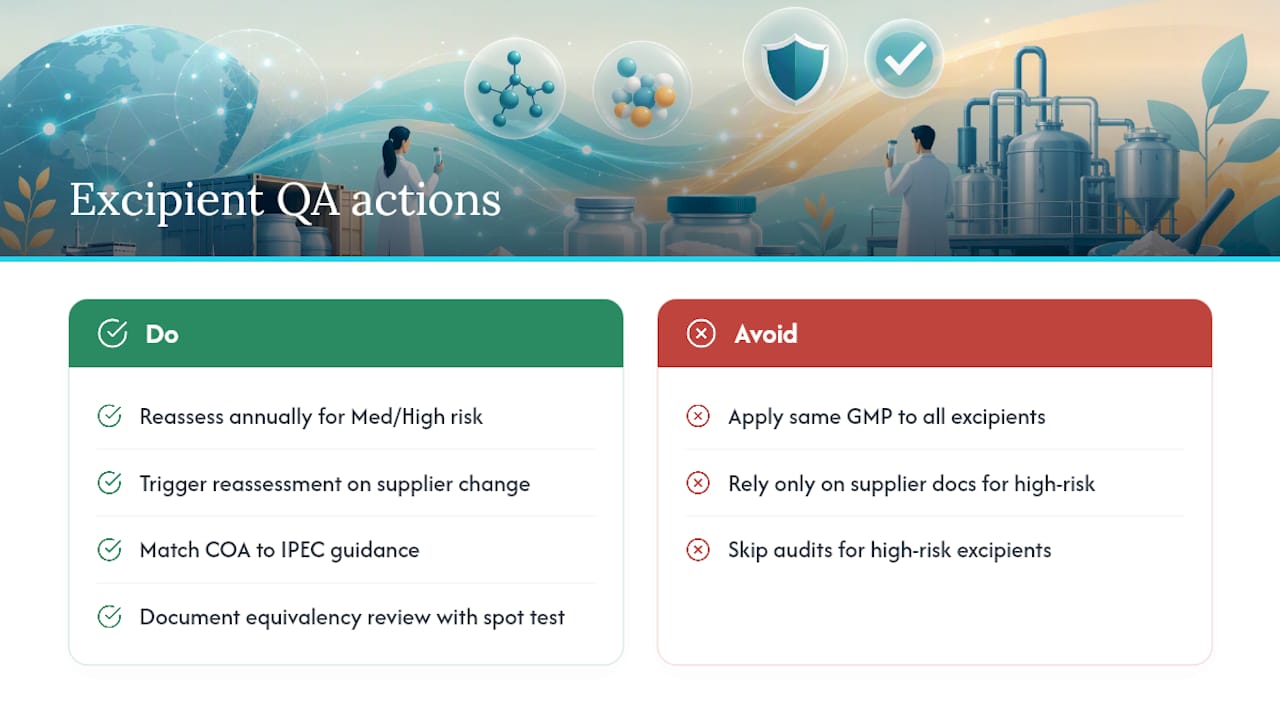
Where monograph differences exist across USP-NF, Ph. Eur., and JP, a documented multi-compendial equivalency review plus spot verification testing can replace redundant full-panel retesting on every lot, saving lab hours without weakening the evidence trail.
How Do You Manage Risk by Tier and Supplier?
Your control matrix should read like a decision table, not a philosophy. A Low-risk excipient typically needs standard release testing and an annual document review. Medium risk usually adds increased testing frequency, a scheduled supplier audit, and possibly a quality improvement plan (QIP) if a pattern of minor deviations shows up. High risk calls for enhanced testing on every lot, more frequent on-site audits, a formal corrective and preventive action (CAPA) process, and, in persistent cases, qualifying a second supplier.
A supplier gap analysis should collect audit reports, current certifications, certificate of analysis content matched against IPEC’s COA guidance, and recent batch records showing consistency over time, not just a single clean sample.
- Quality agreements should specify notification timelines for any manufacturing change
- COAs should be independently spot-checked against incoming material, not filed on trust
- Audit cadence should scale with risk tier, not default to the same annual schedule for every supplier
Pro Tip: Set your CAPA trigger before you need it. A predefined threshold, such as two consecutive out-of-specification results or any undisclosed site change, keeps the decision from becoming a debate under deadline pressure.
When Should You Re-Assess an Excipient?
Routine review typically runs annually for Medium and High-risk materials, but several events should force an off-cycle reassessment regardless of the calendar: a supplier or manufacturing-site change, drift in COA values from batch to batch, a production deviation traced to raw material, or an update to relevant guidance. Change control should log the trigger, the reassessment findings, any revised GMP-level assignment, and confirmation that the supplier was notified before the next release decision.
What Does Audit-Ready Documentation Look Like in Practice?
RJR Worldwide Corp. builds its chemical sourcing agreements around the same evidence an auditor expects to see in a supplier dossier: verified COAs, documented supplier audits, and full batch traceability across pharmaceutical, food, and technical grades sourced from vetted manufacturers in China and India.
Multi-year, index-linked supply agreements do more than stabilize pricing. They give QA teams a fixed, qualified supplier relationship to reference in every reassessment cycle, instead of rebuilding a risk file from scratch each time a spot-market vendor changes.
That continuity extends into logistics. Because RJR Worldwide Corp. operates its own FedEx Linehaul lanes from California terminals, shipment records and chain-of-custody data are available as part of the same documentation package auditors review for supplier qualification.
Getting Long-Term Supply Support for Your Assessment Program
An excipient risk assessment is only as strong as the supplier relationship behind it. A rating of Low today can drift to Medium if a supplier changes ownership, shifts a manufacturing site, or goes quiet on documentation requests. RJR Worldwide Corp. works directly with pharmaceutical, food, and technical-grade buyers on multi-year, index-linked contracts backed by full compliance documentation, so your gap analysis starts from a qualified baseline instead of an unknown. If your team is evaluating a new excipient source or trying to stabilize a supply chain that keeps triggering reassessments, the Chemical Sourcing Division is built around exactly that problem.

The Real Gap in Most Excipient Risk Programs
Most companies treat excipient risk assessment as a paperwork exercise completed once, at qualification, then filed away. That reading misses the point of the EU’s 2015 guideline entirely. The formalised assessment was never meant to be a one-time gate. It is a living record that should update every time the excipient’s context changes, whether that is a new dosage form, a new supplier site, or new impurity data from a lot that looked fine on paper.
The bigger blind spot is over-reliance on the certificate of analysis as if it were independent verification. A COA is a supplier’s claim about their own material. Pairing it with periodic analytical checks, SSNMR for structurally sensitive excipients, targeted assays for known degradation pathways, gives you evidence instead of trust.
If you take one thing from IPEC’s 2025 update and the FDA’s tiered evidence approach together, it is this: match the rigor of your evidence to the excipient’s actual function, not to how long you have worked with the supplier. A stabilizer in a biologic deserves more scrutiny than a filler, regardless of how many years the relationship has run clean.
Frequently Asked Questions
What is the difference between excipient risk assessment and excipient safety evaluation? Risk assessment is the broader trinomial process covering excipient, supplier, and use, scored and mapped to a GMP level. Safety evaluation is narrower: it refers specifically to the nonclinical or toxicology data FDA expects when a new excipient or novel route of administration is involved.
How often should pharmaceutical excipients analysis be repeated? Annually for Medium and High-risk materials at minimum, with immediate reassessment triggered by a supplier change, COA drift, a production deviation, or new regulatory guidance.
Does every excipient need the same level of GMP? No. The EU 2015 guideline explicitly rejects a one-size GMP standard, mapping the required level to the excipient’s function, route of administration, and the risk found during the trinomial assessment.
What counts as sufficient evidence for a Low-risk excipient? Verified supplier documentation, a current certificate of analysis matched against IPEC’s COA guidance, and standard release testing are usually sufficient. High-risk excipients typically need stronger audits and, in some cases, additional functional or nonclinical data.
Can multi-compendial testing reduce my analytical workload? Yes. A documented equivalency review across USP-NF, Ph. Eur., and JP, backed by spot verification testing, can eliminate redundant full-panel retesting where monograph specifications genuinely align.
Sources
Four documents anchor a defensible excipient risk assessment, and each one hands you a different piece of the puzzle.
- IPEC releases updated risk assessment guide for excipient manufacturers
- Guidelines of 19 March 2015 on the formalised risk assessment for ascertaining the appropriate good manufacturing practice for excipients of medicinal products for human use
- Nonclinical Studies for the Safety Evaluation of Pharmaceutical Excipients | FDA
- Solid-state NMR characterization of polysaccharide-based excipients (PMC article)
- Formalizing a Risk Assessment for Excipients | PDA