FDA Food Grade Chemicals: What Procurement and QA Must Verify

In the United States, an “FDA food grade chemical” is a substance whose intended use in food is either authorized as a food additive or classified as Generally Recognized as Safe under sections 201(s) and 409 of the Federal Food, Drug, and Cosmetic Act. There’s no separate “food grade” stamp the agency hands out. What exists instead is a legal test tied to intended use, backed by a manufacturer’s own evidence that the substance carries a reasonable certainty of no harm under that specific use.
Before you sign a purchase order, three FDA resources deserve a bookmark:
- Substances Added to Food (formerly EAFUS), the agency’s running list of nearly 4,000 additives
- The GRAS Notice Inventory, where you can check if a supplier’s GRAS claim actually cleared FDA review
- The Food Contact Substance listings, relevant if the chemical touches packaging rather than the food itself
Your first move with any new supplier: map the intended use precisely, request a certificate of analysis that references the Food Chemicals Codex (FCC) or the applicable U.S. Pharmacopeia (USP) monograph, and budget for independent testing on the first shipment. Skipping that last step is how contamination and mislabeling issues make it onto a production line.
Key Takeaways
FDA food grade compliance rests on documented, use-specific evidence of no harm, not a generic label, and manufacturers carry that documentation burden alone.
| Point | Details |
|---|---|
| Legal basis is use-specific | FD&C Act sections 201(s) and 409 tie safety determinations to a substance’s exact intended use, not a general label. |
| GRAS has two evidence tracks | Scientific-procedure GRAS requires petition-level evidence; pre-1958 common-use GRAS relies on documented history instead. |
| Check the FDA inventory first | The Substances Added to Food database lists close to 4,000 entries and should be your first stop for any new chemical. |
| Demand monograph-specific CoAs | A credible certificate of analysis names the FCC or USP monograph and lists itemized test results, not a pass/fail summary. |
| RJR Worldwide standardizes documentation | Multi-year, index-linked agreements with vetted suppliers keep CoA format and traceability consistent across every shipment. |
Table of Contents
- FDA Food Grade Chemicals: The Regulatory Framework Explained
- Which FDA Databases Actually List Food-Grade Chemicals?
- GRAS vs. Food Additives: What the Difference Means for Procurement
- What FDA Expects From Manufacturers on Compliance
- Sourcing Food-Grade Chemicals: FCC, USP, and What a Real Contract Should Cover
- How to Verify a Supplier’s Paperwork Before You Trust It
- Your Procurement Checklist for FDA Food Grade Chemicals
- Where to Go for Primary FDA Guidance and Sourcing Templates
- The FDA Approval Process: Petitions and Notifications Explained
- How FDA Rules Compare to EFSA and Codex Alimentarius Standards
- Health Risks and Toxicological Considerations Worth Understanding
- Recent FDA Policy Changes Affecting Food-Grade Chemicals
- Food-Grade Chemicals in Packaging and Contact Materials
- Why Documentation, Not Labels, Determines Real Compliance
- How RJR Worldwide Supports Audit-Ready Chemical Sourcing
- Frequently Asked Questions
- Sources
FDA Food Grade Chemicals: The Regulatory Framework Explained
Every substance added to food in the U.S. falls into one of a handful of legal buckets, and which bucket it lands in determines what documentation you’re entitled to demand.
The FD&C Act’s Section 409 requires premarket approval for food additives, while Section 201(s) carves out the GRAS exception. Both routes ultimately answer the same question: does the intended use create a reasonable certainty of no harm? The FDA’s own guidance is explicit that GRAS conclusions reached through scientific procedures require the same quantity and quality of evidence as a formal additive petition. That distinction matters more than most sourcing teams realize, because a vague “GRAS” label on a spec sheet doesn’t tell you which path a substance took to get there.
Beyond additives and GRAS, three other categories show up constantly in industrial chemical sourcing:
- Color additives go through their own petition process under separate regulations, distinct from general food additives
- Prior-sanctioned substances received explicit FDA or USDA approval before 1958 and operate under legacy conditions rather than modern petition standards
- Food Contact Substance notifications cover chemicals that migrate from packaging or processing equipment into food, a narrower and often faster premarket pathway than a full additive petition
The GRAS side of this framework is shifting. In August 2026, the FDA proposed a rule to increase oversight of GRAS determinations, aiming to close a gap where companies could self-affirm GRAS status without notifying the agency at all. If finalized, that rule will change how much documentation a supplier needs to hand over before you can rely on a GRAS claim at face value. Procurement teams tracking food processing chemicals should treat this as a live regulatory area, not settled law.
Which FDA Databases Actually List Food-Grade Chemicals?
Three FDA inventories cover almost everything a procurement team needs, and each one has blind spots worth knowing before you rely on it.
The Substances Added to Food database, the successor to the old EAFUS list, catalogs close to 4,000 substances along with their regulatory status and typical use category. It’s the fastest way to confirm whether a chemical has any FDA history at all. What it won’t tell you is the specific concentration limit for your exact application. That detail lives in the underlying regulation, not the database entry.
The GRAS Notice Inventory lists substances where a company voluntarily notified FDA of a GRAS conclusion and the agency responded without objection. Here’s the part suppliers sometimes gloss over: not every GRAS claim on the market went through this notification process. A company can self-affirm GRAS status internally and never file with FDA. That’s legal, but it means an unlisted substance isn’t automatically non-compliant, and a listed one isn’t automatically the safest option for your use case.
The Food Contact Substance inventory covers chemicals authorized for packaging, adhesives, and processing equipment, a separate track from direct food additives.
When you pull any of these listings, check for three things: the authorized use category, any numeric limit (parts per million, percentage by weight), and the date of the last update. A ten-year-old entry with no amendments isn’t necessarily current if the compound’s use has expanded since.
GRAS vs. Food Additives: What the Difference Means for Procurement
GRAS status comes from two distinct roads, and knowing which one your supplier’s chemical traveled changes how much scrutiny you should apply.
The first road is GRAS through scientific procedures, which demands published, peer-reviewed evidence and, per FDA guidance, the same quantity and quality of data an additive petition requires. The second is GRAS through common use in food before 1958, a historical carve-out that relies on documented widespread use rather than modern toxicology studies. A chemical qualifying under the second route may have far thinner safety documentation than one qualifying under the first, even though both carry the same “GRAS” label on a spec sheet.
Pro Tip: Ask your supplier which GRAS pathway applies and request the underlying safety data or expert panel report. A supplier who can’t answer this question in one email is telling you something about their documentation practices.
Nearly 4,000 substances sit in FDA’s public inventory of food additions, and GRAS status covers a meaningful share of that list, yet the label tells you nothing about which evidence standard applied.
That’s the core misconception worth killing early: GRAS does not mean “always safe, no conditions attached.” GRAS status is specific to an intended use and specific conditions of use. A preservative deemed GRAS for baked goods at a certain concentration isn’t automatically GRAS for a beverage application at a different concentration. Procurement teams who treat GRAS as a blanket safety label, rather than a use-specific determination, are the ones who get surprised during an audit.
What FDA Expects From Manufacturers on Compliance
The legal burden never shifts to the FDA to prove a chemical is unsafe. It sits with you, the manufacturer or the company putting that ingredient into a finished product, to demonstrate the “reasonable certainty of no harm” standard before the product ships.
That standard is use-specific. A chemical’s safety profile depends entirely on how much of it ends up in the final food, at what frequency, and for what population. FDA’s Food Chemical Safety program exists partly to help industry meet this burden, but the documentation responsibility stays with the company, not the agency.
Practical steps QA and regulatory teams should run through with every new ingredient supplier:
- Confirm the substance’s regulatory category (additive, GRAS, color additive, or food contact substance) and match it against your specific application.
- Request CGMP compliance documentation and, where applicable under FSMA, verify the supplier’s preventive controls and registration status.
- Pull the Certificate of Analysis and confirm it cites a specific monograph, not a generic “meets food grade standards” statement.
- Establish traceability records back to the manufacturing lot, not just the shipping container.
- Schedule independent verification testing for the first shipment before it enters production inventory.
- Build a supplier verification file that an FDA investigator or third-party auditor could review without follow-up questions.
Pro Tip: Keep a single digital folder per supplier per chemical grade, containing the CoA, the FSVP verification record, and the most recent audit result. When an FDA inspector or customer auditor asks for documentation, the difference between finding it in ninety seconds and finding it in three days is often the difference between a clean audit and a warning letter.
FSMA’s supplier verification requirements aren’t optional paperwork. They’re the mechanism FDA expects you to use to confirm that a foreign or domestic supplier is actually controlling the hazards they claim to control, and that mechanism has to run continuously, not just at initial qualification.
Sourcing Food-Grade Chemicals: FCC, USP, and What a Real Contract Should Cover
Not every “food grade” claim rests on the same specification standard, and that distinction affects both your testing budget and your legal exposure.
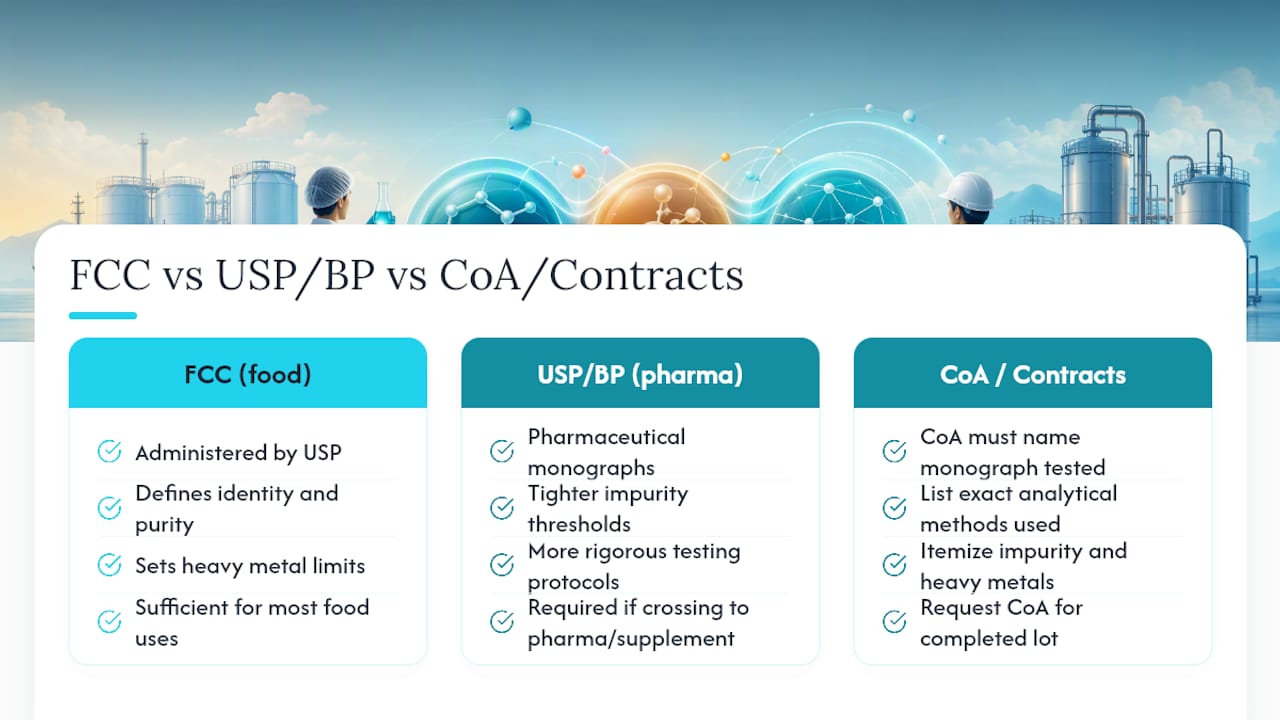
The Food Chemicals Codex (FCC), administered by USP, is the standard reference most food-grade chemicals should meet or exceed. It defines identity, purity thresholds, and heavy metal limits for a given substance. For most food manufacturing applications, FCC compliance is sufficient. But if that same chemical will cross over into a pharmaceutical, supplement, or medical device application anywhere in your supply chain, USP or BP monograph compliance may be the actual requirement, not FCC. Pharmaceutical-grade specifications typically carry tighter impurity thresholds and more rigorous testing protocols than food-grade specs, even for the identical chemical formula. Confusing the two, or assuming FCC-grade material automatically satisfies a pharma-adjacent use, is a documentation gap that surfaces during an audit at the worst possible time.
A CoA that’s actually worth trusting names the specific monograph it’s testing against, lists the exact analytical methods used (not just “tested per industry standard”), and itemizes impurity results rather than reporting a pass/fail summary. Heavy metals should appear as individual figures, not a bundled statement. If your supplier hands you a CoA that reads more like a marketing sheet than a lab report, that’s your signal to request a redo before the shipment clears your dock.
Pro Tip: When comparing two suppliers quoting the same nominal grade, ask both for a CoA on a completed lot, not a “typical values” template. Templates smooth over the batch-to-batch variation that actually matters for compliance.
This is where long-term supply relationships earn their keep over spot-market purchasing. RJR Worldwide Corp structures multi-year, index-linked agreements specifically because one-off spot purchases tend to produce inconsistent documentation from shipment to shipment, and inconsistent documentation is what triggers extended audit findings. A standing agreement with a vetted supplier means the CoA format, the monograph references, and the testing protocol stay consistent across every lot, which is exactly what an FDA investigator or third-party auditor wants to see when they pull your supplier file. Ingredient pages like xanthan gum and sodium metabisulfite show how specification and CoA details get documented for individual food processing chemicals in practice.
How to Verify a Supplier’s Paperwork Before You Trust It
Document review has to happen before the shipment lands, not after production starts pulling from it.
- Confirm the CoA cites a specific monograph (FCC, USP, or the relevant international standard) rather than a general claim of “food grade” compliance.
- Check batch traceability, meaning the CoA should tie to a specific lot number that matches what’s printed on the container, not a generic reference document reused across shipments.
- Verify the test methods named on the CoA are specific (e.g., a named USP chapter or AOAC method), since a CoA that lists no method at all is effectively unverifiable.
- Order independent lab testing on the first shipment from any new supplier, covering heavy metals, any impurities specific to that chemical class, and microbiological limits where the application calls for it.
- Repeat verification testing periodically, not just at first qualification, since formulation or process changes at the supplier’s plant don’t always come with a notification.
Red flags that should pause a release rather than get waved through: a CoA missing test methods entirely, a price that’s dramatically below the rest of the market for the same claimed grade, or impurity results reported as “within limits” without the actual figures. Any one of those, on its own, is worth a follow-up call. Two together should stop the shipment at receiving until resolved. Our USP grade compliance checklist walks through the full document review sequence QA teams can adapt for incoming inspection.
Your Procurement Checklist for FDA Food Grade Chemicals
Paste this sequence into your supplier qualification template or incoming inspection SOP:
- Identify the regulatory category (food additive, GRAS, food contact substance, or color additive) for the specific intended use, not a general use case.
- Pull the relevant FDA inventory entry and confirm authorized limits match your application.
- Request a CoA that names the applicable monograph (FCC or USP) and lists specific test methods.
- Order independent testing on the first lot from any new supplier before it enters production.
- Verify the supplier’s FSVP status and registration, particularly for foreign suppliers shipping into the U.S.
- Confirm CGMP documentation covers the specific chemical, not just the facility’s general certification.
- File all documentation in an audit-ready format, organized by supplier and chemical grade.
- Set a recurring review date to re-verify documentation, since specs and regulatory status can change without notice.
Run this checklist at onboarding for every new supplier, and re-run steps 4 through 7 at defined intervals for existing ones. Skipping the recurring review is the most common gap in otherwise solid QA programs.
Where to Go for Primary FDA Guidance and Sourcing Templates
Bookmark FDA’s Food Chemical Safety page for the agency’s core framework on manufacturer responsibility, and the Substances Added to Food database for checking any specific chemical’s regulatory history. The GRAS guidance page covers both GRAS pathways and the pending 2026 oversight rule.
For spec writing, 21 CFR Parts 170 through 189 cover food additives generally, while Part 182 addresses substances generally recognized as safe. Federal Register notices remain the authoritative source for confirming any additive ban or revocation, since a database entry can lag behind a formal regulatory action by months.
The FDA Approval Process: Petitions and Notifications Explained
A food additive petition starts when a company submits safety data, proposed use conditions, and analytical methods to FDA, which then reviews the petition for a reasonable certainty of no harm before publishing a final rule in the Federal Register. That process can run several years and requires the same evidentiary rigor whether the petition is for a new preservative or a novel processing aid.
The GRAS notification route moves differently. A company can either self-affirm GRAS status internally, based on published safety data and, often, an independent expert panel review, or submit a formal notice to FDA and wait for the agency’s response. FDA’s response to a GRAS notice isn’t an “approval” in the same sense as an additive petition; it’s a statement that the agency has no questions about the conclusion, based on the data submitted.
Food Contact Substance notifications follow a related but distinct track, typically faster than a full additive petition because the exposure levels for packaging migration are usually lower than direct food addition. A company submits migration and toxicology data specific to the intended contact use, and FDA has a defined review window to respond.
For procurement teams, the practical takeaway is this: ask which pathway a chemical went through, and ask for the actual filing number or Federal Register citation if one exists. A supplier who can produce that reference has real documentation behind their food-safe chemicals claim.
How FDA Rules Compare to EFSA and Codex Alimentarius Standards
The FDA framework and the European Food Safety Authority’s approach share a safety goal but diverge sharply on process. EFSA requires a positive list approach for nearly all food additives sold in the European Union, meaning a substance must be explicitly authorized before use, with no equivalent to the American self-affirmed GRAS pathway.
That structural difference matters for any manufacturer sourcing chemicals for products that cross both markets. A substance recognized as GRAS in the U.S. without a formal FDA notification may have no EFSA authorization at all, and shipping the same formulation into both markets without checking EU status is a common compliance trap for growing manufacturers.
Codex Alimentarius, the joint FAO/WHO body, sets international reference standards that neither FDA nor EFSA is legally bound to follow, but that many trading partners use as a baseline for import requirements. Codex often serves as the tiebreaker reference when a company needs one specification that satisfies multiple export markets simultaneously, even though FDA’s own domestic determination remains the controlling standard for anything sold in the United States.
Procurement teams sourcing dual-grade chemicals, food and pharmaceutical, or food and industrial, should treat each market’s approval as independent rather than assuming a U.S. GRAS determination carries weight elsewhere.
Health Risks and Toxicological Considerations Worth Understanding
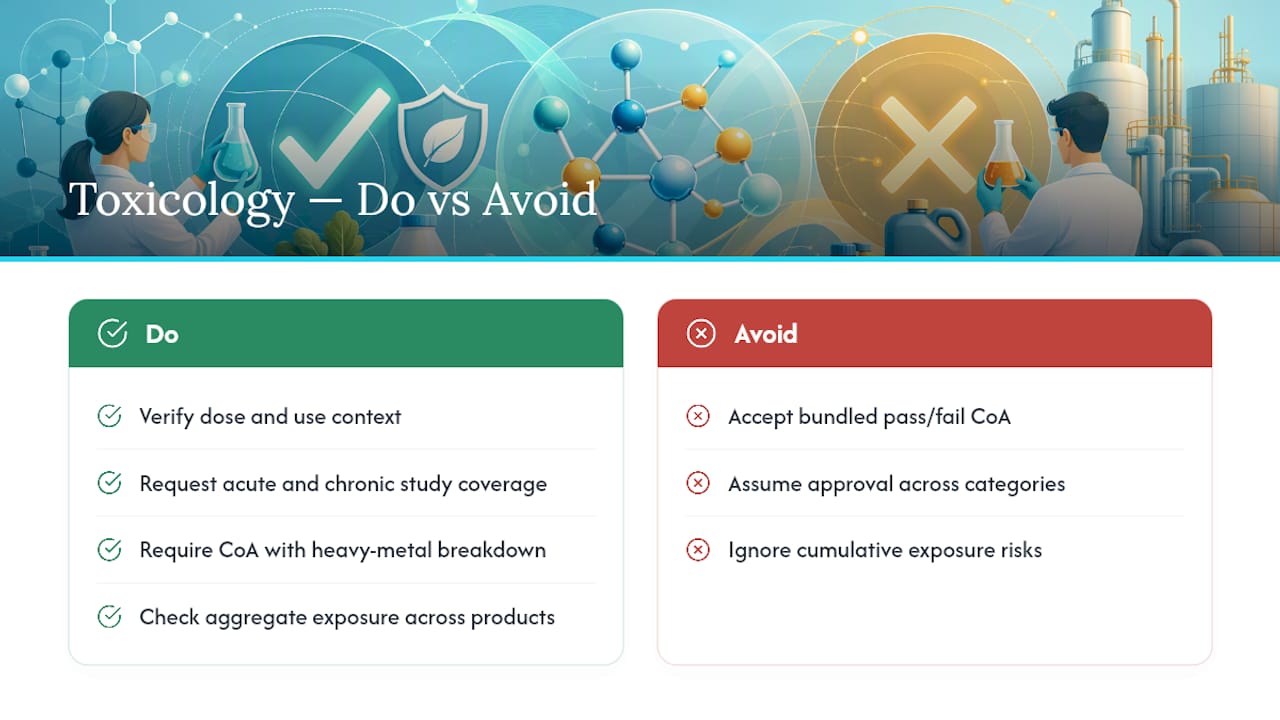
The “reasonable certainty of no harm” standard is inherently dose and use dependent, which means a substance’s toxicological profile only means something in the context of how much of it a person actually consumes.
Toxicological review for a food additive petition or scientific-procedure GRAS determination typically covers acute toxicity, chronic exposure studies, and sometimes reproductive or developmental endpoints, depending on the substance’s chemical class and intended use level. The evidence bar for these studies is the same whether the substance seeks approval via petition or GRAS, which is a distinction worth repeating because it’s so often misunderstood in the market.
Heavy metal contamination is one of the more common practical risks in industrial-scale chemical sourcing, not because the base chemical is inherently hazardous but because manufacturing processes can introduce trace contaminants that exceed FCC or USP limits if quality control slips. This is precisely why a CoA with itemized heavy metal results, rather than a bundled pass/fail statement, matters so much at the receiving dock.
Cumulative exposure is a separate consideration procurement teams sometimes overlook. A preservative approved for use in one product category at a defined concentration doesn’t account for a consumer’s total exposure across multiple product categories using the same substance. FDA’s regulatory limits are set with an eye toward aggregate exposure, but a manufacturer adding a new use case for an existing approved chemical should confirm that use falls within the substance’s approved conditions, not simply assume approval in one category extends automatically to another.
Recent FDA Policy Changes Affecting Food-Grade Chemicals
The most significant recent shift is the FDA’s August 2026 proposal to tighten oversight of GRAS determinations, aimed directly at the self-affirmation gap that has let companies market GRAS ingredients without ever notifying the agency. If finalized, this would push more substances toward mandatory disclosure, closing a transparency gap that’s existed for decades.
Additive revocations also continue on a rolling basis. The 2024 revocation of brominated vegetable oil as an authorized food additive is a useful case study in how these actions unfold: FDA published a proposed rule, took public comment, and then issued a final revocation in the Federal Register, giving industry a defined compliance window rather than an immediate ban.
For procurement teams, the practical implication is that a chemical’s regulatory status isn’t static. A substance authorized for years can lose that authorization following updated safety review, and the only reliable way to catch that change is monitoring Federal Register activity directly, not relying on a supplier’s spec sheet from an earlier purchase order. Building a recurring review step into your supplier qualification cycle, rather than treating initial approval as permanent, is the single most effective defense against buying a chemical mid-revocation.
Food-Grade Chemicals in Packaging and Contact Materials
Food contact substances occupy a regulatory category distinct from direct food additives, covering everything from can linings and plastic packaging resins to adhesives and processing equipment coatings that never become part of the food itself but can migrate into it.
FDA reviews these substances based on estimated migration levels into food under realistic conditions of use, not the raw concentration in the packaging material. A resin used in high-heat applications, for instance, faces different migration testing expectations than the same resin used for cold storage packaging, because migration rates change with temperature and contact duration.
The Food Contact Substance notification process typically moves faster than a full additive petition, largely because exposure levels from packaging migration tend to run far lower than direct food addition. That said, faster doesn’t mean lighter scrutiny on the toxicology side. Chemicals like sanitizing agents used in food processing environments, including compounds such as calcium hypochlorite in water treatment and surface sanitation applications, fall under related but distinct regulatory frameworks depending on whether they contact food directly or simply clean equipment and surfaces upstream of production.
Procurement teams sourcing packaging materials or food grade cleaning agents should request the specific Food Contact Substance notification number where one exists, and confirm the intended use (temperature range, contact duration, food type) matches what the original notification actually covers. A resin approved for one packaging application isn’t automatically cleared for a different one.
Why Documentation, Not Labels, Determines Real Compliance
The industry habit of treating “food grade” as a static label rather than a use-specific legal conclusion causes more audit failures than any single contaminated shipment we’ve seen discussed in regulatory circles. A chemical’s GRAS status or additive approval is only as good as the documentation trail proving it applies to your exact application, at your exact concentration, for your exact product category.
Long-term, vetted supplier relationships solve this more reliably than spot-market purchasing ever will, because consistency in documentation format across every shipment is what actually holds up during a customer or FDA audit, not the lowest quoted price on a single lot.
How RJR Worldwide Supports Audit-Ready Chemical Sourcing
Sourcing food-grade chemicals shouldn’t mean choosing between price and paperwork. RJR Worldwide Corp works directly with vetted suppliers in China and India under multi-year, index-linked agreements, so every shipment arrives with the same monograph-referenced CoA format, not a different template every time you reorder.

When you contact us, come ready with your intended-use specification and any existing supplier CoA you want reviewed against FCC or USP standards. Our team can coordinate independent sample testing before your first full shipment lands, and we maintain full traceability documentation for every batch, so your QA file is audit-ready from the first order forward. Explore our Chemical Sourcing Division for the full range of food, technical, and pharmaceutical-grade chemicals we supply, or reach out directly to request pricing, a sample, or a CoA review on your current supplier’s paperwork.
Frequently Asked Questions
What makes a chemical “FDA food grade” if there’s no official certification? There’s no FDA-issued “food grade” certificate. A substance qualifies when its intended use is authorized as a food additive or classified as GRAS under the FD&C Act, and the manufacturer can document a reasonable certainty of no harm for that specific application.
Are food grade chemicals safe by default? Safety is tied to intended use and concentration, not the chemical alone. A substance GRAS for one application at a defined level isn’t automatically safe or approved for a different use case or higher concentration.
How many substances are in the FDA’s food additive inventory? The Substances Added to Food database lists close to 4,000 substances, spanning direct additives, GRAS notified substances, and other regulatory categories.
What’s the difference between pharmaceutical grade and food grade chemicals? Pharmaceutical grade typically requires compliance with USP or BP monographs, which carry tighter impurity thresholds than the FCC standard that governs most food-grade specifications, even for an identical chemical formula.
How do I confirm a chemical hasn’t been banned or revoked recently? Check the Federal Register directly rather than relying on a supplier’s spec sheet. Revocations, like the 2024 action on brominated vegetable oil, get published there before older database entries catch up.
Does GRAS notification mean FDA approved the substance? Not exactly. An FDA response of “no questions” to a GRAS notice means the agency reviewed the submitted safety conclusion without objection, which is a narrower statement than a formal additive approval.