Drafting and Second Sourcing: Force Majeure for Chemical Contracts

Force majeure is a contractual excuse, narrowly applied, and it rarely saves a party from a bad bet on supply. If your chemical contract is disrupted, read the clause first, check whether the triggering event is enumerated or plausibly caught by a catch-all, confirm your notice window, and start second-sourcing immediately. Documentation of causation and mitigation matters more than the invocation itself.
TL;DR:
- Force majeure clauses in chemical contracts are narrowly interpreted; named events such as export bans or natural disasters are more likely to excuse performance than broad or vague language.
- Drafting effective clauses requires listing specific risks relevant to your supply chain, establishing causation standards, and including mitigation, substitution, and allocation provisions.
- Upstream force majeure declarations do not automatically excuse downstream obligations unless explicitly linked through contractual language, requiring clear trigger definitions and conditions.
- Proper notice and documentation within specified windows are critical; vague or late notices often invalidate the reliance on force majeure protections.
- A resilient supply chain benefits from operational redundancy, documented supplier relationships, and index-linked pricing to reduce reliance on force majeure claims during disruptions.
Table of Contents
- Legal Considerations for Force Majeure in Chemicals Contracts
- What Does Force Majeure Cover in Chemical Supply Contracts?
- How Should You Draft Force Majeure Clauses for Chemical Contracts?
- Cascading Force Majeure Risk Between Upstream and Downstream Contracts
- Notice, Mitigation, and Allocation: What Proof Do You Need?
- Force Majeure Checklist and Sample Clause Language for Chemical Contracts
- RJR Worldwide’s Operational Approach to Reducing Force Majeure Exposure
- How Do Chemical Regulatory Changes Affect Force Majeure Claims?
- Force Majeure, Hazardous Materials Transport, and Storage Disruptions
- Force Majeure Case Studies: Chemical Industry Disruptions
- Does Insurance Cover What Force Majeure Excludes?
- What Should You Prioritize When Force Majeure Hits Your Supply Chain?
- How RJR Worldwide Builds Continuity Into Chemical Supply Contracts
- Sources
- FAQ
Legal Considerations for Force Majeure in Chemicals Contracts
There is no federal force majeure statute. What you have is whatever language the parties negotiated, interpreted against a patchwork of state contract law and, for goods transactions, Article 2 of the Uniform Commercial Code. That last point trips up a lot of in-house counsel who assume force majeure is some free-floating doctrine of fairness. It is not. If your contract has no force majeure clause, you are left arguing common-law impossibility or impracticability, and courts set that bar high.
U.C.C. § 2-615 is the closest thing to a statutory backstop for sellers of goods, including bulk chemicals. It excuses delayed or non-delivery when performance “has been made impracticable by the occurrence of a contingency the non-occurrence of which was a basic assumption” of the contract. Courts applying that standard generally demand something close to impossibility, or a government order that directly makes the specific performance illegal. A price spike, a strike at one supplier among several, or a shipping delay that merely makes performance more expensive almost never clears that bar.
New York courts, which govern a large share of commercial chemical supply agreements, are notoriously strict. The controlling reference point is Kel Kim Corp. v. Central Markets, Inc., where New York’s Court of Appeals held that force majeure clauses are interpreted narrowly and will only excuse performance for the specific events listed or events genuinely comparable to them, a doctrine known as ejusdem generis. The COVID-era case JN Contemporary Art LLC v. Phillips Auctioneers LLC reinforced the same lesson in a different context: a New York federal court found that a pandemic-triggered postponement fell within a broadly worded force majeure clause, but the outcome turned entirely on how that specific clause was drafted, not on any general “pandemic excuse” theory.
English common law runs on a similar track, construing force majeure clauses strictly against the party invoking them and refusing to imply relief the contract does not expressly grant. Governmental measures, export bans, and sanctions regimes get special attention in both systems because they often satisfy the “beyond reasonable control” test cleanly, while market-driven shortages almost never do. If your chemical supply chain runs through jurisdictions with active export licensing regimes, the governing-law choice in your contract deserves as much scrutiny as the force majeure clause itself, since a New York court and an English court can reach different conclusions from nearly identical facts.
What Does Force Majeure Cover in Chemical Supply Contracts?
Most force majeure clauses in chemical agreements enumerate common events such as war and armed conflict, embargoes and sanctions, export or import restrictions, port or terminal closures, natural disasters, labor strikes, and government orders that prohibit performance. A well-drafted clause names these events specifically rather than leaning on vague language, because vague language is exactly what courts strip out under the ejusdem generis rule described above.
What force majeure almost never covers, absent express language, is economic hardship. A feedstock price doubling, a general market shortage, or a supplier’s decision to sell elsewhere for a better margin will not qualify. Thomson Reuters’ overview of force majeure law makes the point directly: courts will not excuse performance for mere economic difficulty, and parties who want protection against price volatility have to negotiate it separately, typically through indexation or hardship provisions rather than force majeure.
Regulatory shutdowns and sanctions deserve their own line item rather than a hope that “government action” language covers them. Export control regimes on precursor chemicals, REACH-related restrictions in the EU, or an EPA enforcement action can each halt performance in ways a generic catch-all may or may not capture. Naming these events specifically, and defining what counts as a qualifying “change in law,” closes gaps that generic templates leave open.
How Should You Draft Force Majeure Clauses for Chemical Contracts?
Drafting a workable force majeure clause for a chemical supply agreement comes down to five decisions, each with real consequences if you get it wrong.
1. Build the enumerated list around your actual supply chain, not a generic template. The ICC’s model force majeure and hardship clauses are a solid starting point, but the ICC itself warns against copying them verbatim. A contract for sulfuric acid moving through a single port faces different risks than one for a specialty pharmaceutical intermediate sourced from three qualified plants. List the events that actually threaten your commodity and your route: export licensing delays, precursor chemical restrictions, terminal or berth closures, and feedstock-specific plant outages.
2. Write catch-all language that survives ejusdem generis scrutiny. Courts read “or any other event beyond the party’s reasonable control” as limited to events similar in kind to whatever precedes it. If your enumerated list only names natural disasters, a catch-all will not stretch to cover a cyberattack on a supplier’s logistics system. Draft the catch-all with a category description, not a throwaway phrase.
3. Pin down the causation standard. Contracts vary between “prevents performance,” “materially hinders performance,” and “renders performance impossible.” Each sets a different bar and shifts the burden of proof differently. A “materially hinders” standard is more seller-friendly and more likely to trigger disputes over what “material” means; “renders impossible” is the toughest standard and the one most consistent with how U.C.C. § 2-615 gets interpreted by courts.
4. Build in mitigation duties and substitution rights. A clause that excuses performance without requiring the invoking party to pursue reasonable alternatives invites bad-faith declarations. Require documented efforts to source substitute material, and give buyers an explicit right to procure from an alternative supplier during the force majeure period without breaching exclusivity terms.
5. Add allocation mechanics and a price re-opener where volumes are genuinely constrained. If a seller supplies multiple buyers from one plant, the contract should say how limited output gets allocated, whether pro rata by historical volume or by a stated priority list.
- Enumerate events specific to the chemical’s route and regulatory exposure
- Define catch-all language by category, not by a vague phrase
- Set a clear causation threshold and state who carries the burden of proof
- Require documented mitigation before relief is granted
- Include supplier substitution rights and allocation rules for constrained volumes
Pro Tip: Do not let your force majeure clause and your indexation clause sit in silence about each other. If a price index spikes because of the same event that triggers force majeure, an unclear interaction between the two clauses is where disputes actually start.
Cascading Force Majeure Risk Between Upstream and Downstream Contracts
An upstream supplier declaring force majeure does not automatically excuse your obligations to your own customers. This is the single most common drafting gap in chemical supply chains, and it catches experienced counsel off guard because the assumption of automatic pass-through feels intuitive. It is not how contract law works. Each agreement in the chain stands on its own language.
Practitioner analysis of recent geopolitical disruptions has flagged this exact trap: buyers who assumed an upstream force majeure notice would flow through to protect their downstream commitments found themselves in breach anyway, because their own sales contracts had no express linkage to the upstream event. The fix is structural, not aspirational.
- Draft a condition precedent tying your performance to actual receipt of a specified raw material from a named or qualified supplier
- Use defined triggers, such as “Supplier’s written notice that a raw material is unavailable due to export restriction,” rather than vague verbs like “affected”
- State explicitly whether the downstream party’s obligation is suspended, reduced pro rata, or fully excused when the trigger fires
- Negotiate allocation priorities in advance so a shortage does not turn into a first-come dispute among your own customers
- Preserve a buyer’s right to procure substitute material elsewhere without penalty when the primary supplier invokes force majeure
Cascading language works best when it names the specific commodity, the specific supplier relationship, and the specific evidentiary trigger, rather than relying on generic “flow-down” boilerplate that courts will read narrowly, consistent with how force majeure clauses generally get construed.
Notice, Mitigation, and Allocation: What Proof Do You Need?
A force majeure notice that shows up late, or lacks specifics, can forfeit the right to rely on the clause entirely, regardless of how legitimate the underlying event was. Most well-drafted contracts require notice within a defined window from when the invoking party knew or should have known of the event, and the notice itself needs to do more than announce a delay.
A complete notice states the start date of the impacted event, the specific volumes or shipments affected, the mitigation steps already underway, and a good-faith estimate of duration. Vague notices inviting the other side to “monitor the situation” tend to get challenged, and challenged notices tend to end up in front of a judge applying the narrow-construction standards described earlier.
Evidence preservation starts the moment the event occurs, not when a dispute looks likely. Retain purchase orders, shipping booking confirmations, customs correspondence, export license applications and denials, and every email exchange with the affected supplier. Advisories on recent supply shocks stress that causation, meaning proof the event directly prevented performance, is the issue that decides most disputes, not whether the underlying event was real.
- Document the exact date operations were impacted and by how much
- Preserve every communication with suppliers, freight forwarders, and customs brokers
- Keep records of alternative sourcing attempts, even unsuccessful ones
- Apply allocation rules consistently across all affected customers, and document the methodology
- Expect disputes over whether “reasonable efforts” to mitigate were actually made
Sellers who never secured firm supply before contracting face a particularly hard road here. A seller that short-sold its position and then invokes force majeure when it cannot cover is likely to be found to have caused its own predicament, a result courts have reached in comparable disputes over unhedged forward sales.
Force Majeure Checklist and Sample Clause Language for Chemical Contracts
A contract portfolio review ahead of a disruption should follow a consistent sequence rather than an ad hoc read-through.
- Identify governing law for every active chemical supply contract and flag which ones sit in strict-construction jurisdictions
- Confirm whether force majeure events are enumerated, catch-all only, or both
- Check whether supplier substitution rights exist and whether they survive a force majeure declaration
- Review notice deadlines and required contents against your actual operational capacity to respond that fast
- Confirm whether termination is triggered automatically after a defined period or requires separate election
Buyer-protective clause elements: substitution rights that survive invocation, allocation language guaranteeing pro rata treatment against other buyers, origin-of-goods control requiring notice of any change in supplier country, and a price re-opener if the force majeure period extends the contract term.
Seller-protective clause elements: a narrow, specifically enumerated event list rather than an open catch-all, a strict and short notice window that limits ongoing liability exposure, and an automatic termination right if the event exceeds a stated duration, commonly 90 to 180 days.
A usable force majeure notice template includes: the specific clause section being invoked, the triggering event and its start date, the specific purchase orders or delivery schedules affected, quantified impact where known, mitigation steps already taken, and a projected resolution date subject to update.
- Governing law and forum
- Enumerated events list and catch-all wording
- Supplier substitution and allocation rights
- Notice window, contents, and delivery method
- Termination trigger and post-termination remedies
Representative SEC-filed contract exhibits give counsel real, publicly available drafting language to benchmark against, rather than relying solely on internal templates that may not reflect current market practice.
RJR Worldwide’s Operational Approach to Reducing Force Majeure Exposure
The best force majeure clause in the world does not replace operational redundancy. RJR Worldwide Corp sources food, technical, and pharmaceutical-grade chemicals under multi-year, index-linked contracts with vetted suppliers across China and India, structured so that supply interruption at one point does not become a single point of failure for a buyer’s entire program. Index-linked pricing also removes one common trigger for bad-faith force majeure claims: when pricing floats with a published benchmark, a supplier has less incentive to invoke force majeure simply because a fixed price became unprofitable.
Freight is the other half of the exposure. The company operates FedEx Linehaul services from California terminals on dedicated lanes, rather than brokering freight through third parties whose capacity constraints may affect chemical supply. Complete documentation, from supplier qualification records to customs paperwork, gives buyers the causation evidence a force majeure dispute actually requires, built into the relationship rather than assembled after a crisis starts.
How Do Chemical Regulatory Changes Affect Force Majeure Claims?
Regulatory shifts specific to the chemical industry create a distinct category of force majeure risk that generic commercial contracts rarely anticipate well. An EPA rule change restricting a solvent, a new EU REACH authorization requirement, or a sudden export licensing regime on a precursor compound can each make performance illegal overnight, which is exactly the kind of event courts treat sympathetically under a “change in law” or “government action” provision.
The catch is specificity. A force majeure clause that says “change in applicable law” broadly may still fail if it does not address whether the change has to make performance illegal outright, or merely more burdensome, to qualify. Chemical contracts should define “change in law” to include new permitting requirements, revised hazard classifications, and export control list additions, since these are the regulatory events most likely to actually hit this sector.
Sanctions regimes deserve separate treatment from general regulatory change language. A sanctions designation affecting a supplier’s home country, or a new export control classification for a specific chemical compound, tends to satisfy force majeure standards more reliably than economic regulation because it makes a specific transaction illegal rather than merely more expensive. Counsel drafting or reviewing chemical supply contracts should treat regulatory and sanctions risk as separate enumerated categories, not folded into one generic “law or regulation” clause, because the evidentiary showing for each differs.
Force Majeure, Hazardous Materials Transport, and Storage Disruptions
Transportation and storage failures create some of the murkiest force majeure territory in chemical supply, because the line between an excusable event and an operational failure is not always obvious. A hazmat carrier losing its DOT certification, a port refusing to handle a specific UN classification after an incident, or a storage terminal hitting capacity limits during a regional disruption can each halt delivery. Whether that qualifies as force majeure depends heavily on whether the disruption was foreseeable and whether reasonable alternative routing existed.
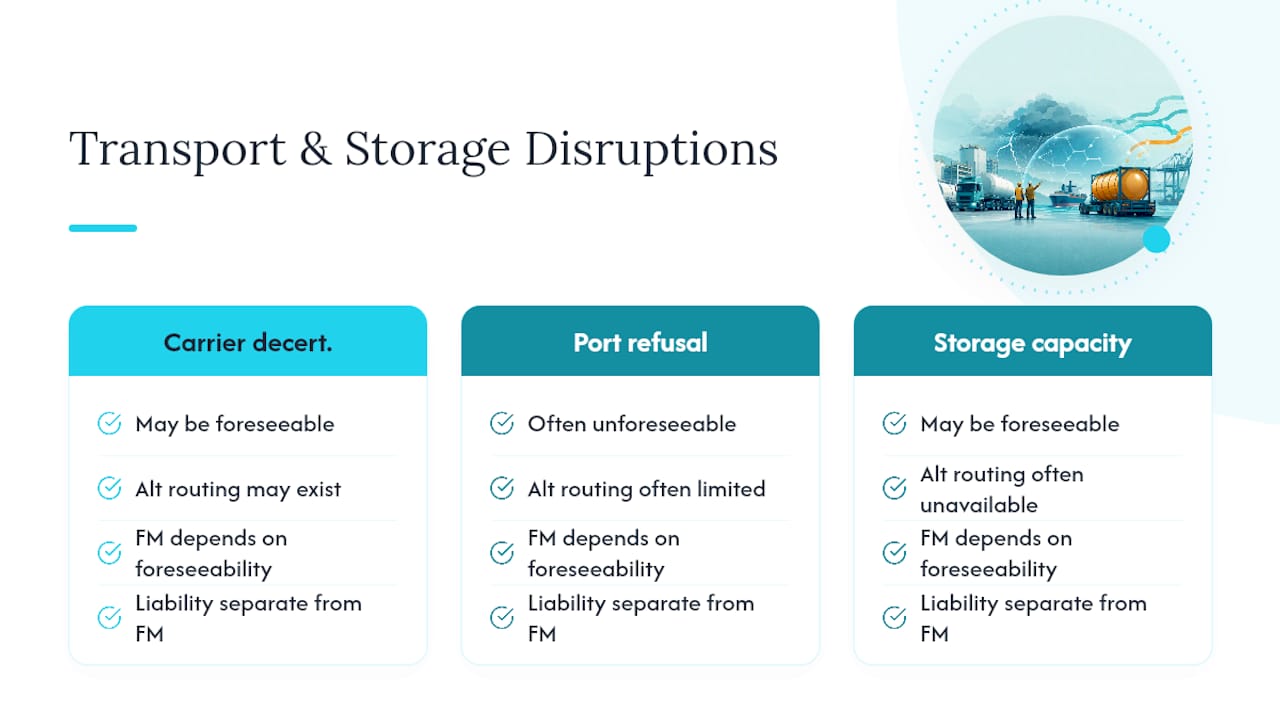
Liability allocation in transport disruptions is a separate legal question from force majeure excuse, and the two get confused often. Guidance on transport damage liability illustrates how carrier responsibility and shipper responsibility get allocated even before force majeure enters the analysis, since a force majeure defense does not erase an underlying liability determination between carrier and shipper.
Storage disruptions carry their own wrinkle: a chemical that cannot be shipped on schedule may need emergency storage capacity, and if a contract’s force majeure clause does not address demurrage, storage fees, or degradation risk during an extended delay, those costs become a separate dispute layered on top of the original disruption. Chemical contracts should specify who bears storage and demurrage costs during a force majeure period, since silence on this point routinely generates secondary litigation even after the underlying force majeure question gets resolved.
Force Majeure Case Studies: Chemical Industry Disruptions
The COVID-19 pandemic produced the largest wave of force majeure litigation the chemical and broader commercial sector has seen in decades, and the results varied enormously based on clause language rather than the severity of the disruption itself. JN Contemporary Art LLC v. Phillips Auctioneers LLC is instructive precisely because it did not involve chemicals at all: a New York court found a broadly worded force majeure clause covered a pandemic-related event, underscoring that outcome hinges on drafting, not industry.
Natural disasters have repeatedly tested chemical supply chains in ways that reveal drafting gaps. Hurricane-driven shutdowns of Gulf Coast petrochemical facilities have triggered force majeure declarations across entire supply chains, cascading from primary producers through intermediate processors to end buyers, exposing exactly the downstream alignment gap discussed earlier when contracts fail to link tiers explicitly.
More recently, geopolitical shocks affecting sulfuric acid and other bulk chemical markets have shown how export restrictions and shipping disruptions intersect. Advisory commentary on the sulfuric acid supply crisis documented how quickly a regional disruption in one commodity market can force counsel across an entire industry to revisit contract language they had not touched in years. The common thread across every one of these episodes: the parties whose clauses named specific, relevant events fared better in negotiation and in court than those relying on generic boilerplate.
Does Insurance Cover What Force Majeure Excludes?
Force majeure and insurance solve different problems, and treating them as interchangeable protection is a mistake that surfaces at the worst possible moment. A force majeure clause excuses a party from liability for non-performance. It does not replace lost revenue, cover the cost of expedited substitute sourcing, or compensate for spoiled inventory sitting in a delayed shipment.
Business interruption insurance and trade credit insurance can fill some of that gap, but policy language on chemical-specific perils, particularly around hazardous materials handling and contamination, tends to be narrower than force majeure clauses assume. A policy that excludes losses from “government action” can leave a buyer doubly exposed: excused from contractual liability by force majeure, but uninsured for the resulting cost, since the same underlying event triggered both provisions.
The practical fix is coordination, not assumption. Chemical supply agreements involving significant volumes should require both parties to disclose relevant insurance coverage, and legal teams reviewing force majeure exposure should loop in risk management to confirm that a declared event actually triggers a payout rather than falling into a coverage gap between the contract’s excuse language and the policy’s exclusions.
What Should You Prioritize When Force Majeure Hits Your Supply Chain?
Preserve evidence and send compliant notices before doing anything else. Map which customers are safety-critical or regulation-bound, and which inputs are genuinely irreplaceable, because that map decides your allocation decisions later. Negotiate allocation with major counterparties before litigating; courts move slowly, and a negotiated interim allocation preserves relationships that litigation destroys. Reserve litigation for cases where a counterparty is invoking force majeure in bad faith or refusing any allocation discussion at all.
— RJR Worldwide
How RJR Worldwide Builds Continuity Into Chemical Supply Contracts
Reading this playbook is the easy part. Actually having a second source qualified, documented, and ready to ship when a force majeure event hits is what separates companies that absorb a disruption from ones that end up in a dispute over allocation. RJR Worldwide Corp exists for exactly that gap: multi-year agreements with vetted suppliers across China and India, index-linked pricing that removes the profit-margin incentive behind opportunistic force majeure claims, and dedicated logistics lanes running out of California terminals rather than a brokered freight market that seizes up right when you need it most.
That structure translates directly into force majeure defense. A qualified alternative supplier already under contract means substitution language in your clause is not theoretical. Complete documentation on every shipment gives your legal team the causation evidence a dispute demands, already assembled rather than reconstructed under deadline pressure. If your current contract portfolio has gaps in supplier substitution or documentation, RJR’s chemical sourcing division can review what a resilient agreement looks like for your specific commodity and route. Reach out through RJR’s contact page to request pricing, samples, or a confidential discussion about second-sourcing your critical chemical inputs before the next disruption forces the issue.
Sources
Counsel drafting or litigating force majeure provisions in chemical contracts should keep a short reference set on hand: the ICC’s model force majeure and hardship clauses for drafting templates, Cornell’s Legal Information Institute overview of U.C.C. § 2-615 and the governing case law, and Thomson Reuters’ practitioner guide for a working summary of how courts approach these disputes. Public contract exhibits filed with the SEC also offer real, benchmarkable clause language.
This article is general information, not a substitute for advice from a qualified lawyer. Consult a qualified legal professional about your own circumstances before acting on anything here.
- ICC Force Majeure and Hardship Clauses
- force majeure | Wex | US Law | LII / Legal Information Institute
- What is force majeure? Overview and resources for lawyers - Thomson Reuters
- When supply chains break: Force majeure, hardship and the sulfuric acid crisis - Mondaq
FAQ
What Do Typical Force Majeure Clauses Include?
Most clauses enumerate specific qualifying events, war, natural disasters, government action, strikes, and export restrictions, followed by a catch-all phrase, notice requirements, and either a suspension or termination mechanism tied to the event’s duration.
What Are the Three Elements of Force Majeure?
Courts generally look for an event beyond the party’s reasonable control, unforeseeability at the time of contracting, and a direct causal link between the event and the inability to perform.
What Three Things Can Cause a Contract to Be Void?
Contracts most commonly become void or voidable due to fraud, mutual mistake about a fundamental fact, or illegality of the subject matter; force majeure operates differently, excusing performance rather than voiding the agreement.
Can You Give an Example of a Force Majeure Clause in a Chemical Contract?
A seller-protective example reads: “Neither party shall be liable for delay or failure to perform due to war, government export restriction, or natural disaster, provided timely notice is given and the affected obligations are suspended, not terminated, unless the event exceeds a specified duration.” Buyer-protective versions add substitution rights and pro rata allocation language.
Does a Force Majeure Event Automatically Excuse an Entire Supply Chain?
No. Each contract in a supply chain must be evaluated on its own force majeure language, and an upstream supplier’s declaration does not flow through to downstream obligations unless the contracts expressly link them.